
Going to submit your assignment or coursework? Don’t do it!
Proofread & Edit it First!
Even if you’re confident with your paper but there are some common mistakes in your university assignment due to missed typos, unclear sentences, or weak structure. They reduce clarity and impact.
That’s why knowing the right proofreading and editing techniques isn’t optional. It’s essential.
There are five key editing techniques:
- Edit for Structure First
- Analyse Argument Strength
- Check Paragraph Transitions
- Remove Redundancies
- Check Format Requirements
And seven proofreading techniques:
- Check Spelling & Grammar
- Correct Punctuation and Capitalization
- Verify Academic Tone
- Read Aloud Technique
- Use Grammar Check Tools
- Check Citation Accuracy
- Check for Consistency
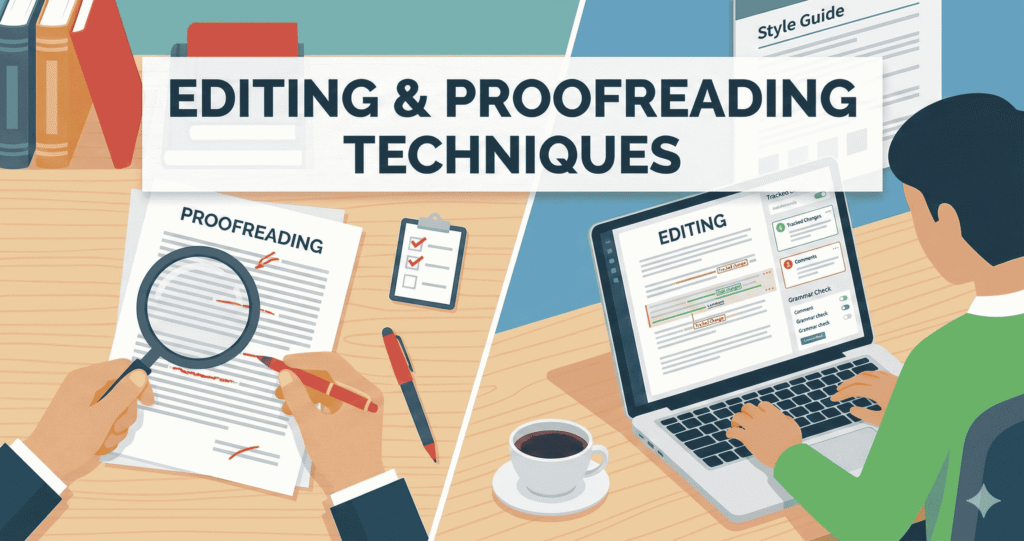
Before diving into each proofreading and editing technique, let’s first get a quick, simple understanding of what editing and proofreading actually mean and how they differ in academic writing.
Editing and Proofreading: Meaning & Differences
Editing
Editing comes first.
It focuses on improving the structure, coherence, and clarity of your writing.
In editing, you reshape your content. Rearranging ideas, strengthening arguments, and ensuring every paragraph flows logically into the next.
You might adjust your topic sentences, replace vague terms with precise academic language, or refine your thesis statement for stronger alignment with the question.
Editing is about improving the quality of ideas and how well they’re expressed.
Proofreading
On the other hand, proofreading comes last.
It’s your final check before submission, focusing on surface-level errors like grammar, spelling, punctuation, and formatting.
In proofreading, you correct comma splices, fix verb agreement, and ensure consistent referencing styles such as APA, MLA, Chicago, or Harvard.
Let’s keep it simple:
- While editing improves how you communicate
- Proofreading ensures what you’ve written is polished and error-free
| Aspect | Editing | Proofreading |
| Purpose | Improves content, structure, and clarity | Fixes grammar, spelling, and punctuation errors |
| Focus Level | Deep, meaning-focused | Surface-level, accuracy-focused |
| Typical Tasks | Restructuring paragraphs, refining tone, strengthening arguments | Correcting typos, checking citation style, and ensuring formatting consistency |
| When Done | Early in the final drafting stage | Final stage before submission |
| Example | Rewriting an unclear argument in a body paragraph | Fixing a misplaced comma or spelling error |
Why Proofreading and Editing Are Crucial
Proofreading and editing are the final quality checks that transform a good assignment into an excellent one. They enhance clarity, ensure logical flow, and make your arguments sound polished and professional.
Without these steps, even well-researched papers can lose marks due to unclear sentences, weak transitions, or overlooked grammar errors.
A single misplaced citation or formatting inconsistency can make your work appear careless. Something university assessors notice quickly.
Consistent proofreading also strengthens your academic credibility, showing your ability to communicate with precision and attention to detail.
It’s not just about fixing typos. It’s about presenting your ideas confidently and clearly.
If you’re still building the foundation of your writing process, you can explore a detailed guide on how to write an assignment for university. It’ll help you understand how structure, research, and editing come together, craft, and bring up a distinction & stronger quality assignment.
Step-by-Step Editing Techniques
Editing goes beyond grammar. It’s about refining the logic, structure, and depth of your writing.
Here’s how to edit your work effectively, step by step:
a. Edit for Structure First
Begin by reviewing whether your essay or report adheres to a clear academic structure. Introduction, body, and conclusion.
Each section should have a clear purpose: the introduction sets context, the body develops arguments, and the conclusion ties them together.
If your structure feels uneven or lacks flow, it might be worth revisiting how essays are built from the ground up. Our detailed guide on how to structure and plan your essay can help you refine this skill and create a logical, cohesive framework for your ideas.
Example:
- Before Editing: “I will talk about climate change in this paper.”
- After Editing: “This essay examines the long-term impact of climate change on global agricultural sustainability.”
A well-structured start gives your reader direction and improves readability.
b. Analyse Argument Strength
Every argument should have a topic sentence, relevant evidence, and critical analysis.
Check if your claims are supported by peer-reviewed research, not just opinions or general statements.
Example:
- Before editing: “Students are stressed.”
- After editing: “Recent studies highlight that academic workload and lack of rest are key contributors to elevated stress levels among university students.”
This strengthens your argument and shows analytical thinking.
c. Check Paragraph Transitions
Smooth transitions enhance coherence. They’re a key marker of strong academic writing.
Transitions act as bridges between ideas. Without them, essays sound disjointed.
Use linking phrases like “furthermore,” “however,” “in contrast,” or “as a result” to maintain flow and logical progression.
Example:
- Before editing: “The economy is unstable. People are losing jobs.”
- After editing: “The unstable economy has directly contributed to rising unemployment rates.”
d. Remove Redundancies
Unnecessary repetition weakens clarity. Avoid filler words like “basically,” “very,” or “in order to.”
Aim for concise, precise expression. Your ideas should speak for themselves. Editing for conciseness keeps your work focused and impactful.
Example:
- Before editing: “In my personal opinion, I think this result is very surprising.”
- After editing: “This result is surprising.”
e. Check Format Requirements
Formatting isn’t just about appearance. It’s about academic compliance.
Confirm your paper meets your university’s font, spacing, and referencing style (APA, MLA, Harvard, Chicago, etc.) guidelines.
Example:
- A report using double-spacing and consistent in-text citations (APA style) looks professional and earns credibility with assessors.
| Editing Focus | What to Check | Example of Improvement |
| Structure | Introduction, body, conclusion flow | “I will talk about…” –> “This essay examines…” |
| Argument Strength | Topic sentences, evidence | Add peer-reviewed source support |
| Paragraph Transitions | Logical connection between ideas | “However,” “In contrast,” “Therefore” |
| Redundancies | Remove repetition, filler words | “Very big” –> “Significant” |
| Format Requirements | Font, spacing, referencing | If using APA style from the beginning of the document, keep using it consistently. |
Step-by-Step Proofreading Techniques
Once your content is structurally sound, proofreading ensures it’s linguistically precise, error-free, and polished.
This stage focuses on details that shape academic professionalism.
a. Check Spelling & Grammar
Minor spelling and grammatical errors can drastically reduce clarity.
Watch for subject–verb agreement, verb tense consistency, and plural forms.
Slowly read line by line. You’ll catch errors your eyes often skip.
Example:
- Before Proofreading: “The results shows significant improvement.”
- After Proofreading: “The results show significant improvement.”
b. Correct Punctuation and Capitalisation
Proper punctuation controls rhythm and meaning. Misplaced commas or missing full stops can confuse the reader.
Check for capitalisation in headings, names, and proper nouns to maintain accuracy and academic formality.
Example:
- “Let’s eat students.”
- “Let’s eat, students.”
c. Verify Academic Tone
Academic writing avoids slang, contractions, and personal bias. Keep it formal, objective, and based on evidence.
Professional tone strengthens your credibility and aligns with university standards.
Example:
- “I think this experiment was kinda cool.”
- “This experiment demonstrated valuable insights into behavioural response patterns.”
d. Read Aloud Technique
Reading aloud helps detect awkward phrasing, missing words, or unclear transitions. If it sounds odd when spoken, it’s likely unclear on paper too.
This method improves sentence rhythm and coherence.
Tip:
- Try text-to-speech tools. They highlight pauses and errors your brain skips over.
e. Use Grammar Check Tools
Digital aids like Grammarly, Hemingway, or QuillBot can catch overlooked errors.
These tools assist in identifying sentence fragments, misused articles, and unclear constructions.
However, never rely solely on them. Combine with manual proofreading for the best results.
f. Check Citation Accuracy
In-text citations and reference lists must follow your academic style guide (APA, MLA, Harvard, or Chicago, etc.).
Even small inconsistencies, missing dates, wrong italics, and misplaced brackets can affect marks.
Cross-verify every citation for accuracy and formatting consistency.
Example:
- “(Smith, 2020)”
- Listed in reference list as “Smith, J. (2020).”
- Ensure the author, year, and format match exactly.
g. Check for Consistency
Maintain uniformity in spelling choices (analyse vs. analyze), numbering formats, and headings.
Inconsistency distracts assessors and weakens the paper’s professional tone.
Example:
- If you start using “Figure 1”, keep the same style. Don’t switch to “Fig. 1”.
- Small details reflect big discipline in presentation.
| Check Area | What to Review | Tip for Accuracy |
| Spelling & Grammar | Typos, tense, plurals | Read slowly, line by line |
| Punctuation | Commas, full stops, and quotes | Pause at every punctuation mark |
| Academic Tone | Avoid casual phrasing | Replace “I think” with evidence |
| Read Aloud | Flow and clarity | Use text-to-speech tools |
| Grammar Tools | Automated error checks | Don’t rely solely on tools |
| Citation Accuracy | In-text and reference list match | Double-check with the style guide |
| Consistency | Fonts, headings, numbering | Keep the same formatting throughout |
When to Consider Professional Proofreading Help
Sometimes, even the most careful students miss small but crucial errors. Especially when working under tight deadlines or managing multiple submissions at once.
That’s where professional proofreading support can make a real difference.
To Review & Refine
If English isn’t your first language, our expert reviewers can help refine grammar precision, maintain academic tone, and correct subtle syntactic inconsistencies that often go unnoticed.
To Ensure Complex Formatting and Citation
They also ensure complex formatting and citation requirements, such as APA, Chicago, Harvard, or MLA, are handled accurately, which is especially vital for research-intensive assignments.
Beyond Surface-Level
Professional proofreading not only improves surface accuracy but also enhances your document’s readability, logical structure, and coherence, saving you valuable time and stress before submission.
If you’re unsure where to find dependable support, take a look at our detailed guide on how to choose reliable assignment help. It’ll help you identify trustworthy services that genuinely strengthen your academic writing. Not just correct it.
Conclusion
Proofreading and editing aren’t just final touches. They’re the final quality filters that separate average work from exceptional submissions.
Both processes help you refine your ideas, correct mistakes, and ensure your arguments sound coherent and academically strong.
By developing a consistent revision routine, you’ll gradually enhance not only your writing style but also your ability to think critically and communicate clearly.
Remember:
- Every great paper goes through multiple rounds of review before it’s truly complete.
If you’d like expert help polishing your assignment, our team at FQ Assignment Help can ensure clarity, accuracy, and academic precision in your work.
From assignment writing and essay editing to dissertation, research paper, and thesis writing help, our professionals are here to elevate every aspect of your academic writing.