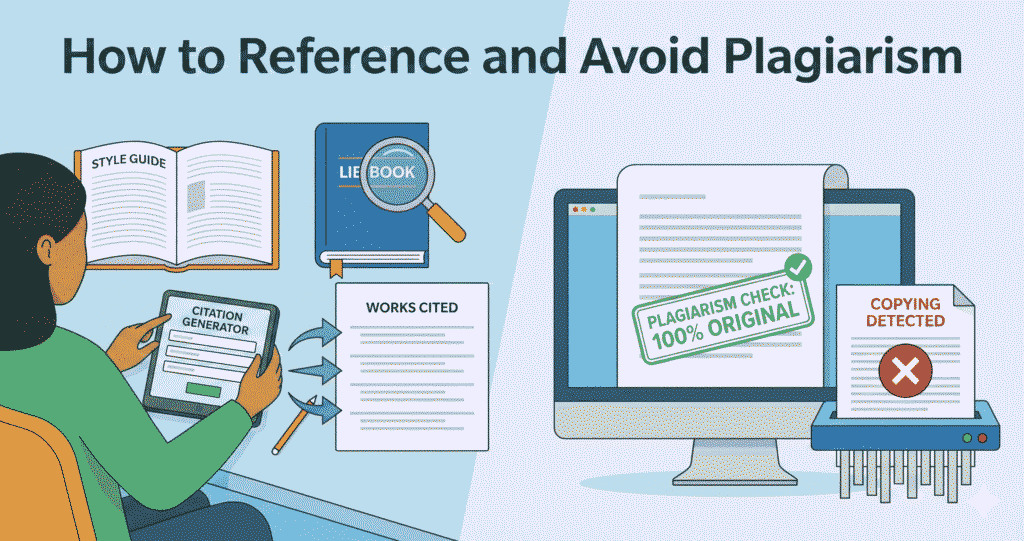
Plagiarism happens when you use someone else’s ideas, words, or data without giving proper credit. 58% of high schoolers and 16% of undergraduates admitted to heavy plagiarism.
But they don’t always do this purposely. However, this small slip turns into major academic breaches.
That’s where proper referencing becomes essential.
And learning how to reference and avoid plagiarism is therefore a key part of successful university writing.
When you understand how citation systems work, you not only acknowledge original authors but also strengthen your own academic voice. Clear, accurate referencing is the most reliable way to show academic honesty, protect your credibility, and demonstrate real research skills.
Many students plagiarise unknowingly, by forgetting quotation marks, paraphrasing too closely, or missing a citation at the end of a paragraph. Students repeat these common assignment mistakes.
This guide will break down:
- Why plagiarism happens
- How referencing fixes it
- And the simplest ways to stay completely safe in every assignment
What is Plagiarism?
Plagiarism means presenting someone else’s ideas, words, or work as your own. It can be intentional, like copying a full paragraph from a website, or unintentional, such as forgetting to cite a source. Both forms are treated the same in academic settings.
Intentional plagiarism happens when a student knowingly copies text, submits someone else’s work, or buys an assignment and presents it as their own.
Unintentional plagiarism happens through missing citations, incorrect paraphrasing, using the wrong referencing style, or assuming that “common knowledge” covers more than it actually does. Even minor citation errors fall into this category.
Universities treat all types of plagiarism seriously, whether it is copied from websites, has no citations, or is patchwritten.
1. Copy–Paste from Websites
Copy–Paste from websites is the most direct form. A student lifts sentences from an article or blog and inserts them into their assignment without quotation marks or acknowledgements.
2. No Citation
Here, the student uses facts, ideas, statistics, or arguments from a source but does not provide an in-text citation or a reference list entry.
3. Patchwriting (Poor Paraphrasing)
Patchwriting happens when a student rewrites a sentence by changing only a few words or rearranging phrases.
It still counts as plagiarism because the original meaning and structure remain the same, and the source isn’t clearly credited.
Academic Penalties
Plagiarism can lead to mark deductions, assignment resubmission, failing the module, or receiving an academic misconduct report.
For repeated cases, universities impose suspension or expulsion.
Even unintentional plagiarism can result in penalties because students are expected to know how to reference correctly.
6 Types of Plagiarism Students Commonly Commit
Plagiarism isn’t always obvious. Students make mistakes without realising that copying, poor paraphrasing, or missing references can seriously affect their grades. Understanding the common types helps prevent them and maintain academic integrity.
1. Direct Copying
This occurs when a student takes a text word-for-word from a source without quotation marks or citation. Even one sentence copied without credit counts as plagiarism.
Example:
“Climate change is the most pressing global issue of the 21st century.” (copied from a journal article without citation)
Correct approach: Use quotation marks and cite the source properly.
Correct implementation: “Climate change is the most pressing global issue of the 21st century” (Smith, 2022).
2. Mosaic/Patchwork Plagiarism
Also called patchwriting, this happens when parts of multiple sources are combined into one passage with only minor wording changes. The ideas are not original, and sources aren’t properly credited.
Example:
“Global warming affects agriculture worldwide, causing crop yield reductions and economic impacts.” (combined from two sources without citations)
Correct approach: Paraphrase fully and cite each source.
Correct implementation: Global warming has significant effects on agricultural productivity and can influence economic outcomes in various regions (Brown, 2021; Lee, 2020).
3. Self-Plagiarism
Submitting work you previously wrote for another assignment without disclosure is considered plagiarism. Universities expect each submission to be original for its specific context.
Example:
Reusing your previous semester’s essay on marketing strategies in a current module without referencing it.
Correct approach: Rewrite content for the new assignment and cite prior work if relevant.
Correct implementation: “This study builds upon earlier analyses of marketing strategies in digital campaigns (Ali, 2023), adapting the methodology to the current consumer context.”
4. Incorrect Paraphrasing
Paraphrasing requires fully rewording and rethinking a source’s idea. Simply changing a few words or sentence structure still counts as plagiarism.
Example:
Original:
- “Social media influences purchasing behaviour among teenagers.”
Student writes:
- “Teenagers’ buying habits are influenced by social media.” (without citation)
Correct approach: Fully reword and cite the original source.
Correct implementation: “Teenagers’ decisions about purchases are significantly shaped by social media trends and influencer recommendations (Johnson, 2021).”
5. Missing Citations
Even when you summarise or quote properly, failing to include in-text citations or a reference list leads to unintentional plagiarism.
Example:
Summarising a study’s results without mentioning the author or year.
Correct approach: Include in-text citation and reference list entry.
Correct implementation: “Recent research indicates a 15% increase in renewable energy adoption among households (Green & Patel, 2022).”
6. Poor Source Tracking
Students lose track of where they found an idea or statistic, making proper referencing impossible. This usually happens during rushed research or inadequate note-taking.
Example:
Including a statistic about global energy consumption, but forgetting the journal it came from.
Correct approach: Maintain a research log or spreadsheet to track sources systematically.
Correct implementation: “According to the International Energy Agency (2022), global energy consumption increased by 2.1% in 2021.”
One effective way to catch these errors before submission is to use proper proofreading and editing techniques.
Check out some best proofreading and editing techniques that we have outlined for you so you can spot and fix such issues in your university assignments. Moreover, regular review helps ensure your work is both original and academically polished.
Importance of Referencing in University Assignments
Referencing is essential in academic writing because it gives credit to the original authors of ideas, arguments, or data you use. Proper referencing not only demonstrates academic integrity but also strengthens your credibility, ensures transparency, and protects you from plagiarism.
1. Shows Academic Credibility
Citing sources signals that your work is grounded in research.
It shows your lecturers that you’ve engaged with scholarly literature and understood key concepts.
2. Supports Claims with Evidence
Referencing allows you to back up statements with authoritative evidence.
For example, including statistics, journal findings, or case studies makes your arguments stronger and more convincing.
3. Helps Readers Verify Sources
Readers can trace your sources to explore topics further or confirm the accuracy of your information.
This transparency reinforces trust and professionalism in your writing.
4. Avoids Plagiarism
Proper citations ensure that original authors are acknowledged.
Even paraphrased or summarized ideas require references to maintain academic honesty.
5. Improves Grades
Lecturers reward assignments that demonstrate careful research and correct referencing.
Clear, consistent references contribute to higher marks and show your academic rigor.
Still unsure how to write an assignment for university? Our UK-qualified experts are available for you 24/7. Let’s have a chat, discuss your requirements, & get your assignment started.
5 Common Referencing Styles in Universities
Referencing styles are standardised systems that guide how students credit sources in academic writing. They ensure consistency in citing books, articles, websites, or other materials and help readers locate original sources. Popular referencing styles include Harvard, APA, MLA, Chicago, and IEEE, each with its own format rules for in-text citations and reference lists.
Harvard uses an author-date system. It’s straightforward and widely accepted across disciplines.
APA emphasises the date of publication, which is critical for disciplines that value recent research.
MLA is simpler for text-based references and does not emphasise publication dates as heavily as APA.
Chicago allows either footnotes or author-date citations, depending on the discipline.
IEEE numbers sources in the order they appear and is commonly used in technical and engineering disciplines.
| Referencing Style | Where Used | In-Text Citation Example | Reference List Example |
| Harvard | UK universities, social sciences, business, and humanities | (Smith, 2020) | Smith, J. (2020) Global Business Trends. London: Routledge. |
| APA | Psychology, education, social sciences | (Smith, 2020, p. 45) | Smith, J. (2020). Global Business Trends. London: Routledge. |
| MLA | Literature, arts, humanities (mainly US) | (Smith 45) | Smith, John. Global Business Trends. London: Routledge, 2020. |
| Chicago | History, some social sciences, and the arts | ¹Smith, Global Business Trends, 45. | Smith, John. Global Business Trends. London: Routledge, 2020. |
| IEEE | Engineering, computer science, technology | [1] | [1] J. Smith, Global Business Trends, London: Routledge, 2020. |
In-Text Citations vs. Reference Lists
In-Text Citations
In-text citations appear inside your paragraph. They quickly show where an idea, fact, or quotation came from. They are short, brief, and placed immediately after the borrowed information.
You must cite in-text when you quote, paraphrase, summarise, or refer to someone else’s idea.
Quoting needs page numbers; paraphrasing does not.
Example (Before):
- Climate change affects global food production.
After (Correct In-Text Citation):
- Climate change affects global food production (Smith, 2020).
Quoted Example:
- “Climate patterns are becoming increasingly unpredictable” (Smith, 2020, p. 44).
Reference Lists
A reference list appears at the end of your assignment. It provides full details of every source cited in-text, allowing the reader to trace your research.
The reference list must follow your required referencing style, Harvard, APA, MLA, Chicago, IEEE, or Vancouver. Formatting needs consistency in the author name, year, title, and publisher.
Example (Before):
In the reference list, no reference exists that matches the in-text citation (Smith, 2020).
It is a sign of a missing or incomplete list at the end of the assignment.
After (Correct Reference List Entry – Harvard):
- Smith, J. (2020) Climate Impacts on Agriculture. London: Routledge.
Make sure every in-text citation has a matching reference-list entry. Nothing should appear in one place and disappear in the other.
Strong citations and a clean reference list improve clarity, academic credibility, and overall argument structure.
When you’re planning where quotations and paraphrased insights should sit within your work, guidance on structuring and planning your essay can help you place references more strategically and naturally within your paragraphs.
How to Paraphrase Without Plagiarising
Paraphrasing without plagiarism means rewriting an idea entirely in your own words while keeping the original meaning intact and still giving credit to the source. It’s not about swapping a few words; it’s about fully understanding, reshaping, and correctly citing the idea. This skill is essential when learning how to reference and avoid plagiarism in any academic paper.
Let’s take a clear and simple look at how to paraphrase without plagiarising:
1. Understand the Source First
Read the original text slowly until you can explain it without looking at it. Good paraphrasing starts with strong comprehension, not word replacement.
Example:
Original: “Regular exercise improves cognitive performance in young adults.”
Paraphrased: Young adults tend to think more clearly and perform better mentally when they engage in consistent physical activity.
2. Change the Sentence Structure
Shift the order of information. Break long sentences into shorter ones. Also, you can combine short ones into a longer version.
Example:
Original: “Global warming has accelerated significantly in the last decade.”
Paraphrased: The past ten years have seen a much faster rise in global warming.
3. Use Synonyms Appropriately
Replace words only when the meaning stays accurate. Never use synonyms that distort technical ideas.
Example:
Original: “The results indicate a strong correlation between study time and exam scores.”
Paraphrased: The findings show a clear link between how long students study and the marks they achieve.
4. Properly Cite Even When Paraphrasing
A paraphrased idea still belongs to someone else, so you must cite the original author. Citing is essential when learning how to reference and avoid plagiarism effectively.
Example:
Students who exercise regularly show improved brain function (Lee, 2021).
How To Confirm That You’ve Done Plagiarism-Free Paraphrasing
This checklist is a simple tool to help you confirm that your paraphrasing is genuinely your own and not too close to the original source.
You can use it after rewriting any idea:
- Go through each point
- Check whether you’ve kept the meaning accurate
- Changed the structure
- Used your own wording
- Cited the source correctly.
If even one box feels uncertain, revise the sentence again.
This quick self-check helps you avoid accidental plagiarism, stay confident in your writing, and maintain strong academic integrity.
| Checklist Item | Yes/No |
| Is the meaning preserved exactly? | |
| Are the sentences fully rewritten, not lightly edited? | |
| Are the important keywords changed appropriately? | |
| Is the citation included after the paraphrased idea? | |
| Can you explain the idea in your own words without looking? |
Direct Quoting Techniques
Direct quoting means using an author’s exact words in your assignment and marking them clearly with quotation marks or block quote formatting. It’s a way to bring precise definitions, key arguments, or unique phrasing into your work without changing the wording.
Quoting is an essential part of the reference & citation process. Understanding how to reference and avoid plagiarism is essential here because a quote without proper citation is treated the same as copied text.
Now, let’s take a detailed look at how to use direct quotes correctly.
When to quote
Use a direct quote when the original wording is powerful, academically significant, or too precise to paraphrase without losing meaning.
Example:
Quoting a definition:
- “Cognitive dissonance refers to the tension experienced when beliefs conflict with behaviour” (Festinger, 1957, p.3).
Use short quotes sparingly
Short, integrated quotations keep your writing clear. Over-quoting makes your assignment look stitched together rather than your own work.
Example of a smooth short quote:
- Smith (2021) argues that “digital habits are reshaping learning behaviours”.
Formatting block quotes
If a quote is longer than around 40 words (varies by style), format it as a block quote.
Example
Keep some spacing from the margin line
— — —> In recent years, researchers have highlighted significant gaps in healthcare accessibility, noting that rural communities often face systematic disadvantages that affect long-term wellbeing (Jones, 2022, p.87).
(No quotation marks needed.)
Add citation + page number
Always include an in-text citation with the author, year, and page number so readers can verify the source instantly.
Example:
- (Ahmed, 2020, p.52).
Best Practices for Avoiding Plagiarism
Avoiding plagiarism is not about fear. It’s about control, accuracy, and confidence in your writing. Once you understand how to reference and avoid plagiarism, you can produce work that is original, well-supported, and academically credible.
These best practices help you stay organised and protect your ideas from accidental misuse.
1. Keep Research Notes Organised
Disorganised notes are one of the biggest causes of unintentional plagiarism. Keep separate sections for quotes, paraphrases, your own ideas, and source details. Create clear labels so you never confuse what belongs to you and what came from a reference.
| Note Type | Description | Example |
| Direct Quote | Copy exact words with page number | “Social mobility is slowing worldwide” (Lee, 2023, p.12) |
| Paraphrase | Your own reworded version of the idea | Mobility trends have declined in many countries (Lee, 2023). |
| Your Idea | Original thought or critique | This challenges earlier assumptions about equal access. |
2. Track Sources as You Write
Don’t wait until the end.
Add citations the moment you use a fact, theory, or idea. This prevents missing references and keeps academic integrity intact.
3. Use Multiple Drafts
The first draft is rarely the clean one.
Rewrite arguments, re-paraphrase unclear ideas, and check whether every sourced point has a citation.
Multiple drafts reduce patchwriting and strengthen originality.
4. Proofread Citations
Incorrect, incomplete, or missing citations are still plagiarism. Check author names, dates, titles, and page numbers carefully.
Make sure your in-text citations match the reference list.
5. Use Plagiarism Check Tools
Tools help identify what your eyes will miss.
You can use Turnitin, Scribbr, Grammarly, Copyleaks, Quetext, and Paperpal to detect overlaps, poor paraphrasing, and missing citations.
| Tool | When to use? | What does it help catch? |
| Turnitin | University submissions | Similarity & improper citations |
| Scribbr | Pre-submission checking | Paraphrasing issues |
| Grammarly | Grammar + plagiarism | Sentence-level overlaps |
| Copyleaks | Academic writing | Source-matching |
| Quetext | Quick checks | Surface-level similarity |
| Paperpal | Academic editing | Weak paraphrasing & tone |
Following these practices helps you maintain originality while producing academically sound arguments.
They also make your writing cleaner, more transparent, and easier for markers to trust.
Still, quality checking is essential at the end of every assignment, and a strong revision routine. With effective proofreading and editing techniques, you can ensure your citations, paraphrasing, and references are accurately presented.
6. Accurately Format References
Use the correct referencing style:
- Harvard
- American Psychological Association (APA)
- Modern Language Association (MLA)
- Chicago
- Institute of Electrical and Electronics Engineers (IEEE)
- or the one your department requires
Formatting mistakes weaken credibility and will count as citation errors.
Double-check indentation, capitalisation, and publication details.
Tools and Resources for Correct Referencing
Referencing tools make referencing far less stressful. Instead of manually typing every citation, these tools help you collect sources, generate references, and stay accurate.
They also reduce the risk of accidental plagiarism by keeping your research organised, a big part of how to reference and avoid plagiarism effectively.
Below are the most reliable tools students use for academic writing.
1. Google Scholar Citations
Google Scholar is a simple tool for quick, basic citations.
Pros
- Generates citations instantly.
- Supports APA, MLA, Chicago, and Harvard.
- Helps you discover credible peer-reviewed sources.
Cons
- Not always 100% accurate.
- Sometimes misses page numbers or exact publication details.
- Doesn’t store your references for future use.
Always Double-Check:
Use Google Scholar for speed, but never rely on it blindly. Compare the generated citation with your university’s referencing guidelines.
2. Zotero
Zotero is a powerful reference manager for students who handle multiple sources.
Pros
- Saves webpages, PDFs, books, and articles with one click.
- Creates in-text citations and reference lists automatically.
- Integrates with Word and Google Docs for smooth writing.
- Excellent for long essays, reports, and dissertations.
Cons
- Needs some setup and learning time.
- Must update regularly for new referencing styles.
Organise Your Library Early:
Create folders for each assignment and add every source you find. It prevents mix-ups and helps you stay consistent.
3. Mendeley
Mendeley is ideal for students working with heavy research articles.
Pros
- Great for annotating PDFs and taking notes.
- Automatically extracts citation information from PDFs.
- Offers collaboration features for group projects.
- Works well for research-intensive subjects like nursing, psychology, business, and engineering.
Cons
- Syncing issues happen sometimes.
- Requires installation and storage management.
Use Notes Inside Your PDFs:
Highlight important points while reading. When you write your assignment later, you’ll instantly know which evidence came from which paper, crucial for referencing and avoiding plagiarism confidently.
4. CiteThisForMe
CiteThisForMe is a beginner-friendly online citation generator.
Pros
- Quick, clean interface.
- Creates citations in many styles.
- No installation required.
Cons
- The free version has limitations.
- Occasional formatting errors.
- Not suitable for large research projects.
Use It for Light Assignments:
Great for short essays or quick tasks, but not enough for major coursework or dissertations.
5. Academic Databases
Academic databases are platforms where you find credible journals, books, and research papers. Examples include:
- Google Scholar
- JSTOR
- PubMed
- ScienceDirect
- EBSCOhost
- Taylor & Francis Online
- IEEE Xplore (for engineering)
- Project MUSE (for humanities)
Pros
- Provide peer-reviewed, high-quality sources.
- Reduce misinformation and unreliable references.
- Allow advanced filtering by year, subject, and methodology.
Cons
- Some require university login access.
- It can be overwhelming for beginners.
- Not all articles are free.
Save Source Details Immediately
When you download a paper, record the author, year, title, journal, volume, issue, and Digital Object Identifier (DOI). This avoids missing reference details later and helps maintain accuracy.
What to Do if You’re Still Unsure
It’s completely normal to feel uncertain about referencing, even after practising how to reference and avoid plagiarism. When a source feels tricky or you’re unsure how to frame an idea in your own words, the safest step is to pause and get a second opinion rather than guessing.
Speak to instructors
Your module leader or tutor can quickly clarify whether a source needs to be cited or if your paraphrasing is accurate.
For example, if you’re unsure whether your summary of a theory is “common knowledge,” you can show them the paragraph and ask if it needs an in-text citation. A brief question will save hours of confusion.
Consult writing centres
Most universities have writing support teams who look at short excerpts of your work and guide you on improving structure, paraphrasing, and citation placement.
You bring a paragraph you’ve reworked and ask, “Is this paraphrased correctly?” They’ll walk you through what’s strong and what needs adjusting.
Peer review
Sometimes a classmate spots missing citations or unclear attribution more quickly because they’re reading your work fresh. Swapping drafts helps you identify places where you’ve accidentally kept too much of the source’s structure or voice.
If you still feel unsure or overwhelmed at any stage, FQ Assignment Help’s academic support team can help you untangle complex referencing rules, refine tricky paragraphs, and keep your submission accurate and stress-free.
And if you ever need broader guidance on choosing trustworthy academic support, our discussion about How to Choose Reliable Assignment Help will show you the best way to evaluate professional options with confidence.
5 Consequences of Plagiarism in Universities
1. Grade Penalties
You will lose marks on the assignment or receive a capped grade.
It can lower your overall module average, but you can still recover through future assessments.
2. Academic probation
A formal warning that signals the university is monitoring your academic conduct.
You remain enrolled, but must show improved academic integrity in future submissions.
3. Transcript remarks
A note will appear on your academic record stating an integrity breach.
It will be visible for internal review, though policies differ by institution. Its impact depends on future academic or professional plans.
4. Failure of module/course
The assessment or entire module will be failed if plagiarism is significant.
You will need to retake the module, but most universities provide pathways to continue your degree.
5. Loss of credibility
Tutors will question the originality of your future work.
It can affect academic relationships, though rebuilding trust is always possible with consistent, honest work.
Conclusion
Referencing is not optional. It can make your assignments plagiagrised, which will lead you to face destructive academic consequences if not referenced correctly. Even small mistakes can affect your overall grades.
Therefore, in every assignment, you need to keep accuracy and originality through proper referencing, which shows academic credibility.
It strengthens your arguments and helps readers verify sources.
If you need support reviewing citations, double-checking paraphrasing, or improving overall originality, FQ Assignment Help can guide you through proper referencing techniques and ensure your work meets university standards.