
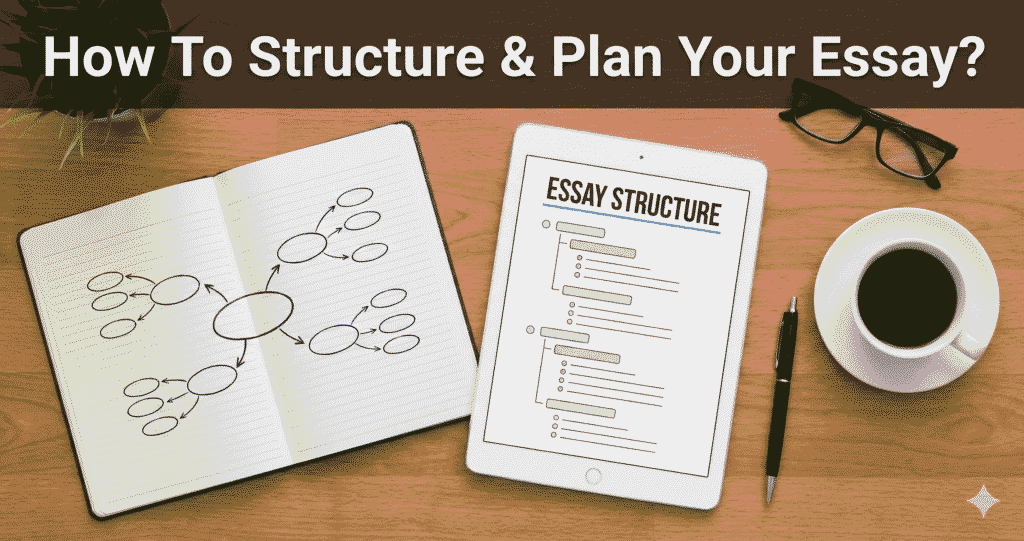
Structuring and planning an essay is the foundation of writing a clear, well-argued, and academically credible essay. Before structuring your essay, it is necessary to plan it by:
- Mapping your ideas
- Defining your central argument
- Organising each paragraph logically before you even start writing
The better your essay plan, the smoother your writing and the stronger your final submission.
Yet, many students struggle with planning because of overlapping deadlines, confusing essay requirements, or not knowing where to start. Others often jump straight into writing without creating a roadmap, leading to repetition, weak arguments, or inconsistent referencing.
That’s where a senior or expert’s help for writing your essay can make a real difference. Not by doing everything for you, but by helping you structure, research, and refine your essay with academic precision.
In this guide, we’ll walk through every stage of planning and structuring your essay.
From understanding your question to developing a strong thesis, building logical flow, and mastering academic formatting that fulfils your university’s requirement.
Step-by-Step Essay Planning Framework
This framework gives you a clear roadmap. From decoding the question to drafting and polishing. So you write with direction, evidence, and academic rigour every step of the way.
Understand the Essay Question
Start by treating the question like a brief from your tutor. Identify directive verbs such as:
- Analyse
- Evaluate
- Compare
- Discuss
- Critically assess
They tell you what kind of response is expected.
Afterwards, highlight scope words, such as:
- To what extent
- Causes
- Consequences
- Advantages
They define the boundaries of your topic. Note any discipline-specific terms and check their definitions in key texts or subject glossaries.
Here’s a quick technique:
- Rewrite the question in plain English as a sentence that states what you must do.
For example,
- Turn “Critically evaluate the impact of neoliberal policies on urban housing”
- Into “Provide a balanced assessment of how neoliberal policies have affected city housing, using evidence and counter-arguments.”
This makes your task concrete and directs your research and structure.
Conduct Preliminary Research
Once you understand the question, begin with preliminary research. It is the phase where you gather context, theories, and credible evidence before writing.
Use academic databases like:
- Google Scholar
- JSTOR
- Scopus
- Web of Science
- ProQuest
- EBSCO
To find peer-reviewed journal articles and discipline-specific case studies. Explore systematic reviews and literature syntheses to identify recurring arguments or theoretical gaps.
Also, create a note-taking framework, such as the:
- Cornell method
- A research matrix
They’ll help you to organise ideas, citations, and critical observations under each theme. Also, they’ll help to maintain analytical coherence when drafting.
If accessing authentic sources or interpreting complex research feels complicated, you can always seek help in essay writing from a senior in your university or an academic expert. They can better guide you in identifying credible literature and structuring your arguments effectively.
Always remember: strong research builds the foundation for a logical and critically sound essay.
Create a Thesis Statement
Your thesis statement is the backbone of your essay. It is a single, precise line that presents your main topic, your essay’s main focus on which you argue, discuss, or present your views.
It’s not just a topic; it’s your position on that topic.
Start by summarising what your research suggests. Ask yourself:
- What am I proving, explaining, or evaluating through this essay?
- What evidence or theoretical framework supports my view?
A strong thesis should be:
- Specific > avoids vague claims.
- Arguable > open to discussion or critique.
- Focused > directly answers the essay question.
For example:
- Fast food industry is effecting people’s health and hygiene.
This sets a clear analytical direction, helping you develop topic sentences, coherent arguments, and critical synthesis in each body paragraph later.
Outline the Structure
Once your thesis is defined, map out your essay’s academic structure. Below we’ll also have an in-depth discussion about structuring an essay
A solid outline ensures logical progression and coherence from start to finish.
A standard essay structure includes:
Introduction:
Here, you define your focus, present the thesis, and preview key points.
Main Body:
In each paragraph, you explore a single argument supported by evidence, theory, or data.
- Start with a topic sentence.
- Integrate peer-reviewed evidence or data-driven insights.
- Conclude with a mini-synthesis linking back to your thesis.
- Integrate peer-reviewed evidence or data-driven insights.
Conclusion:
Here, you summarise your findings, reflect on implications, and reinforce your argument’s significance.
Here’s a bonus Tip for you:
- Use bullet outlines or concept maps to plan your argument flow.
- This visual mapping enhances thematic cohesion
- And keeps your essay aligned with the original research objective.
Allocate Time Strategically
Time management is one of the most underestimated parts of essay planning. Most students rush into writing without a schedule, and end up missing citations, editing errors, or word count limits.
Therefore, set a realistic timeline for every stage before you begin writing your essay:
- 20–30% of your time > Research and note-taking
- 40–50% > Drafting and developing arguments
- 20–30% > Editing, proofreading, and formatting
Break large tasks into smaller milestones. Like completing one paragraph or referencing section per day.
You’ll find are more amazing & effective time management strategies in our guide on how to write an assignment for university. It explains how to structure your writing time effectively across multiple academic tasks.
Planning your schedule this way keeps your essay development systematic, stress-free, and academically consistent.
The Ideal Essay Structure Explained
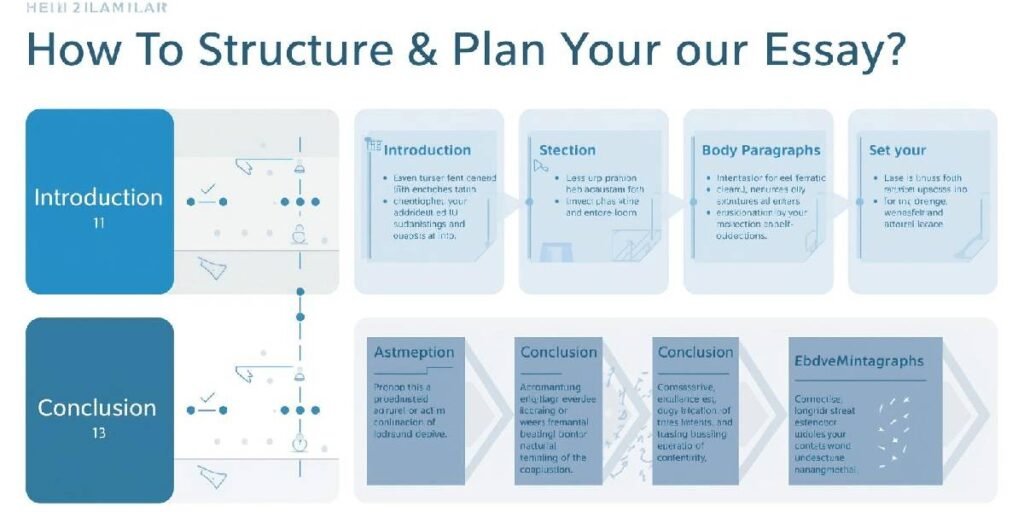
Every distinction quality essay follows a structured academic flow. A logical, balanced, and critically reasoned pattern that guides your reader from introduction to conclusion.
Whatever the essay format is:
- Whether it’s a Descriptive essay
- Expository essay
- Narrative essay
- Argumentative essay
- Persuasive essay
- Cause and effect essay
- Compare and contrast
- Reflective essay
- Analytical essay
- Critical essay
Essay structure is must-have factor in all of them. It ensures that your ideas unfold in an organised and academically coherent way.
Following are the main parts of essay structure:
Introduction
Your introduction is the reader’s first impression. It sets context, defines purpose, and clearly presents your thesis statement.
Start with a brief contextual background or a striking academic observation that introduces your topic. Then, narrow your focus to what specifically your essay will examine.
For example:
- While climate change has global implications, its socio-economic effects on developing nations remain critically underexplored.
A strong introduction also outlines the scope of discussion and signals the analytical framework you’ll use. For example, a comparative, thematic, or evaluative approach.
If you’re unsure how to refine your introduction’s structure or argument focus, you can ask for help writing your essay from professionals who understand university-level expectations for clarity, coherence, and academic style.
Main Body
The main body is where your argumentation and analysis take shape. Each paragraph should begin with a topic sentence that introduces one central idea connected to your thesis. Follow this with supporting evidence, such as:
- Data
- Scholarly citations
- or theoretical discussion
Then close with a synthesis sentence that ties the argument back to your main claim.
A standard structure for analytical essays looks like this:
- Topic Sentence: Introduces argument.
- Evidence: Integrates peer-reviewed research or empirical findings.
- Analysis: Critically interprets how this evidence supports the thesis.
- Link Sentence: Connects back to the essay’s central argument.
| Essay Type | Focus Area | Purpose / Writing Approach |
| Descriptive Essay | Explaining facts, contexts, and observable details. | Present information objectively; describe what, where, and how without deep analysis. |
| Analytical / Evaluative Essay | Critical discussion, contrast of perspectives, and interpretive depth. | Examine why and how; analyse underlying meanings, assess arguments, and draw reasoned conclusions. |
Maintaining logical flow and paragraph cohesion ensures your essay reads like a consistent, evolving discussion rather than a list of disconnected points.
Conclusion
Your conclusion shouldn’t just repeat the introduction. It must synthesise your findings and reaffirm your essay’s academic value. Briefly revisit your thesis statement, summarise the key insights discussed, and reflect on their implications.
For Example:
- This analysis demonstrates that while digital education improves accessibility, it also widens disparities in learner engagement, a challenge that demands inclusive pedagogical reform.
End with a line that offers closure or forward thinking. Something that invites further academic exploration.
A well-crafted essay conclusion gives your essay intellectual weight and leaves the reader with a sense of completion and scholarly clarity.
Common Mistakes in Essay Planning & How to Avoid Them
Even the best performing students often make mistakes. Not because they lack knowledge, but because they skip the structural intelligence that turns research into a coherent essay.
Here are some of the most frequent academic missteps and how to fix them:
1. Unstructured Outlines
Jumping straight into writing without a detailed framework often leads to fragmented paragraphs and inconsistent argumentation.
Therefore, always prepare a hierarchical outline, from thesis to topic sentences, so every paragraph builds logically toward your central argument.
2. Overloading References
Students sometimes mistake quantity for quality, stuffing essays with excessive citations. This weakens authorial voice and causes synthesis gaps.
Therefore, you should use selective referencing and apply Harvard, APA, MLA, Chicago, or the citation style specified by the university to support, not overshadow, your interpretation.
3. Lack of Critical Argument
Summarising sources without analytical evaluation results in descriptive rather than argumentative essays.
Then what’s the best practice?
- Integrate comparative critique. Contrast theories, assess methodologies, and link each paragraph back to your thesis statement.
4. Ignoring Cohesion and Flow
Paragraphs that don’t transition logically reduce semantic continuity and reader comprehension.
To keep a proper cohesion & flow, use lexical linking, discourse markers, and thematic progression for clarity.
If you ever find it complex to structure your essay or need expert guidance to refine your drafts, our professional essay writing services are available for you 24/7. We can help ensure academic precision, coherence, and originality. Without compromising your personal identity.
Practical Example: How a Student Plans an Essay
Sarah, a postgraduate psychology student, is preparing an essay on:
- The Impact of Cognitive-Behavioural Therapy on Adolescent Anxiety.
She begins by decoding the question, identifying key verbs like evaluate and analyse, which indicate she must go beyond description and engage in critical synthesis.
Next, Sarah conducts preliminary research using databases like PsycINFO and Google Scholar, ensuring that all her sources are peer-reviewed empirical studies.
She then compiles her notes in a matrix method, categorising evidence by author, year, and theoretical orientation.
Her thesis statement is clear and directional:
- Cognitive-Behavioural Therapy remains the most empirically supported intervention for adolescent anxiety, primarily due to its structured skill-building techniques.
She outlines her essay using the IMRAD structure (Introduction, Methods, Results, and Discussion) adapted for coursework. In the IMRAD structure, each body paragraph starts with a topic sentence, followed by critical comparison of studies, and concludes with evaluative commentary.
Before submission, Sarah applies:
- APA 7th edition formatting
- Checks Turnitin similarity
- And reads her essay aloud to assess semantic flow and lexical coherence.
This workflow:
Planning > structuring > referencing > proofreading
Shows how a well-prepared student transforms academic complexity into a clear, persuasive, and high-distinction essay.
Conclusion
Planning and structuring your essay isn’t just about organising paragraphs. It’s about building a logical, evidence-based narrative that communicates your argument with precision and academic depth.
A well-planned essay demonstrates:
- Critical reasoning
- Clarity of thought
- And mastery of scholarly conventions like coherence, citation accuracy, and analytical synthesis.
If you ever feel stressed because of complex essay frameworks or academic formatting standards, you don’t have to hassle with it alone. You can get professional essay guidance from us anytime.
Also, if you’re looking for help in assignment writing, dissertation writing, or thesis writing – our experts are always here to support you. From brainstorming ideas to refining final drafts with perfection, we ensure your entire academic journey is guided with expertise.