
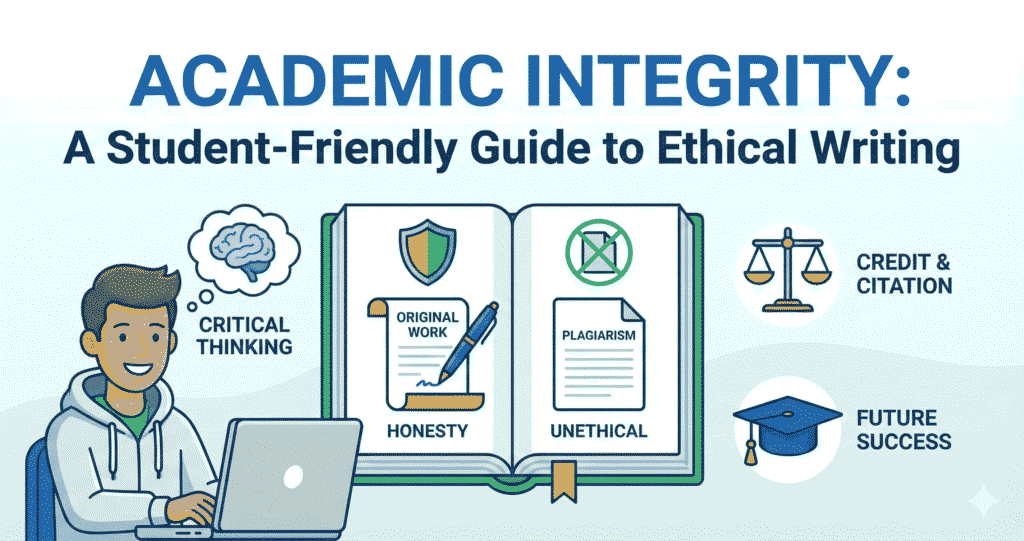
Academic integrity is the honest, responsible, and ethical way of doing academic work. And in university life, it’s the rulebook everyone follows, whether they talk about it or not.
According to UK higher-education standards (QAA guidelines), every student is expected to produce work that reflects their own thinking, built on properly credited sources. No shortcuts. No copying. No hidden help.
And here’s the truth: academic integrity isn’t just a policy. It’s the foundation of your credibility.
- Lecturers trust your submissions.
- Universities trust your results.
- You trust your own growth.
So if you’ve ever wondered what is academic integrity and why every university keeps mentioning it. It’s because it directly affects your:
- Grades
- Reputation
- And long-term academic success
This guide breaks everything down about academic integrity and its value in your academic life and beyond, so you can stay confident, compliant, and fully in control of your work.
Why Academic Integrity Matters
Academic integrity matters far more than most students realise. It’s the backbone of your entire academic journey. When you submit honest, well-referenced work, you’re proving that your grades reflect your real abilities, not shortcuts or borrowed thinking.
That makes grading fair for everyone, especially in competitive courses where one copied paragraph can distort the whole marking curve.
But beyond fairness and compliance, academic integrity protects something bigger:
- Your reputation.
UK universities record misconduct on your academic file, and that record can follow you into postgraduate admissions, scholarship applications, and even professional licensing routes.
Employers increasingly value candidates who can demonstrate independent thinking, ethical judgement, and research accuracy. All behaviours are rooted in integrity.
There’s another factor students rarely think about, but it is really true:
- Integrity protects your confidence.
When you do the work properly, you actually grow in analysis, writing, reasoning, and subject mastery. No fear of being caught. No anxiety over similarity checks. Just clean, stress-free progress.
So academic integrity is a long-term strategy for building credibility, developing real skills, and leaving university with results you can proudly defend.
Key Principles of Academic Integrity
Academic integrity isn’t just a rulebook. It’s a set of principles that shape how you think, work, and behave at university. And five of these principles guide every assignment you submit:
- Honesty
- Trust
- Fairness
- Responsibility
- And Respect
Each one sounds simple, but in real student life, they’re tested more than you’d expect.
- Honesty
Honesty means representing your work truthfully. No hidden sources, no recycled essays, no AI-written paragraphs passed off as your own.
For example, a student paraphrases an article properly instead of copying three sentences “just to save time.”
- Trust
Trust is built when lecturers know your submissions are genuinely yours. For example, you provide accurate citations, so your supervisor trusts your research process.
- Fairness
Fairness ensures that everyone earns marks based on real effort. For example, you avoid helping a friend by sharing your full assignment, even when they’re stressed.
- Responsibility
Responsibility is about owning your learning and choices. For example, you start early instead of blaming plagiarism on “tight deadlines.”
- Respect
Respect means valuing other people’s ideas and intellectual labour. For example, you reference a theory properly because the original author deserves credit.
Together, these principles create a culture where you grow academically, produce authentic work, and earn results you can genuinely be proud of.
Common Academic Misconducts
Academic misconduct isn’t always dramatic or intentional. Sometimes it happens because a student was stressed, confused, or rushed. But every form has consequences, and universities record them separately in your file.
Here are the big four academic misconducts you must understand clearly to avoid them and keep your academic integrity maintained:
1. Plagiarism
Plagiarism is using someone else’s words, ideas, structure, or data without proper credit. Even if you “changed a few words.”
Example: Copy-pasting a journal paragraph and swapping synonyms.
Consequences:
- Grade reduction
- Assignment resubmission
- In serious cases, failure of the module or a formal misconduct entry on your academic record
Plagiarism often starts quietly. A rushed deadline, a paragraph that “fits perfectly,” or confusion about how to credit sources properly. That’s usually where students slip without realising it. And because referencing rules can feel like a maze at first, many rely on guesswork instead of clear guidance.
If you ever feel stuck on how to credit ideas, structure, or borrowed arguments the right way, our guide on referencing and avoiding plagiarism will walk you through proper citation and safe paraphrasing, helping you avoid accidental plagiarism before it becomes a problem.
2. Cheating
Any dishonest behaviour during exams, tests, or assessments.
Example: Using hidden notes in an exam, unauthorised calculators, or external help during online tests.
Consequences of Cheating:
- Automatic exam failure
- Disciplinary hearing
- Potential suspension depending on severity
3. Collusion
Collusion is working with someone when the task must be completed individually. Even unintentional “sharing for ideas” can cross the line.
For example, two students writing similar arguments or sharing drafts.
What are the consequences of collusion?
- Both students will receive a failing grade and an academic misconduct flag.
4. Data Fabrication
Data fabrication is making up, altering, or manipulating data to “fit” your argument or research.
Example: Inventing survey results because the sample size was too small.
Consequences:
- Research invalidation
- Failed coursework
- Potential escalation to higher academic conduct panels
Checking Your Work
Before you submit anything, pause and audit your own writing. This is where small errors hide. The messy sentences, repeated ideas, missing citations, and those sneaky typos weaken an otherwise strong assignment. Effective checking isn’t just reading your work once; it’s a systematic sweep that helps you spot issues your brain normally ignores.
Start with proofreading:
- Read your work slowly, sentence by sentence.
- Look for grammar slips, awkward phrasing, inconsistent tenses, and unclear transitions.
Then shift to editing:
- This is the deeper layer where you refine arguments, eliminate unnecessary content, and enhance clarity.
A trick that works?
- Read your work out loud.
- If you stumble, the sentence needs to be fixed. Explore more about this technique among our other editing and proofreading techniques.
Create a simple self-check routine:
- Have you repeated any points?
- Does every paragraph support your main argument?
- Are citations accurate and complete?
- Is the tone academic and coherent?
Maintaining Integrity in Group Work
Group work sounds simple, but its different schedules, different writing styles, and different levels of effort often create chaos. And in the middle of that chaos sits a major academic risk: collusion.
Most students don’t collude intentionally; it usually happens when groups “share too much,” rewrite each other’s sections, or submit work that looks suspiciously similar.
To stay on the right side of integrity, follow one core rule:
- Collaborate, Don’t Copy!
Start by clarifying your university’s collaboration policy. Most UK universities allow discussion, brainstorming, and shared planning. But the writing must be individual unless stated otherwise. Use shared documents only for outlining ideas, deciding roles, or tracking progress.
A helpful tool is a group work log. It documents who contributed what, when, and how. This protects everyone in case the marker questions authorship, and it keeps the workload transparent.
To avoid accidental collusion:
- Discuss concepts together, but write your own section independently.
- Don’t exchange completed paragraphs.
- Cite any external sources, even if the group discovered them collectively.
- Keep drafts separate until the final merging stage.
With clear boundaries and responsible teamwork, you can collaborate confidently without crossing integrity lines, and if things ever feel challenging, you can contact us to avail our assignment writing services in the UK and get your group work managed smoothly.
University Policies and Support
Whenever we wonder what is academic integrity, we should take a look at UK universities. Those who take academic integrity seriously and whose policies are designed not just to punish misconduct but to protect students and support honest learning. Every institution has a formal Academic Integrity Policy outlining what counts as misconduct, how cases are investigated, and what support is available if you’re unsure about the rules.
Reporting and Investigations
When suspected misconduct is reported, whether plagiarism, collusion, or exam irregularities, the university follows a structured process. This includes:
- Turnitin reports
- Review panels
- Written statements
- Sometimes, a meeting with an academic integrity officer
The aim isn’t to intimidate students; it’s to ensure fairness and give you a chance to explain your side, especially in cases of accidental mistakes.
Support Services for Students
Most universities offer workshops on referencing, seminars on ethical writing, and one-to-one academic skills appointments. Academic advisors, learning development tutors, and writing centres guide students on paraphrasing, citation styles, and proper research habits.
Many universities even provide draft-checking consultations to help you correct issues before submission.
If you’re ever unsure about rules, referencing, or collaboration guidelines, asking for help early is the smartest move. Policies + support services exist for one reason: to help you succeed with integrity and avoid unnecessary academic risks.
Practical Tips for Ethical Writing
Ethical writing isn’t just about avoiding plagiarism. It’s about producing work that’s honest, credible, and academically valuable. At its core, it combines careful planning, proper referencing, and disciplined writing habits.
1. Plan Ahead:
- Start by breaking your assignment into stages: research, note-taking, drafting, and editing.
- Planning prevents rushed decisions that often lead to shortcuts or accidental misconduct.
- Using checklists and timelines helps keep tasks manageable and deadlines realistic.
For practical time-management strategies, explore the best ways to improve time management for writing assignments we’ve outlined for you.
2. Manage Your Time:
- Avoid last-minute work.
- Cramped schedules increase the risk of copying, poor paraphrasing, and incomplete citations.
- Consistent writing sessions, micro-deadlines, and focus techniques keep your work on track while reducing stress.
3. Cite Sources Correctly:
- Every idea that isn’t yours must be referenced. Use the right style like Harvard, APA, MLA, or Chicago, and double-check each citation.
- Proper paraphrasing shows understanding, while accurate referencing protects you from plagiarism.
If you need more structured guidance, our guide on referencing and avoiding plagiarism will make this process straightforward.
4. Proofread and Edit:
- Before submission, review your work for clarity, consistency, and citation accuracy.
- Step-by-step editing techniques ensure your writing is polished and ethically sound.
For detailed tips, see our proofreading and editing techniques.
Following these steps builds credibility, protects your academic record, and ensures your work genuinely reflects your knowledge and effort.
Conclusion
Ethical writing is more than a rule to follow. It’s a habit that shapes your credibility, skills, and academic success. By planning, managing time effectively, citing sources correctly, and carefully proofreading your work, you not only avoid plagiarism but also produce assignments that genuinely reflect your understanding and effort.
Maintaining academic integrity builds trust with lecturers, protects your reputation, and gives you confidence in your abilities.
If you want help ensuring your assignments are plagiarism-free, properly referenced, and polished to perfection, FQ Assignment Help can provide expert guidance at every step, helping you submit work that meets the highest academic integrity with ease and confidence.