
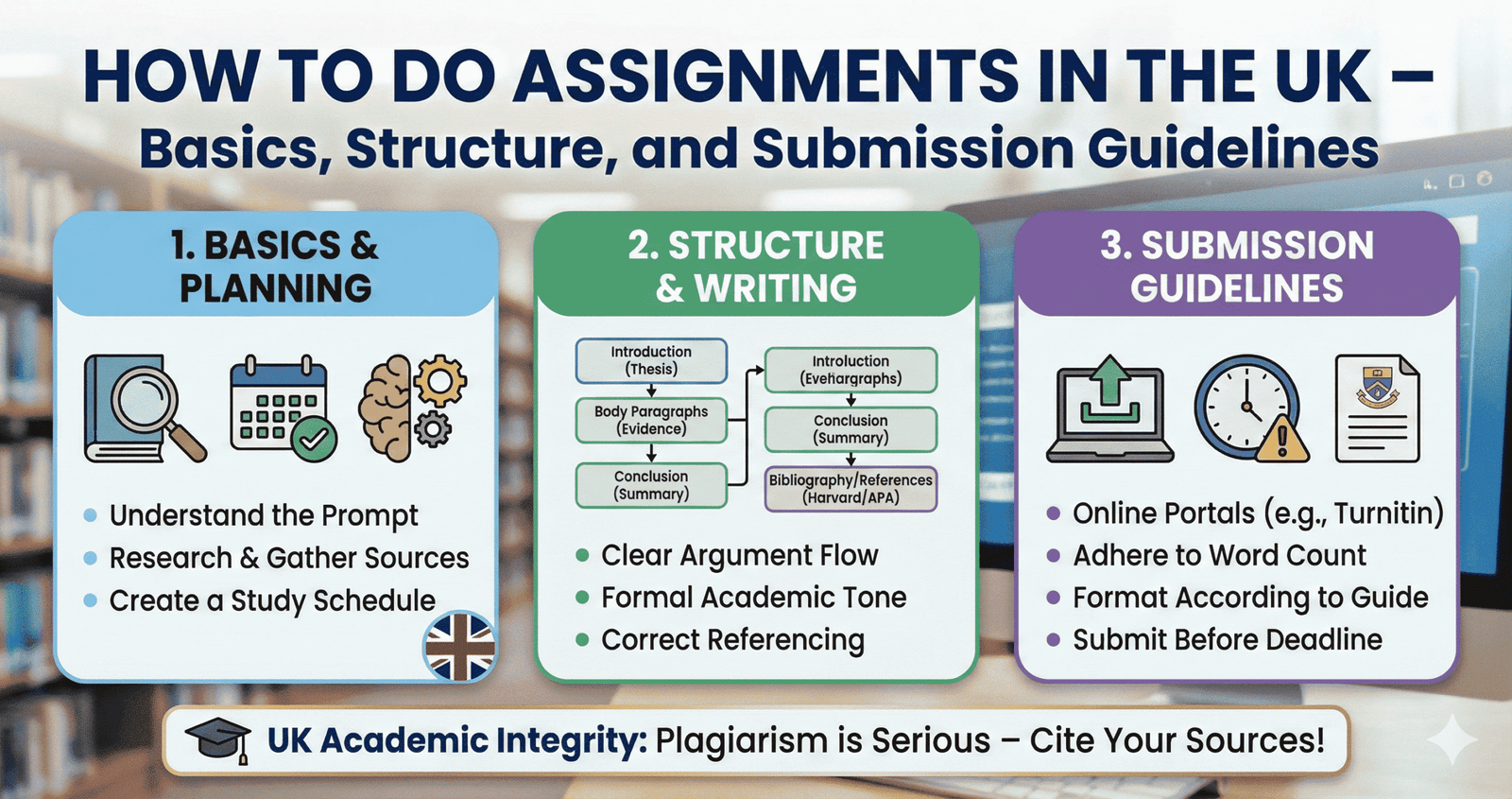
The UK has always attracted students from every corner of the world, and the numbers prove it. In 2025, 47,000 international students were enrolled in UK universities. This represents a 32% increase over 2024. And with global demand for UK degrees still rising (despite stricter visa policies), these figures are expected to stay high through 2026 & later.
But here’s the catch: many students arrive ready to study. But completely unaware of how to do assignments in the UK. Different structure. Different marking criteria. Different academic integrity rules.
One wrong assumption? And suddenly you’re rewriting your entire paper the night before the deadline.
That’s exactly why understanding how to do assignments in the UK isn’t optional. It’s survival! UK academics expect clarity, critical thinking, proper referencing, and strict formatting.

Miss any of these, and your grades take the hit.
This guide will walk you step-by-step through exactly what’s expected: from structuring your work and citing sources correctly, to submission guidelines & using submission systems without errors.
And if you need deeper help with writing techniques, you can always check our detailed guide on how to write a university assignment.
Understanding UK Academic Assignment Expectations
In the UK, academic writing follows clear expectations and standards, and knowing them can make a real difference to your grades. According to marking-criteria guidance used by many universities, assessors look for several core features:
- A logical structure
- A well-developed argument
- Clear presentation
- And correct referencing
Here’s how it actually works:
- Clarity and structure: Your assignment must be easy to follow, with a clear introduction, body, and conclusion. Each paragraph should have a purpose and contribute to a coherent argument.
- Strong argument and critical analysis: It’s not enough to describe facts. You need to show critical thinking: analyse evidence, compare viewpoints, evaluate theories, and draw reasoned conclusions.
- Referencing and academic integrity: Every claim or idea based on others must be cited properly. References must follow the referencing style required by your course. Mistakes here can cost marks and even trigger integrity concerns.
- Presentation and academic writing style: Proper grammar, formal tone, correct formatting, and clean presentation are essential. Poor presentation or sloppy writing will affect readability and marks.
Because these criteria are so important, many students, especially international students. They struggle when they treat assignments like a piece of cake, neglecting the brief, time management, which are the common mistakes in assignments made by university students. Without adopting UK-style academic conventions, you risk losing marks even if your ideas are good.

Reading and Understanding the Assignment Brief
Most students lose marks before they even start writing. Simply because they misread the brief. The assignment outline isn’t a formality; it’s the exact blueprint your lecturer will use when marking your work.
And the real power lies in the instructional verbs. Words like analyse, evaluate, compare, discuss, justify, and critically reflect aren’t random. They tell you how deep your thinking should go and what angle your writing must take.
| Instructional Verb | Meaning and Example |
| Analyse | Break the idea into parts and explain how they work. Example: Analyse the causes of climate change by separating human and natural factors. |
| Evaluate | Judge the quality or effectiveness of something using evidence. Example: Evaluate whether online learning improves student performance. |
| Compare | Show similarities and differences between ideas. Example: Compare two leadership styles and highlight what makes each effective. |
| Discuss | Present different perspectives before forming a conclusion. Example: Discuss whether social media has a positive or negative impact on students. |
| Justify | Provide clear reasons to support your position. Example: Justify why your chosen research method is the most suitable. |
| Critically Reflect | Review your own experience, strengths, weaknesses, and learning.Example: Critically reflect on what you learned from completing a group project. |
If you’ve been ignoring them, you’ll spend hours producing the wrong kind of answer.
Misreading the brief leads to rewrites, broken structure, confused arguments, and wasted time, especially when deadlines are tight. A five-minute careful reading can save you five hours of panic later.

If you’re unsure how to break down these verbs or interpret assignment expectations, our detailed guide on how to write an assignment for university offers a clearer step-by-step approach.
Assignment Structure Basics
A strong assignment begins with a clear structure. Most UK universities expect work to follow a logical flow: Introduction > Main Body > Conclusion. This isn’t just tradition. It makes your arguments easier to follow, helps examiners understand your points, and ensures that marks aren’t lost due to poor organisation.
Introduction: Start with context, define key terms, and clearly state your thesis or objective. Avoid overloading it with detail, which belongs in the body.
Main Body: Divide into paragraphs or sections, each covering a single point. Support arguments with evidence, examples, and references. Use headings to organise ideas for clarity.
Conclusion: Summarise your key points and link back to your thesis. Avoid introducing new ideas here.
However, the structure differs as on the type of assessment.
| Assignment Type | Structure Example |
| Essay | Intro > 3–4 body paragraphs > Conclusion |
| Report | Intro > Methodology > Findings > Discussion > Conclusion |
| Case Study | Intro > Context > Analysis > Recommendations > Conclusion |
Formatting is equally important. Clear, consistent presentation improves readability and demonstrates professionalism. Key tips:
| Formatting Element | Recommendation |
| Headings | Use clear, descriptive headings for each section |
| Font | Standard fonts like Arial or Times New Roman, size 11–12 |
| Spacing | 1.5 or double spacing, consistent throughout |
| Margins | Typically 2.5 cm all around |
| Numbering | Pages and headings for easy navigation |
Following these basic structure and formatting rules saves time during editing, ensures clarity, and keeps you aligned with UK academic standards. For a deeper, step-by-step approach, you can also check our guide on how to structure and plan your essay, which provides practical planning tips and examples.
Research and Note-Taking Techniques
Research is the process of gathering credible information to support your arguments, ideas, or analysis. Note-taking is recording information in a clear, organised way so you can use it effectively when writing. Both are essential for producing high-quality assignments and avoiding last-minute panic.
Start by using reliable sources. Library databases, Google Scholar, JSTOR, and other academic platforms provide peer-reviewed, trustworthy material. Avoid random internet sites. They lack credibility and mislead your arguments.
Once you collect information, organisation is key. Divide notes by topic or argument, highlight key quotes, and summarise findings in your own words. This not only saves time during writing but also reduces the risk of plagiarism.
Here’s a simple approach:
- Identify topic & keywords
- Search credible sources
- Summarise key points in notes
- Record source details for citations

Planning Your Writing
Effective planning is the backbone of completing assignments on time. Without a clear plan, students waste hours deciding what to do next, scrambling for sources, or rewriting sections. Knowing how to do assignments in the UK properly starts with breaking the work into manageable stages.
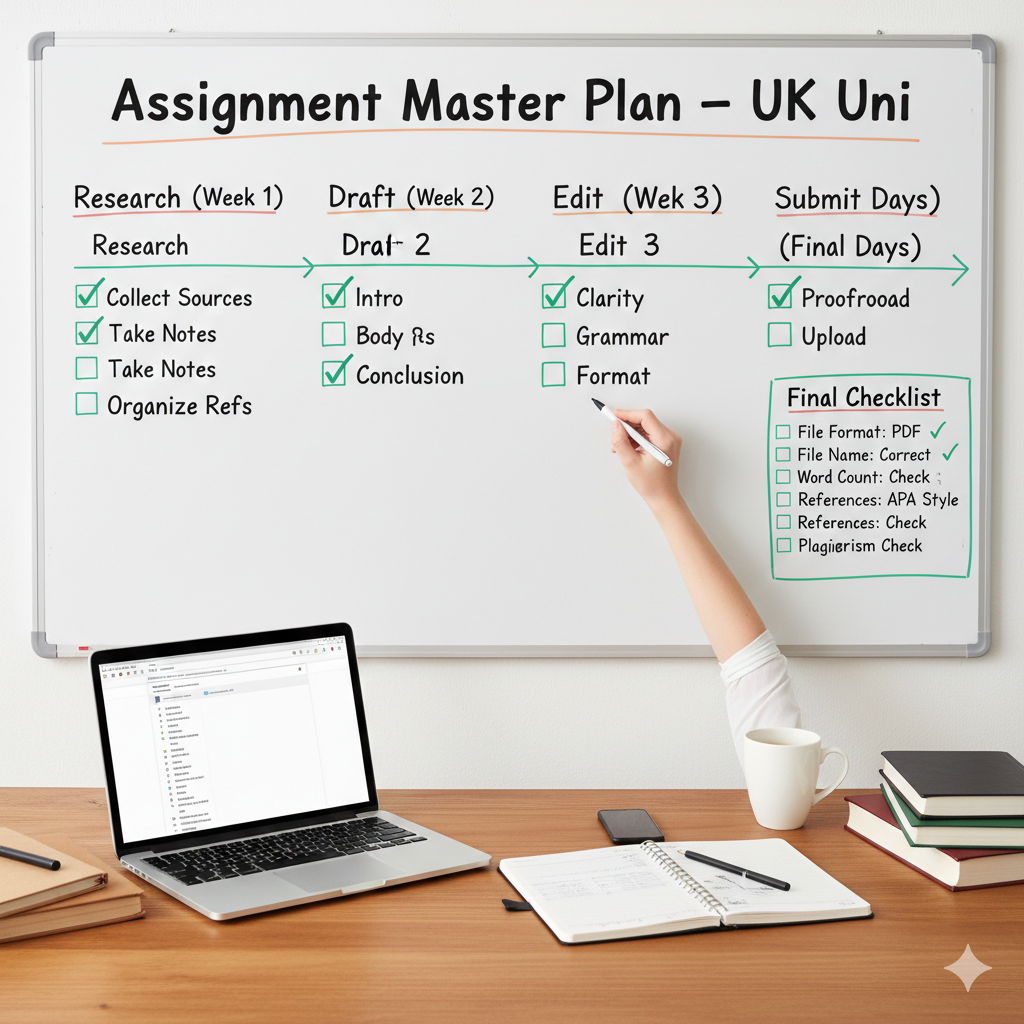
Begin by creating a timeline based on your deadline. Divide your assignment into key tasks:
- Research
- Drafting
- Editing
- Submission
Assign realistic dates to each stage to avoid last-minute stress. For example, allocate the first few days to reading the brief and collecting sources, the next few to drafting paragraphs, and the final days to editing and finalising.
| Check | Stage | Tasks |
| Research | Collect sources, take notes, organise references | |
| Draft | Write the introduction, main body, and conclusion | |
| Edit | Check clarity, arguments, grammar, and formatting | |
| Submission | Proofread, finalise citations, submit online |
Checklists are a simple but powerful tool. They keep you accountable, remind you of crucial steps, and ensure nothing is overlooked. You can use the checklist attached above for each stage, including research notes, references, formatting, proofreading, and submission requirements.
Planning your writing in this way will improve your time management, reduce stress, and ensure your assignment is structured, complete, and submission-ready.
Writing the Assignment
Writing a UK university assignment isn’t about filling pages. It’s about communicating your ideas clearly and convincingly. Many students lose marks not because their ideas are weak, but because their writing is cluttered with filler, repetition, or unclear sentences.
If you’re unsure how to do assignments in the UK or want a deeper strategy for structuring paragraphs and integrating evidence, our how to write an assignment for university guide will help you with practical steps and examples to build confidence and efficiency.
Start by focusing on clarity and conciseness. Each paragraph should make a single point, supported by evidence, examples, or references. Avoid long, winding sentences or unnecessary words.
Ask yourself:
- Does this sentence add value to my argument? If not, cut it.
Use signposting phrases to guide the reader through your ideas, for example:
- “This shows that…,”
- “In contrast…,”
- “Evidence suggests…”
- And more
These small touches improve readability and show the examiner that your arguments are structured.
Always draft first, then refine. Don’t chase perfection in the initial draft. Getting your ideas down should always be the priority.
After finishing, revisit your work to remove repetition, tighten sentences, and ensure logical flow. Tools like Grammarly or manual proofreading and editing techniques can help polish your writing before submission.
Focused, structured writing saves time, reduces stress, and increases your marks — because clarity and strong arguments always stand out.
Referencing and Avoiding Plagiarism
Referencing is how you credit the sources of ideas, quotes, or data in your assignment. UK universities take it seriously. Proper referencing not only avoids plagiarism but also demonstrates academic rigour. However, different courses prefer different referencing styles.
| Style | Used In / Purpose | Example |
| APA | Social sciences; focus on author-date citation | (Smith, 2020) |
| Harvard | Many UK courses; author-date format, popular in essays & reports | (Brown, 2019, p.45) |
| MLA | Humanities; concise author-page format, in literature assignments | (Johnson 78) |
| Chicago | History & some arts; can use footnotes or author-date | Johnson, History of Art, 78 |
Paraphrasing & Citing Correctly
Paraphrasing is putting ideas into your own words while still crediting the source.
- Incorrect: Climate change is caused by human activity (Smith, 2020).
- Correct: Human activity is a major driver of climate change (Smith, 2020).
Always include full details in your reference list. Structured note-taking during research helps you track sources and reduces accidental plagiarism.
After finishing your assignment, revisit your work to tighten sentences, remove repetition, and check references.
For step-by-step guidance on referencing and avoiding plagiarism, you can explore our dedicated guide, which shows practical examples and strategies to keep your work academically honest and well-structured.
Submission Guidelines and Checklist
Submitting your assignment correctly is just as important as writing it well. Universities in the UK require:
- Specific file formats (commonly .docx or PDF).
- Proper naming conventions (e.g., Lastname_AssignmentTitle_Date).
- And timely uploads via portals like Turnitin, Moodle, or Blackboard.
Ignoring these requirements can cost marks or even trigger late submission penalties.
Before hitting the submit button on your portal, a last-minute checklist ensures nothing is overlooked. You’re lucky that we’ve already made one for you, so you can use it before any of your submissions.
| Checklist Item | Action |
| File Format | Save as required format (.docx, PDF) |
| File Name | Use correct naming convention (Lastname_AssignmentTitle_Date) |
| Word Count | Verify it meets the minimum and maximum requirements within a +/- 10% range of the word count. |
| References | Check all in-text citations and reference list entries |
| Formatting | Ensure font, spacing, headings, and margins are correct |
| Plagiarism | Run a check for accidental plagiarism if required |
| Submission Portal | Upload to the correct portal (Turnitin/Moodle/Blackboard) |
| Confirmation | Ensure receipt or submission confirmation is received |
Following this checklist saves last-minute panic, avoids technical errors, and ensures your assignment meets your university’s submission standards. A few minutes checking these points can prevent hours of stress and lost marks.
Still, if you’re unsure & want your assignment to be checked and refined by an expert before submission, FQ Assignment Help is available 24/7 to get your assignment error-free & submission-ready.
Conclusion
Completing assignments in the UK comes down to following a clear, organised process.
- Start by reading and understanding the brief
- Plan your research and writing stages
- Structure your work properly
- Reference sources accurately
- And submit on time
Using effective note-taking, breaking tasks into manageable steps, and checking your work before submission all contribute to smoother, more confident progress.
Mastering how to do assignments in the UK not only improves your grades but also reduces stress, builds academic confidence, develops strong writing skills, and strengthens time management. Following these steps ensures that your work is clear, well-structured, and academically sound.
If you need guidance with writing, structuring, or referencing your assignments, our expert support can ensure a high-quality, submission-ready assignment, helping you meet deadlines and achieve your academic goals with confidence.