
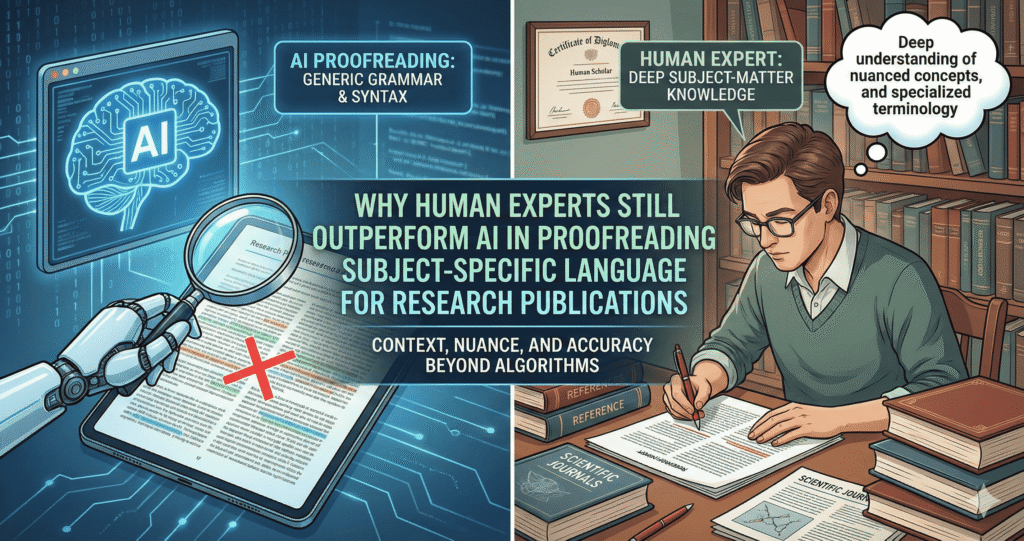
Human experts still outperform AI in proofreading subject-specific language for research publications because they:
- Understand disciplinary context
- Verify methodological accuracy
- Recognise when technically correct language conveys a scientifically incorrect meaning
In 2026, it is a universal truth that AI tools have revolutionised academic writing support. They catch spelling errors instantly, identify grammatical mistakes efficiently, and suggest phrasing improvements rapidly.
For general writing tasks, they’re remarkably capable.
But research publications aren’t general writing.
A psychology paper discussing “significant findings” means something completely different from a statistics paper using identical words.
Medical research using “subjects” versus “participants” carries ethical implications AI cannot evaluate.
Engineering specifications requiring “tolerance” versus “clearance” represent distinct technical concepts that sound interchangeable to non-specialists.
Research publication proofreading demands more than linguistic correctness. It requires:
- Disciplinary expertise
- Methodological understanding
- Scientific judgement that current AI systems fundamentally lack
When a single misused term can invalidate conclusions. When statistical notation errors can mislead readers. When field-specific conventions determine publication acceptance. In all cases, human expertise remains irreplaceable.
AI Proofreading vs Human Proofreading: The Critical Differences
| AI Proofreading | Human Proofreading |
| Checks grammar rules mechanically | Understands context and meaning |
| Identifies spelling errors instantly | Verifies technical term accuracy |
| Suggests generic improvements | Applies field-specific conventions |
| Flags statistical symbols as errors | Confirms statistical notation correctness |
| Misses discipline-specific conventions | Ensures compliance with journal standards |
| Cannot verify methodological accuracy | Validates research terminology appropriateness |
| Treats all “correct” words as acceptable | Recognises when correct words are incorrectly used |
| Provides identical feedback regardless of the field | Tailors corrections to disciplinary expectations |
| Misunderstands specialised terminology | Comprehends nuanced technical language |
| Operates without subject-matter knowledge | Leverages expertise in specific research domains |
What makes human proofreading essential for research publications?
The answer lies in understanding how subject-specific proofreading actually works, and where AI consistently fails despite impressive general capabilities.
Let’s examine the standard methods researchers and academic editors use to ensure publication-quality accuracy, and why each method exposes fundamental limitations in AI proofreading tools.
Where AI Fails and Humans Excel?
Subject-Matter Expert (SME) Review
AI cannot distinguish between correct and contextually inappropriate technical terminology.
AI recognises that words exist in dictionaries. It cannot evaluate whether those words mean what you think they mean in your research context.
For example, a neuroscience paper states: “The hippocampus exhibits neuroplasticity through dendritic pruning during adolescence.”
AI sees correctly spelled technical words. Approved.
A neuroscience expert recognises the error immediately. Dendritic pruning occurs in early childhood, not adolescence. “Synaptic pruning” would be accurate for adolescent brain development. This isn’t a spelling mistake. It’s a fundamental scientific inaccuracy undermining the paper’s credibility.
Human experts verify that technical terms are used appropriately within disciplinary standards. They catch:
- When “correlation” is confused with “causation”
- When “theory” means “hypothesis”
- When statistical terms apply to inappropriate contexts
AI cannot do this. It lacks subject-matter knowledge.
Domain-Specific Style Guide Adherence
AI applies generic style rules without understanding field-specific formatting requirements.
Every research discipline has unique citation formats, heading structures, and presentation conventions.
Subject-specific reference styles are:
- Education, Psychology, Social Sciences, Nursing use APA (American Psychological Association)
- Humanities, English, and Literature use MLA (Modern Language Association)
- History, Business, Fine Arts, and Theology use the Chicago/Turabian
- Chemistry uses ACS (American Chemical Society)
- Biology and Life Sciences use CSE (Council of Science Editors)
- Political Science uses APSA (American Political Science Association)
- Sociology uses ASA (American Sociological Association)
- Medicine and Health Sciences use AMA (American Medical Association)
- Engineering and Technology uses IEEE
- Arts and Humanities use MHRA (Modern Humanities Research Association)
- Business, Economics, and General Studies use Harvard
- Law uses OSCOLA
These aren’t preferences. They’re professional standards, determining publication acceptance.
For example, a medical paper cites: “Smith et al. (2023) found that treatment efficacy improved significantly.”
AI checks that the citation exists. No errors flagged.
A medical editor recognises this violates AMA style immediately. AMA requires superscript numbers. Not author-date format. The entire reference section needs restructuring.
Journal editors will reject the paper on formatting grounds alone.
Human proofreaders ensure submissions comply with field-specific style guides completely. They know Nature requires different formatting from PLOS ONE. They verify every heading level, citation format, and figure caption matches journal specifications exactly.
AI treats all academic writing identically. It is a fatal mistake of AI in academia.
Understanding proper assignment structure and submission guidelines becomes critical when formatting errors alone trigger immediate rejection.
Consistency Checks for Specialised Terms
AI cannot maintain consistency across complex technical vocabularies with multiple acceptable variants.
Research papers use hundreds of:
- Specialised terms
- Abbreviations
- Variables
- Units
Consistency matters. Readers need confidence that “ROS” means “reactive oxygen species” every time, not sometimes “return on sales.”
For example, a chemistry paper alternates between “mol/L,” “M,” and “molarity” when discussing concentration.
AI sees three correctly spelled terms. No consistency check performed.
A chemistry expert, professor, supervisor, or lecturer creates a glossary, ensuring one term is used consistently throughout. They standardise on “M” for body text whilst defining “M = mol/L” in methodology. They catch when “catalyst” appears as “catalyser” in British sections.
Human editors build term checklists specific to each manuscript. They track every acronym’s first use, verify consistent hyphenation, and ensure measurement units follow field conventions.
AI lacks this discriminating judgement entirely.
Contextual Accuracy Verification
AI cannot evaluate whether technically correct language alters scientific meaning.
The most dangerous proofreading failures aren’t obvious errors. They’re subtle changes that make text grammatically perfect whilst making science completely wrong.
For example,
Original text: “The treatment showed no significant effect (p = 0.08).”
AI suggests: “The treatment showed significant effects (p = 0.08).”
Grammatically improved. Scientifically catastrophic.
A statistics-trained editor recognises this immediately. P-values above 0.05 indicate non-significance in standard hypothesis testing.
Changing “no significant effect” to “significant effects” whilst keeping p = 0.08 creates a fundamental statistical contradiction. This error could mislead future researchers, influence clinical decisions incorrectly, or result in journal retraction.
Human experts verify that methodology descriptions, results interpretations, and discussion sections maintain scientific accuracy through every edit. They ensure that the limitations sections appropriately qualify claims. They catch when “correlation” language accidentally implies causation. They identify when simplified explanations oversimplify into inaccuracy.
AI optimises for readability. Humans optimise for truth.
Maintaining academic integrity in research publications demands this level of scientific vigilance that automated tools simply cannot provide.
Backward Reading for Technical Accuracy
AI processes text linearly without strategic reading techniques for error detection.
Human proofreaders employ deliberate reading strategies that force attention to individual words rather than predicted meaning. Backward reading. Starting from the conclusion and reading sentence-by-sentence toward the introduction. It disrupts narrative flow, making technical term errors more visible.
Reading forward, your brain autocorrects:
“The method demonstrates high prescision in measuring cellular responses.”
You read “precision” even though “prescision” is written.
Reading backward forces attention to each word independently. “responses cellular measuring in prescision high demonstrates method The”
Suddenly, “prescision” looks wrong because contextual prediction isn’t smoothing over the spelling error.
Human editors use backward reading specifically for technical sections dense with specialised vocabulary. They catch transposed letters in chemical names, identify missing subscripts in formulas, and spot duplicated words that contextual reading skips automatically.
This strategic approach catches errors that both authors and AI tools consistently miss.
AI reads forward. Always. It cannot employ alternative reading strategies.
Data and Statistical Review
AI cannot cross-reference numerical data between text, tables, and figures.
Research papers present data in multiple formats, such as:
- Within prose
- In tables
- In figures
- In supplementary materials
These must match exactly. Discrepancies suggest either typographical errors or, worse, data manipulation concerns.
For example:
The results section states: “Mean response time was 487ms (SD = 23).”
Table 2 shows: Mean = 478ms, SD = 32.
Figure 3 caption states: “Average response time (487ms).”
AI checks each location independently. Grammar correct. Numbers formatted properly. No errors flagged.
A human reviewer cross-references all three instances immediately. They identify the table discrepancy, verify which value is correct by checking raw data or statistical output, and ensure consistent reporting. They catch when standard deviations, confidence intervals, or p-values don’t match across sections.
Human experts verify that statistical symbols match field conventions. They ensure beta coefficients aren’t confused with correlation coefficients. They confirm that asterisks denoting significance levels in tables correspond correctly to p-value thresholds.
They check
- Degrees of freedom
- Sample sizes
- Effect sizes
All are reported completely and consistently or not.
AI cannot perform this integrated analytical checking. It evaluates isolated sentences, not interconnected data narratives.
Using AI Tools Appropriately Within Human Oversight
AI tools are useful for research proofreading. But only under expert human supervision.
Tools like:
- Grammarly
- QuillBot
- Paperpal
- Writefull
- Hemingway
- And more
They all offer real-time grammar suggestions and, increasingly, field-specific terminology recommendations. They’re valuable first-pass tools for catching obvious errors quickly.
But they’re supplements, not replacements.
For example,AI suggests changing “The bacteria were cultured” to “The bacteria was cultured.”
Grammatically, “bacteria” looks plural, so “were” seems wrong.
But “bacteria” IS plural (singular: bacterium).
AI’s suggestion introduces an error whilst claiming to fix one.
Human microbiologists know bacterial nomenclature instinctively. They use AI to catch typos and awkward phrasing, then verify every suggestion against disciplinary knowledge before accepting changes. They override AI when it conflicts with field conventions.
Effective proofreading combines AI efficiency with human expertise. Let AI handle basic grammar. Let humans handle scientific accuracy. This division of labour maximises both speed and quality. But only when humans maintain final authority over all decisions.
Want to robust your research paper further? Explore various editing and proofreading techniques that integrate technological tools with human expert oversight effectively.
Read Aloud Method for Technical Credibility
AI cannot evaluate how text sounds when spoken, missing awkward technical phrasing.
Reading research papers aloud reveals problems invisible in silent reading, such as:
- Awkward sentence rhythms
- Unclear antecedents
- Technical terminology used so densely that comprehension becomes impossible even for specialists
For example:
“The implementation of the methodology utilised for the examination of the phenomenon observed within the experimental parameters demonstrates the efficacy of the approach employed.”
AI sees correct grammar. Complex, but acceptable.
Reading aloud exposes this as incomprehensible jargon. Too many abstract nouns, unclear referents, and passive voice obscuring agency.
Human editors simplify: “Our methodology effectively examined the observed phenomenon within experimental parameters.”
Human proofreaders use read-aloud techniques specifically for methodology and discussion sections where technical density often sacrifices clarity.
- They ensure that specialised terminology serves precision. Not obfuscation.
- They catch run-on sentences that lose readers despite technical accuracy.
AI evaluates correctness. Humans evaluate communication effectiveness.
Eliminating Inflated Diction
AI cannot distinguish between appropriate technical precision and unnecessary complexity.
Research writing demands precise terminology. But some authors confuse precision with complexity, using elaborate phrasing when simple language communicates more effectively.
For example:
“The therapeutic intervention exhibited substantial ameliorative effects on symptomatic manifestations.”
AI approves this sentence. Sophisticated vocabulary, correct grammar.
A medical editor simplifies: “The treatment significantly improved symptoms.”
Both versions are technically accurate. The second is infinitely clearer. Research publications should be as simple as content allows, as complex as content requires. Never more complex than necessary.
Human editors identify inflated diction that obscures meaning unnecessarily.
They replace:
- “utilise” with “use”
- “commence” with “begin”
- “facilitate” with “help”
They ensure technical terms appear only when simpler alternatives sacrifice precision. They maintain scientific credibility through clarity, not complexity.
AI suggests synonyms without understanding whether simplification improves or damages scientific communication.
Conclusion
Human experts outperform AI in research proofreading because scientific communication demands more than grammatical correctness. It requires disciplinary knowledge, methodological understanding, and judgement about when language precision affects scientific meaning.
AI tools are powerful assistants. But they can never be a replacement for human expertise.
Research publications:
- Determine career advancement
- Influence clinical practice
- Shape policy decisions
- Advance human knowledge
Therefore, it demands human expert review. Not algorithmic approximation.
When your research deserves publication-quality proofreading that protects scientific integrity whilst meeting journal standards, you need experts who understand both language and science.
FQ Assignment Help provides subject-specific proofreading from qualified academics with genuine expertise in your research field.
Other services use AI and claim it’s a human review. They promise publication acceptance they cannot guarantee. They disappear when your journal submission gets rejected due to errors they missed.
But we understand that your research matters. Your career matters. Your contribution to human knowledge matters. Publication-quality proofreading protects all three through expertise that AI cannot replicate.
Therefore, we don’t use AI to generate random essays or papers. We use it for auxiliary assistance. Not relying on the entire writing process on it and calling it “expert editing.”
Human intelligence created your research. Human expertise should refine it for publication.
Whether you need support with:
- Research paper writing
- Thesis development
- Dissertation preparation
- Essay refinement
- Coursework completion
We provide proofreading that respects both your research and your field’s standards.