
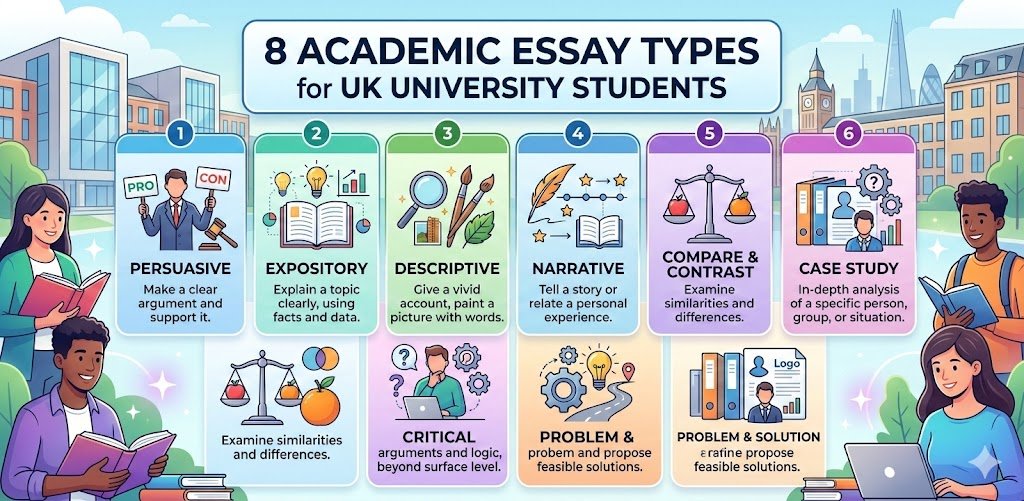
Academic essay types for UK university students include 4 core categories: argumentative, expository, narrative, and descriptive essays.
Furthermore, there are 4 specialised and additional types of essays, including reflective, analytical & evaluative, comparative, and summary essays.
Each essay distinctly tests academic skills from critical reasoning to creative expression.
This guide categorises 8 essay types and standardises identification for UK university students with clear examples and structural guidance, enabling students to identify requirements and apply appropriate writing strategies, such as PEEL paragraphing, linear outlining, and evidence synthesis, confidently.
Core Academic Essay Types
Essay format mastery ensures academic success across 160+ UK higher education institutions, including the University of Oxford, University of Manchester, and UCL. Academic success requires proficiency in 4 primary essay categories: argumentative, expository, narrative, and descriptive writing.
Each format demands specific writing approaches, structural conventions, and analytical techniques. Recognising which essay type your assignment requires enables effective planning, appropriate evidence selection, and proper structural organisation, ensuring distinction-level submissions.
Argumentative Essays: Building Evidence-Based Cases
An argumentative essay is an essay that presents a debatable position supported by research evidence, persuading readers to accept a specific viewpoint.
Argumentative essays require forming positions through research, evaluating evidence systematically, and constructing logical arguments persuading readers toward specific viewpoints.
This essay type dominates undergraduate and postgraduate curricula across disciplines. Writers establish thesis statements and anchor claims in peer-reviewed research through scholarly evidence, including statistical data and expert testimony.
Effective argumentative essays acknowledge counterarguments before refuting them through stronger evidence. The structure typically follows: introduction, establishing thesis, body paragraphs presenting supporting evidence with analysis, addressing opposing views, and conclusion, reinforcing argument strength.
Example
Typical argumentative prompts (essay questions) require taking positions on debatable issues. This is what argumentative essay questions look like:
- Has social media positively or negatively impacted mental health among UK teenagers?
- Should universities adopt pass-fail grading systems instead of traditional classifications?
- Does increased funding for public transport reduce urban congestion more effectively than road expansion?
Strong argumentative writing demonstrates critical thinking through evidence evaluation rather than mere opinion assertion. Students strengthen arguments by analysing source credibility, identifying logical fallacies, and connecting evidence directly to thesis claims.
Review our structural planning guide if you require comprehensive instructions for planning and structuring your essays.
Expository Essays: Explaining Concepts Clearly
Expository essays function as informative documents that explain topics, processes, or concepts through objective factual presentation without requiring original arguments or personal opinions.
These essays test subject knowledge and communication clarity. Unlike argumentative writing, expository essays inform rather than persuade, presenting balanced topic overviews through factual explanation. Common across sciences, social sciences, and humanities, they require demonstrating a comprehensive understanding through systematic information organisation.
Typical structures include: introduction, establishing topic scope, body paragraphs explaining key concepts sequentially, and conclusion summarising information presented.
Common Examples:
Standard expository prompts ask students to explain processes or concepts, such as:
- Explain how the printing press transformed European society in the 15th century
- Describe the process of photosynthesis in plant cells
- Outline the key stages of the UK legislative process
Effective expository writing employs clear definitions, relevant examples, and logical progression from simple to complex concepts. Academic writers eliminate bias and maintain an objective tone to ensure credibility and ensure smooth transitions between ideas, enabling the reader’s comprehension without requiring prior knowledge.
Narrative Essays: Telling Meaningful Stories
Narrative essays tell stories. Often personal experiences. It demonstrates creative writing skills whilst conveying meaningful insights or lessons learned.
These essays allow greater creative freedom than other academic formats. Students recount experiences using descriptive language, dialogue, and chronological or thematic organisation, creating engaging narratives. Whilst common in creative writing modules, including Fiction Workshops, Scriptwriting, and Creative Non–Fiction. Narrative essays also appear in reflective practice requirements across nursing, education, and social work programmes.
Effective narrative essays balance storytelling with purpose. Rather than merely recounting events, strong narratives reveal significance through reflection, showing what experiences taught or how they shaped perspectives.
Common Examples:
Narrative prompts (essay questions) invite personal storytelling with reflective insights. This is what narrative essay questions look like:
- Write about an experience where you learned something important about yourself
- Describe a challenging situation that demonstrated your resilience
- Recount a moment that changed your perspective on education
Students strengthen narratives through vivid descriptions, authentic voice, and clear connections between events and insights gained.
The structure of a narrative essay includes:
- Engaging opening
- Establishing context
- Detailed middle recounting events with sensory details
- Reflective conclusion explaining the experience’s significance.
Descriptive Essays: Creating Detailed Portraits
Descriptive essays create vivid sensory portraits of people, places, objects, or experiences through carefully chosen language, evoking the reader’s imagination.
These essays test creative language use and observational skills. Students employ figurative language, including metaphors, similes, and sensory imagery, creating memorable descriptions. Unlike narrative essays telling stories, descriptive essays focus on capturing single subjects in rich detail.
Descriptive writing engages 5 sensory modalities, including visual (sight), auditory (sound), olfactory (smell), gustatory (taste), and tactile (touch), to create immersive environments, creating immersive experiences. Its organisation follows 3 patterns:
- Spatial patterns (describing location top-to-bottom or left-to-right)
- Chronological sequences (describing objects through time)
- Order of importance (establishing overall impression before specific details)
Common Examples:
Descriptive prompts focus on sensory detail and vivid characterisation, such as:
- Describe an object that has sentimental value for you
- Characterise a place that holds personal significance in your life
- Depict your childhood home in vivid detail
Effective descriptions avoid clichés, employ specific rather than generic language, and create coherent impressions through careful detail selection. Students are advised to focus on showing rather than telling, using concrete imagery, allowing readers to experience subjects themselves.
Specialised Academic Essay Types
Reflective Essays: Analysing Personal Learning
A reflective essay examines personal experiences using structured analysis frameworks to identify learning outcomes and inform future practice.
Reflective essays are common in professional programmes, including nursing, education, and social work. Reflective writing connects theory with practice. Students describe experiences, analyse what happened using theoretical frameworks, evaluate outcomes considering alternative approaches, and identify future development areas.
Scholars utilise 6 reflective frameworks to analyse professional experiences.
- Gibbs’ Reflective Cycle (description to action plan)
- Kolb’s Experiential Learning Cycle (experience to experimentation)
- Driscoll’s “What?” Model (simple three-step approach)
- Schön’s Reflective Practice (reflection-in/on-action)
- Rolfe et al.’s Framework (2001)
- The Big 6 Model
The most frequently used reflective model is Gibbs’ Reflective Cycle. The structure of an essay in which Gibbs’ Reflective Cycle is used is:
- Description (what happened?)
- Feelings (what were you thinking?)
- Evaluation (what was good/bad?)
- Analysis (what sense can you make?)
- Conclusion (what else could you have done?)
- Action plan (what will you do differently?)
Common Examples:
Reflective prompts connect professional experience with learning analysis. For example:
- Reflect on your experience during clinical placement and identify areas for professional development
- Analyse a teaching session you delivered, evaluating its effectiveness and planning improvements
- Examine a challenging patient interaction, considering how theoretical knowledge informed your response
Reflective essays balance description with analysis. Students are advised to avoid merely recounting events without deeper examination, instead demonstrating critical thinking about practice improvement and professional development.
Analytical and Evaluative Essays: Breaking Down and Judging
An analytical essay breaks down a subject into constituent parts, examining relationships between components to interpret the overall meaning.
Analytical essays dominate 3 academic disciplines, including English Literature, Film Studies, and Modern Humanities. Students dissect texts, artworks, or theories, identifying significant features, examining how they function individually and collectively, and interpreting overall significance.
Effective analytical essays move beyond summary into interpretation. Rather than explaining what happens in Hamlet, students analyse how Shakespeare uses soliloquies to reveal character psychology or how staging choices affect audience interpretation.
Common Analytical Examples:
Analytical prompts require examining parts and their relationships, like the following:
- Analyse the use of symbolism in George Orwell’s 1984
- Examine how economic factors contributed to the 2008 financial crisis
- Break down the components of effective leadership using contemporary case studies
On the other hand, an evaluative essay is an essay that makes informed judgments about a subject’s quality, effectiveness, or value using explicit criteria and supporting evidence.
Evaluative Essays require establishing explicit assessment criteria, applying them systematically, and supporting judgments with evidence. Common in business, education, and policy studies, they assess programme effectiveness, policy impacts, or intervention success.
Common Evaluative Examples:
Evaluative prompts demand judgments based on explicit assessment criteria that we have listed below for you:
- Evaluate the effectiveness of UK diabetes prevention programmes
- Assess the impact of remote learning on student engagement during the pandemic
- Judge the success of renewable energy policies in reducing carbon emissions
Strong analytical and evaluative writing distinguishes between objective criteria and subjective judgements, prioritises evidence over opinion, and acknowledges limitations in available evidence.
For strategies managing multiple essay deadlines and assessment types, explore our guide on time management for assignments.
Additional Essay Formats in UK Education
Comparative Essays: Examining Similarities and Differences
Comparative essays analyse two or more subjects, identifying similarities and differences, evaluating the significance of comparisons, and drawing conclusions about relationships between subjects.
These essays test critical thinking by requiring students to establish meaningful comparison criteria, organise complex information coherently, and synthesise insights from multiple sources.
Common Examples:
Comparative prompts require identifying similarities and differences between subjects:
- Compare and contrast Keynesian and Classical economic theories
- Examine the similarities and differences between Victorian and Modernist literary movements
- Contrast the UK and US higher education systems
Two organisational approaches exist: block structure (discussing Subject A completely before Subject B) and point-by-point structure (alternating between subjects for each comparison point). Point-by-point typically produces more integrated analysis.
Summary Essays: Condensing Key Information
A summary essay condenses key information from longer texts or multiple sources into a concise account without personal interpretation.
Summary essays condense primary information from longer texts into concise, objective accounts without personal interpretation.
Common Examples:
These examples show how a summary essays ask students to condense information from multiple sources:
- Summarise the main arguments presented in the week’s reading materials
- Provide a brief overview of current research on climate change mitigation
- Condense the key findings from three journal articles on memory formation
Choosing the Right Approach
Essay type identification begins with careful prompt analysis, noting action words signalling the required approach.
Key action words include:
- Analyse: Break down components, examining relationships
- Argue: Present evidence-based position on a debatable issue
- Compare/Contrast: Identify similarities and differences
- Describe: Provide a detailed sensory account
- Evaluate: Make a judgment using explicit criteria
- Explain: Clarify how or why something occurs
- Reflect: Examine experience, considering learning outcomes
- Summarise: Condense key points from multiple sources
Approximately 75% of advanced undergraduate essays require combining 2 or more rhetorical approaches. An evaluative essay includes comparative analysis and expository explanation. High-achieving students execute shifts between essay types to meet complex assignment rubrics, using each approach purposefully, supporting overall assignment goals.
Common Pitfalls to Avoid
First-year students exhibit 3 common struggles when matching writing styles to specific essay type requirements.
Descriptive writing appears where analysis proves necessary. Students summarise texts rather than analysing literary techniques. Argumentative essays present opinions without substantial evidence. Reflective essays describe events without deeper examination.
Strengthening essay writing requires:
- Analyse assignment prompts multiple times to identify the required rhetorical mode.
- Review specific marking criteria to align content with assessment expectations.
- Planning a structure appropriate to the essay type before writing
- Implement topic sentences that signal paragraph transitions.
- Balancing description, analysis, and evaluation appropriately
- Proofreading, ensuring a consistent approach throughout
Conclusion
Each essay type develops distinct competencies:
- Argumentative essays build critical reasoning.
- Expository writing clarifies complex information.
- Narrative essays develop voice.
- Descriptive writing strengthens observation.
- Reflective essays deepen learning.
- Analytical essays reveal interpretation skills.
Understanding which approach specific assignments require recognising how to structure responses appropriately, and developing proficiency across formats, ensures academic success regardless of discipline or level.
FQ Assignment Help provides academic specialists if essay requirements or time constraints create challenges. We connect you with academic specialists understanding UK university essay expectations across all types and disciplines.
Consult our academic specialists if you require professional essay writing guidance. Our PhD writers ensure structural precision and analytical depth in every academic submission.