
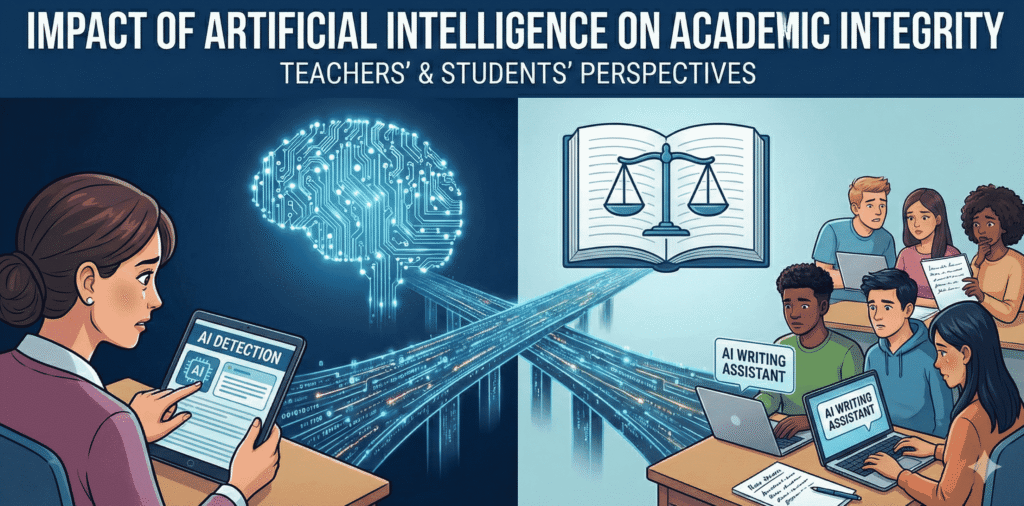
The impact of artificial intelligence on academic integrity has created an unprecedented tension between technological innovation and traditional academic values.
AI tools now enable both sophisticated academic dishonesty through automated content generation and advanced detection mechanisms to combat it. Fundamentally, it is reshaping how educators and students approach learning. Assessment. Intellectual honesty.
In this Guide, You’ll Learn:
- How AI tools blur ethical boundaries in academic work
- Why detection methods struggle against generative AI
- What teachers and students actually think about AI usage
- Where institutions are updating policies and pedagogy
- How to maintain integrity whilst navigating AI’s role in education
The AI Revolution in Academic Settings
Artificial intelligence represents the simulation of human cognitive processes by computer systems, particularly learning, reasoning, and self-correction capabilities.
In educational contexts, AI has evolved from simple spell-checkers to sophisticated language models. Capable of producing entire research papers. Solving complex mathematical problems. Generating code indistinguishable from human work.
This technological leap hasn’t emerged gradually.
It exploded onto campuses almost overnight when tools like ChatGPT, Perplexity AI, Jasper AI, and more became publicly accessible in late 2022.
The transformation happened faster than policy could respond.
Universities suddenly faced students submitting AI-generated essays. Lecturers couldn’t definitively prove authorship anymore. Traditional assessment methods, refined over decades, became vulnerable within months. The fundamental assumption underlying academic work, that submitted material represents a student’s own intellectual effort, collapsed under AI’s capability to produce seemingly original content on demand.
This wasn’t just another technological challenge. It struck at the heart of what education means.
The Dark Side: How AI Facilitates Academic Dishonesty
Plagiarism Without Copy-Pasting
Traditional plagiarism meant copying text from existing sources without attribution. Detection was straightforward: run the submission through Turnitin, identify matches, and investigate.
AI-generated plagiarism operates differently.
These tools don’t copy existing text. They generate new text based on patterns learned from vast training datasets.
When a student asks ChatGPT to
“write a 2,000-word essay on Keynesian economics,”
The output appears completely original. No matching sources exist because the text has never been published before. Standard plagiarism detectors find nothing suspicious.
Yet the intellectual dishonesty remains identical.
The student hasn’t engaged with the material, hasn’t developed their understanding, and hasn’t demonstrated learning. They’ve outsourced cognitive work to a machine whilst claiming authorship. The technological sophistication doesn’t change the ethical violation. It just makes detection exponentially harder.
The Spectrum of AI-Assisted Misconduct
Academic dishonesty involving AI isn’t binary. Students and educators navigate a complicated spectrum where ethical boundaries blur:
Low-risk usage:
Checking grammar, rephrasing awkward sentences, and generating topic ideas for brainstorming. Most students view these applications as legitimate assistance, similar to using a thesaurus or discussing ideas with classmates.
Moderate grey area:
Getting AI to explain complex concepts, summarise lengthy research papers, or provide outline structures. Some students consider this acceptable learning support. Others see it as avoiding the intellectual work of comprehension.
Clear violations:
Submitting AI-written essays, using AI to complete problem sets, and generating entire sections of dissertations. Even students who regularly use AI for lighter tasks generally recognise these actions as cheating.
The problem? Institutional policies haven’t clearly defined these boundaries yet.
Different modules have different expectations. One lecturer explicitly permits AI for research, whilst another forbids any AI usage whatsoever. Students navigate inconsistent rules across their degree programme, creating confusion about what constitutes acceptable behaviour. This ambiguity doesn’t excuse misconduct, but it explains why violation rates have surged. Many students genuinely don’t know where the line sits.
Over-Reliance: The Hidden Cost
Beyond outright cheating lies a subtler danger: dependency that erodes learning itself.
Students increasingly use AI as a first resource rather than a supplementary tool.
Struggling with an econometrics concept? Ask AI to explain it instead of wrestling with the textbook. Can’t structure your argument? Let AI generate an outline rather than developing organisational skills through practice.
Each shortcut sacrifices skill development.
Critical thinking emerges through challenge, through getting stuck and working through problems independently. When AI provides immediate answers, it eliminates the productive struggle that builds intellectual capability. Students might complete assignments successfully but leave university without developing the analytical reasoning, problem-solving abilities, and intellectual resilience that education should cultivate.
This phenomenon mirrors calculator dependency in mathematics. Calculators are valuable tools when used appropriately, but students who never learn mental arithmetic or understand underlying mathematical principles struggle when technology isn’t available or when they need to verify whether automated outputs make sense.
AI dependency creates graduates who can produce work when AI is accessible, but can’t think independently when it’s not. That’s catastrophic for their long-term career prospects and intellectual development.
Detection Challenges: The AI Arms Race
Why Traditional Methods Fail
Plagiarism detection systems like Turnitin operate by comparing submitted text against massive databases of published work, previously submitted student assignments, and web content. They identify matching strings of words and calculate similarity percentages.
AI-generated content matches nothing because it’s genuinely novel text.
The language models don’t retrieve stored passages. They predict word sequences probabilistically based on training patterns. Each generation produces unique combinations of words and sentence structures that have never appeared together before.
Traditional text-matching algorithms find no matches because no matches exist.
Some detection tools have attempted to identify AI-generated content through statistical analysis of writing patterns:
- Measuring vocabulary diversity
- Sentence length variation
- Comparing text against known AI output characteristics
Early versions of these tools showed promising results in controlled testing environments.
Then they failed spectacularly in real-world application.
False positive rates remained unacceptably high, flagging human-written work as AI-generated. False negatives occurred regularly as students learned to “humanise” AI output through minor editing. The tools couldn’t reliably distinguish between a strong student writer using clear, direct language and AI-generated prose mimicking that style.
The Turning Point: Turnitin’s AI Detection Launch
Turnitin is the world’s leading academic integrity platform, used by thousands of universities globally to detect plagiarism and maintain submission authenticity.
On 4 April 2023, everything changed!
Turnitin launched its AI writing detection feature. The first major institutional response to the ChatGPT crisis had paralysed universities for months. This wasn’t just another software update. It was academia’s declaration of war against AI-generated submissions.
Universities worldwide held their breath. Would this finally solve the problem?
The tool analysed writing patterns, identified AI fingerprints, and generated confidence scores indicating whether submissions were machine-generated. Institutions rushed to integrate it. Lecturers finally had something concrete to point to when suspicious submissions arrived. Students knew they were being watched.
But relief proved premature.
Within weeks, students discovered workarounds. Minor editing fooled the detector. Paraphrasing tools masked AI origins. The detection accuracy debates began. How reliable were these scores really? Could a 40% AI detection indicator justify academic misconduct charges? What about false positives flagging innocent students?
Other platforms quickly followed, GPTZero, Originality.AI, Copyleaks, each promising superior detection. The arms race had officially begun. Every detection improvement triggered generation improvements. Technology couldn’t solve what was fundamentally a trust and values problem.
The AI Detection Dilemma
Universities now face an uncomfortable reality: the most effective tools for detecting AI-generated academic work are… other AI systems.
Companies have developed AI-powered detection tools trained specifically to identify content created by language models. These analysers look for subtle statistical fingerprints, consistency patterns, and linguistic markers that characterise machine-generated text versus human writing.
This creates an escalating technological arms race.
Detection AI improves. Generation AI adapts to evade detection. Detection methods evolve again. Students learn new techniques to mask AI involvement. The cycle continues indefinitely, with neither side achieving a decisive advantage.
Institutions cannot win this battle through technology alone. Even if detection accuracy reached 99%, the remaining 1% creates massive problems when applied across thousands of submissions.
Falsely accusing a student of AI usage without definitive proof risks legal challenges and damages trust. Failing to catch actual violations undermines academic standards.
The fundamental issue isn’t technological. It’s philosophical.
Education cannot function long-term on an enforcement model where every submission requires forensic investigation. The adversarial relationship this creates between students and educators corrodes the collaborative learning environment that universities should foster.
Teachers’ Perspectives: Frustration and Adaptation
The Assessment Crisis
Lecturers have watched their carefully designed assessment methods become obsolete within months.
Take-home essays, once the gold standard for evaluating analytical thinking and written communication, now feel impossible to assess fairly. Did the student write this? Did AI write it with minor student editing? Did the student write it with minor AI assistance? Without direct observation, definitive answers don’t exist.
Long-form written assessments have become tests of undetectability rather than understanding.
Some academics express profound frustration. They entered education to cultivate intellectual growth and critical thinking. Instead, they’ve become detectives, scrutinising:
- Submissions for stylistic inconsistencies
- Interrogating students about their writing processes
- Second-guessing whether work represents genuine learning
Others feel their expertise is being devalued. Years of subject mastery and pedagogical skill matter less when students can generate competent-looking work without attending lectures or engaging with course materials.
The teaching relationship, built on trust, intellectual challenge, and guided development, feels undermined when technology provides shortcuts around the learning process that educators carefully designed.
Pedagogical Innovation Under Pressure
The AI challenge has forced rapid pedagogical evolution. Educators are fundamentally rethinking how they assess learning and design coursework that AI cannot easily complete.
In-person assessments have resurged dramatically.
Closed-book examinations, oral presentations, practical demonstrations, and supervised writing sessions guarantee work authenticity. Students cannot consult AI during a face-to-face viva to examine their dissertation methodology. They cannot use language models whilst defending their research conclusions before an assessment panel.
This shift isn’t merely defensive. It often improves educational quality.
Oral examinations reveal whether students genuinely understand material or have just memorised (or AI-generated) responses. In-class writing demonstrates actual composition skills rather than edited AI output. Practical assessments measure real-world capability, not theoretical knowledge that AI can fake convincingly.
Process-focused assessment is replacing product-focused evaluation.
Rather than judging only final submissions, lecturers increasingly assess intermediate stages: research proposals, annotated bibliographies, draft outlines, and reflection journals documenting thought development.
This approach makes AI assistance more transparent. Students must demonstrate their intellectual journey, not just produce a polished final product that could have originated anywhere.
Some educators embrace AI integration thoughtfully. They explicitly teach students how to use AI tools appropriately: generating initial brainstorming ideas, explaining unfamiliar concepts, and identifying relevant research directions. Then they design assessments requiring students to critique AI outputs, identify limitations, or build upon AI-generated starting points with original analysis.
This treats AI as a tool requiring skilled use, not a shortcut eliminating learning.
Students’ Perspectives: Temptation and Confusion
Why Students Turn to AI
Understanding student AI usage requires acknowledging the intense pressures driving these decisions.
Time scarcity sits at the centre.
Modern students juggle coursework across multiple modules, part-time employment to fund their education, caring responsibilities, mental health challenges, and social pressures. When three essay deadlines collide with a work shift and a personal crisis, AI offers apparent salvation. A way to submit something adequate when producing quality work feels impossible, given time constraints.
Academic pressure compounds this desperation. Scholarships depend on maintaining specific grade averages. Career prospects require competitive classifications. Fear of failure, parental expectations, and financial investments in education create enormous stakes. AI provides a risk-mitigation strategy when students feel overwhelmed by these consequences.
Then there’s the normalisation factor.
When classmates openly discuss using AI, when online forums share prompts for generating assignments, and when detection seems unlikely, ethical boundaries erode. Students witness peers apparently using AI without consequences and question why they should disadvantage themselves by refusing similar tools.
The collective behaviour shifts toward acceptance, even among students who initially felt uncomfortable with AI assistance.
The Ethical Confusion
Many students genuinely struggle to distinguish acceptable AI use from academic misconduct.
- Is using AI to check grammar different from using Grammarly?
- If spell-check is permitted, why not AI-suggested sentence improvements?
- Where’s the line between getting AI to explain a concept and getting AI to write the explanation you’ll submit?
These questions lack clear, consistent answers across different contexts.
Students also perceive hypocrisy in institutional responses.
Universities promote AI literacy and technological fluency as career-essential skills. They encourage students to engage with cutting-edge tools and develop digital competence. Then they prohibit using these same tools for academic work. The mixed messaging creates cognitive dissonance. Students are told simultaneously to embrace AI and avoid it.
Some students rationalise AI usage by comparing it to other accepted forms of assistance. Working with tutors who suggest improvements, receiving feedback from peers, and consulting writing centre advisors.
All involve external input to improve submitted work. If those supports are legitimate, students ask, why is AI assistance categorically different?
The distinction lies in intellectual labour and the learning process, but these nuances get lost in blanket prohibitions.
Student Voices: Mixed Attitudes
Research into student perspectives reveals diverse viewpoints rather than universal endorsement or rejection of AI use.
Pragmatists view AI as an inevitable tool they’d be foolish to ignore. They believe learning to use AI effectively represents practical skill development for careers where AI will be ubiquitous. They question whether traditional academic integrity standards, developed in pre-AI eras, remain relevant in contemporary contexts.
Traditionalists express concern that widespread AI usage devalues their own honest efforts. They worry that grades become meaningless when some students use AI whilst others don’t, creating unfair comparisons. They want clearer enforcement protecting students who choose not to use AI from a competitive disadvantage.
Confused moderates. Likely the largest group. Want explicit guidance. They’re willing to follow rules but need clarity on what those rules actually are. They don’t want to accidentally violate policies through ignorance, but they also don’t want to handicap themselves unnecessarily if AI use is actually acceptable.
What’s largely absent? Students advocating for unlimited, unchecked AI usage without any boundaries.
Even heavy AI users typically acknowledge that some activities clearly constitute cheating. The debates centre on where boundaries sit, not whether boundaries should exist at all.
Institutional Responses: Policy and Practice
Updating Academic Integrity Policies
Universities are scrambling to revise academic integrity frameworks written before AI’s current capabilities existed.
Effective policies are moving toward specificity rather than blanket prohibitions.
Instead of “AI use is forbidden,” updated policies delineate acceptable versus unacceptable applications:
“Students may use AI tools to generate research topic ideas and check grammar. Students may not submit AI-generated text as their own work or use AI to complete problem sets without explicit instructor permission.”
This specificity helps but creates complexity. Policies must be detailed enough to provide genuine guidance whilst remaining flexible enough to accommodate different disciplines and pedagogical approaches.
Engineering coursework might appropriately include AI-assisted coding, whilst literature essays require entirely human-written analysis. One-size-fits-all rules fail to respect these disciplinary differences.
Some institutions are implementing declaration requirements. Students must disclose any AI usage in their submission, explaining what tools they used and how. This transparency doesn’t necessarily prohibit AI assistance but ensures honesty about its role. Educators can then assess whether that usage was appropriate and whether the student demonstrated sufficient understanding independently.
Enforcement mechanisms remain problematic.
Universities lack reliable technological detection. Investigating suspected violations consumes enormous academic and administrative resources. Proving AI usage conclusively is difficult without student admission. These practical challenges mean many violations likely go unaddressed, undermining policy effectiveness regardless of how well-written the rules might be.
Shifting Assessment Design
Beyond policy changes, institutions are fundamentally reconsidering what and how they assess.
Competency-based assessment is gaining prominence.
Rather than measuring knowledge recall or the ability to produce written documents. Skills AI can now replicate.
Assessments increasingly target capabilities AI cannot demonstrate:
- Applying knowledge in novel contexts
- Exercising professional judgement in ambiguous situations
- Demonstrating interpersonal communication
- Solving ill-defined problems, requiring creative human thinking
This shift demands significant pedagogical innovation. Designing meaningful competency assessments requires more time and expertise than traditional essays or exams. Grading becomes more subjective and labour-intensive. But the trade-off is assessments that AI cannot easily complete and that better measure genuine student capability.
Authentic assessment frameworks are expanding.
These approaches connect academic work to real-world applications, making AI shortcuts less viable. Students might analyse actual case studies, propose solutions to genuine organisational problems, or create portfolios demonstrating progressive skill development. The complexity and context-specificity of authentic tasks resist simple AI automation.
Some disciplines are embracing “bring your own AI” assessment models.
Students are explicitly permitted. Even encouraged to use AI tools during assessments, but tasks are designed such that AI assistance alone proves insufficient. Students must critically evaluate AI outputs, identify errors or limitations, synthesise multiple AI-generated responses, or apply AI-provided information to contexts requiring human judgement.
This treats AI as a tool students must learn to use effectively rather than a threat to be eliminated.
The Positive Potential: AI Supporting Academic Integrity
Detection and Prevention Tools
Whilst AI enables academic dishonesty, it also provides powerful tools for maintaining integrity.
AI-powered plagiarism detection systems now analyse writing patterns, identify stylistic inconsistencies suggesting multiple authors, and flag unusual submission characteristics warranting investigation. These tools don’t definitively prove misconduct but help educators identify submissions requiring closer examination.
Pattern recognition algorithms detect suspicious behavioural trends.
When a student’s writing quality suddenly jumps dramatically, when submission timestamps suggest impossibly rapid composition, when references cited don’t actually support claims made, AI systems can flag these anomalies for human review.
Some institutions implement AI proctoring for online assessments, using computer vision and pattern recognition to monitor test-taking behaviour remotely. Whilst these systems raise legitimate privacy concerns requiring careful implementation, they do enable secure remote assessment that wouldn’t otherwise be feasible.
Educational Enhancement
When used appropriately, AI serves as a powerful educational aid supporting rather than replacing learning.
Research assistance has improved dramatically.
AI tools help students navigate vast academic literature, identifying relevant sources and summarising key findings efficiently. This capability doesn’t eliminate the need for critical evaluation and synthesis. Students must still assess source quality and integrate information meaningfully.
But it reduces the mechanical work of initial literature searching.
Concept explanation and tutoring represent valuable AI applications. Students struggling with complex topics can query AI systems for alternative explanations, worked examples, or clarifying questions. This supplementary support proves especially valuable for students lacking easy access to human tutors or those working outside traditional office hours.
Personalised feedback becomes more accessible.
AI writing assistants can provide immediate formative feedback on draft work, identifying unclear passages, suggesting structural improvements, or noting missing logical connections. This instant feedback loop helps students improve before submitting final work, supporting the learning process rather than short-circuiting it.
Language support for international students offers another positive application. Non-native English speakers can use AI to check idiomatic expressions, verify grammar, and clarify meaning without the embarrassment or inconvenience of repeatedly asking native speakers for help. This assistance reduces linguistic barriers without doing the intellectual work for students.
The key distinction? AI supporting human effort versus AI replacing human effort.
When students use AI to understand concepts more deeply. To improve their own writing through feedback, or to work more efficiently while maintaining intellectual engagement.
AI enhances education!
When they use AI to avoid thinking, to fake understanding they haven’t developed, or to submit work representing no personal intellectual contribution, AI undermines educational purpose.
Finding Balance: Maintaining Integrity in the AI Era
Clear Communication and Education
Students cannot comply with expectations they don’t understand.
Universities must prioritise explicit, accessible communication about AI policies.
Every module should clearly state AI usage rules. Handbooks should include concrete examples of acceptable versus prohibited applications. Orientation sessions should discuss AI ethics and institutional expectations directly. This clarity eliminates the “I didn’t know” excuse while genuinely helping students navigate grey areas.
AI literacy education should become standard. Students need to understand how AI tools work, their limitations, their appropriate applications, and their potential harms. This knowledge helps students make informed ethical decisions rather than just following rules they don’t understand.
Faculty development proves equally essential. Many educators lack confidence in their own AI understanding. They need training on effective AI integration, on identifying potential misuse, on discussing AI ethics with students, and on designing AI-resistant assessments. Institutions investing in faculty development see more consistent, thoughtful AI policies across departments.
Fostering Intrinsic Motivation
Long-term integrity requires students to value learning itself, not just grades.
This cultural shift demands systemic changes beyond policy enforcement. When assessment systems prioritise ranking students against each other rather than measuring genuine understanding, they incentivise cheating as a competitive strategy. When degree classifications determine entire career trajectories, they create enormous pressure for grade inflation through any available means.
Institutions cultivating growth mindset cultures. Where effort and learning matter more than perfect performance, where mistakes become learning opportunities rather than failures. See reduced academic dishonesty. Students who feel supported rather than judged develop less need for shortcuts.
Meaningful engagement requires relevant, interesting coursework. When students see clear connections between academic work and their future goals, when assignments feel genuinely worth completing, intrinsic motivation increases. Generic, disconnected busywork invites shortcuts because students perceive no real value in honest completion.
Relationship-based pedagogy matters enormously.
Students are less likely to cheat when they respect their instructors, when they feel known as individuals rather than anonymous submissions in a marking queue, and when they believe their intellectual development genuinely matters to someone.
Small-group teaching, personalised feedback, and accessible faculty office hours all strengthen these protective relationships.
Accepting Technological Reality
Education cannot return to pre-AI conditions. AI tools exist, will continue improving, and will shape students’ professional futures.
Fighting this reality wastes energy better spent on adaptation.
The question isn’t whether students will use AI, but how they’ll use it.
Forward-thinking institutions explicitly teach responsible AI usage as a core skill. They help students develop critical thinking about algorithmic outputs, skepticism toward AI-generated content, and judgment about when AI assistance proves helpful versus harmful.
Some educators advocate for transparent AI integration where students and teachers collaboratively explore AI’s educational potential. This approach normalises AI as a learning tool whilst maintaining clear boundaries around academic integrity.
When students feel they can openly discuss AI usage without fear of punishment, educators gain insight into actual behaviour rather than forcing dishonesty underground.
Assessment must evolve to measure capabilities AI cannot replicate.
Human creativity, ethical reasoning, emotional intelligence, complex communication, and adaptive problem-solving remain distinctly human strengths. Focusing evaluation on these areas makes education more meaningful whilst naturally reducing AI’s potential to undermine integrity.
Conclusion
The impact of artificial intelligence on academic integrity reveals a fundamental truth: technology exposes existing tensions rather than creating new problems.
Academic dishonesty existed before AI. Students sought shortcuts, faced overwhelming pressure, and struggled with ethical boundaries. AI hasn’t invented these challenges. It has made them more visible and complex to address.
What matters most isn’t technology itself but the values and systems surrounding it.
In this context, responsible academic support such as online assignment help service in London, UK emphasize guidance, originality, and ethical learning—can play a constructive role in supporting students without undermining academic standards.
Students and teachers share responsibility, but institutions must lead.
When deadlines collide, when part-time work clashes with coursework, when you’re genuinely stuck. You need support that doesn’t compromise integrity.
That’s exactly why FQ Assignment Help exists.
At FQ Assignment Help, we offer honest help for your academic assignments from qualified writers with real subject expertise. We don’t promise magical shortcuts or churn out AI-generated essays. We provide original work, accurate referencing, and breathing space whilst maintaining your university’s standards.
You’re not outsourcing education. You’re accessing genuine help for your academic assignments that protects your grades whilst building actual capabilities, not just quick fixes.