
Racing your peer and saying, ‘I’ll write my assignment faster than you’?
Or struggling to balance your part-time job, personal life, and academic work altogether?
Whatever the situation is, it usually ends with you taking a quick look at your assignment brief and jumping straight into writing without a proper time plan.
The result? Poor time management.
It’s one of the common mistakes that 95% of students make when writing their university assignments.
It leads to last-minute submissions, rushed writing, weak arguments, overlooked errors, and ultimately, a drastic drop in your academic progress.
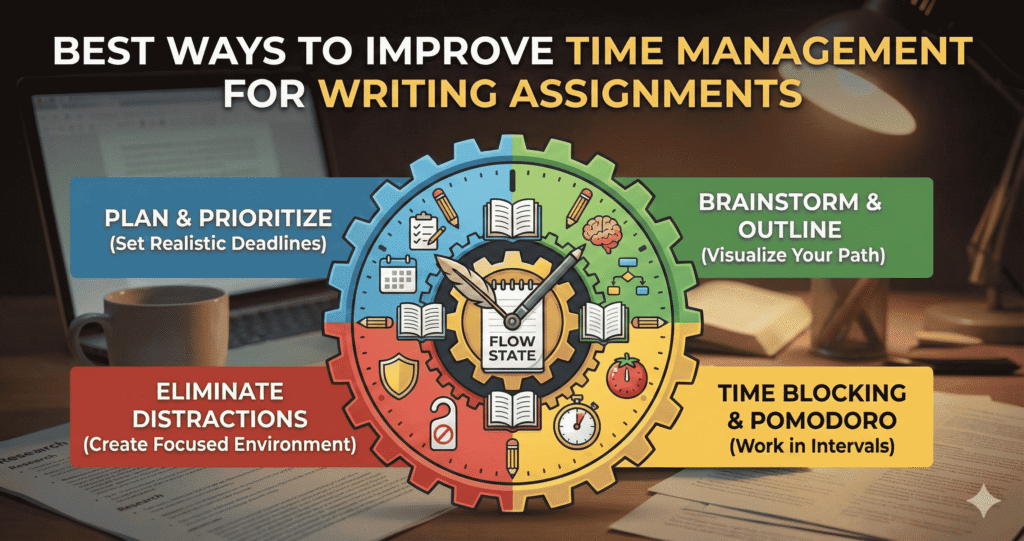
Since supporting you throughout your academic journey is our core mission, we’ve brought you the best ways to improve time management for writing assignments.
Why Time Management Matters in Academic Writing
Time management matters a lot in academic writing. Otherwise, poor time management quietly kills the quality of your work. Arguments become shallow. Research gets skipped. Citations are rushed or forgotten.
And the writing? It looks panicked, because it really was.
These small slips stack up fast and drag your grade down, not because you’re incapable, but because you didn’t give your brain enough time to think, structure, and refine.
But here’s the upside.
Good time management gives you breathing room. Suddenly, tasks feel manageable, your ideas flow better, and you write with clarity instead of chaos.
You feel less stressed, more productive, and more in control of your academic pace, and that confidence shows in every paragraph you write in your assignment.
10 Best Ways to Improve Time Management for Writing Assignments
1. Say No to Procrastination
Procrastination is the biggest time drain in academic writing. Students don’t delay because they’re lazy. They delay because the task feels intimidating. Sometimes it’s fear of getting it wrong. Sometimes, there is confusion about the assignment brief. And sometimes it’s perfectionism whispering, “Don’t start until you’re fully ready.”
The problem? That moment of “readiness” never arrives.
When you push the start line further and further away, the consequences hit hard.
You rush through research. You write without structure. You miss key citations or forget to reference completely.
And the final result? A weaker assignment that doesn’t reflect your actual ability.
Procrastination doesn’t only waste time. It steals the opportunity to think clearly, draft properly, and refine your writing with confidence.
So here’s the fix, and it works really well:
- Break the entire assignment into micro-steps.
Instead of “Write the essay,” create steps like:
- Read the brief
- Find three sources
- Create a quick plan
- Draft the introduction
- Write one body paragraph
Micro-steps remove the mental pressure because each task feels small and manageable. You don’t need motivation. You just need movement, even tiny movement.
And once you start, momentum does the rest.
2. Understand Your Assignment Before Starting
One of the best ways to improve time management for writing assignments is to fully understand what the assignment brief is asking you to do. Students lose more time rewriting than writing. Not because they’re slow, but because they misunderstood the instructions from the beginning. An improper reading of the brief leads to confusion, wasted research, and paragraphs that don’t match the marking criteria.
Before writing a single sentence, slow down and read your brief properly. Identify the key directive verbs, the words that tell you what your lecturer actually wants.
| Directive Verb | What It Means |
| Analyse | Break into parts and explain how they connect |
| Compare | Show similarities and differences |
| Evaluate | Judge strengths and weaknesses |
| Discuss | Present different views before concluding |
Check out our detailed guide on writing an assignment for university and get a deeper breakdown of understanding the assignment brief, including planning steps, learning outcomes, assessment criteria, and more.
Clarity at the start saves hours later. You avoid rewriting entire sections. Your research becomes sharper. And your writing stays aligned with the actual question. Not what you assumed it meant.
3. Create a Realistic Assignment Timeline
A solid timeline stops your assignment from turning into a last-minute crisis. Instead of guessing what to do next, you break the process into clear stages: research > notes > draft > edit > submit.
Simple structure. Massive time savings.
Most students underestimate how long each stage takes, which is why timelines matter. They give you direction, keep your workload balanced, and remove the panic that comes from doing everything in one night.

Here’s how different deadlines can be managed realistically:
The 1 Week Plan
| Day 1 | Read brief & plan |
| Day 2–3 | Research + notes |
| Day 4–5 | Draft |
| Day 6 | Edit |
| Day 7 | Final check & submit |
The 2 Week Plan
| Week 1 | Brief, planning, research |
| Week 2 | Drafting + editing + referencing |
The 1 Month Plan
| Week 1 | Understand task + extensive research |
| Week 2 | Detailed notes & planning |
| Week 3 | Full draft |
| Week 4 | Edit, refine, proofread, submit |
Working in small, consistent sessions is the secret weapon. This way, you avoid burnout. You stay mentally fresh. And you produce higher-quality writing because you’re not rushing through every stage.
A realistic timeline doesn’t just save time, it saves your marks.
4. Use the Pomodoro Technique or Focus Work Blocks
When your assignment feels too big to start, the Pomodoro Technique cuts it into manageable pieces. Pomodoro is a time management technique where you work for 25 minutes, take a 5-minute break, and repeat.

It sounds almost too simple. But this structure trains your brain to stay focused without burning out.
It’s especially powerful for long essays, research papers, and heavy reading sessions where concentration usually fades fast.
Why it works:
- Short bursts prevent mental overload
- Breaks reset your focus
- You make steady progress without feeling exhausted
- Distractions lose their grip because the timer keeps you accountable
You should also take digital help, apps like Focus To-Do, Forest, and Pomodoro Timer make the process easier by tracking sessions and blocking distractions.
Here’s an example Pomodoro workflow for a study session:
| Pomodoro Round | Task |
| 1 | Read the assignment brief + outline tasks |
| 2–3 | Research and gather sources |
| 4 | Write notes or paraphrase key ideas |
| 5–6 | Draft one section of the assignment |
Remember that:
- After four Pomodoros, take a longer break (15–20 minutes).
- With this method, you’ll write more in two hours than you usually do in an entire afternoon of “trying to start.”
5. Prioritise Tasks Using the Eisenhower Matrix
The Eisenhower Matrix is a decision-making tool that helps you sort tasks by urgency and importance so you stop wasting time on things that don’t matter yet.
Eisenhower Matrix removes guesswork & tells you what to do first, what to do later, & what isn’t worth stressing over.
The matrix splits tasks into four categories:
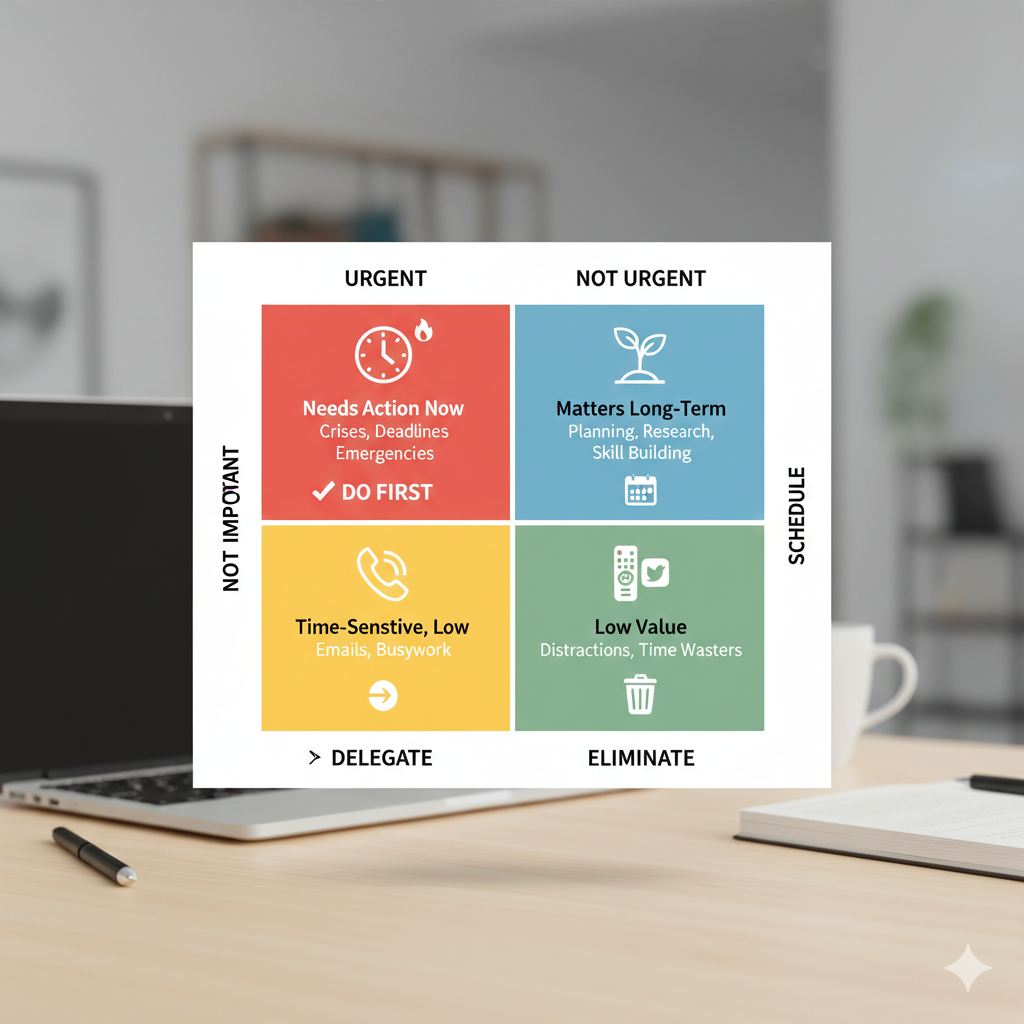
| Category | Meaning | Example |
| Urgent + Important | Needs action now | Approaching the deadline, overdue reading |
| Important, Not Urgent | Matters long-term but not immediate | Research, planning, outlining |
| Urgent, Not Important | Time-sensitive but low impact | Emails, admin tasks |
| Not Urgent + Not Important | Low-value tasks | Extra formatting, over-polishing |
When writing an assignment for university, this matrix becomes a lifesaver.
Research, note-taking, and planning usually sit in the Important, Not Urgent box, meaning they deserve dedicated time before the deadline grows close.
Tasks like formatting or checking spacing belong in Not Urgent because they don’t affect your argument or grade in the early stages.
When you prioritise properly, you stop wasting hours on low-impact work. You move through your assignment in the right order.
- Research first > structure next > drafting after
This right order saves you from bouncing between tasks and losing momentum.
Use the Eisenhower Matrix once, and your workflow becomes sharper, calmer, and far more controlled.
6. Improve Research Efficiency
Students waste hours jumping between random websites, blogs, and unreliable sources. The result? Confused notes, forgotten references, and last-minute panic.
Efficient research starts with trusted platforms. Use Google Scholar, JSTOR, your university library database, Project MUSE, or ScienceDirect.
Stop wandering.
Targeted searching saves time and gives credible material you can actually use.
Next: organise your notes. Tools such as Notion, OneNote, Zotero, Mendeley, or Evernote let you store sources, tag ideas, and track citations.
Example workflow:
- Find 5–7 credible sources
- Summarise key points in a note-taking tool
- Tag each point with the topic and page number
- Keep citations ready to insert
Structured research makes writing far easier. You don’t waste time hunting for quotes or guessing which source said what. Instead, you can move straight from notes > draft > edit without losing momentum.
Do it right, and your assignments write themselves more smoothly. You save hours, reduce stress, and end up with stronger arguments backed by solid evidence. Instead of a frantic scramble at the last minute.
7. Reduce Digital Distractions
Social media, constant notifications, and multitasking are silent killers of focus. A recent study of university students found that 84.5% of respondents spent more than four hours daily on social media, and 39.4% admitted it negatively affected their ability to complete assignments.
One scroll, one ping, and suddenly an hour of writing is gone. Students think they can “do it all,” but the brain doesn’t actually multitask. It just switches rapidly, burning energy and slowing progress.
The solution is simple, but challenging:
- Remove temptation.
- Use website blockers like Cold Turkey or StayFocusd.
- Put your phone on DND (Do Not Disturb) or a notification-off mode.
- Create a dedicated study space where writing is the only task.
Even short, distraction-free sessions work wonders. Without interruptions, your brain stays in flow, sentences form faster, and ideas connect more logically. Tasks that once took hours can be completed in half the time.
A focused session isn’t just about speed. It’s about quality. You write more confidently, make fewer errors, and enjoy the process instead of fighting digital chaos every minute.
8. Start With an Outline to Save Hours
Jumping straight into writing without an outline is one of the common mistakes when writing an assignment for university. Students quickly get lost in paragraphs, repeat ideas, or realise they forgot key points. The result? Weak structure and organisation of your assignment
But all is avoidable with a simple outline. Creating an outline doesn’t have to be complicated.
- Start by dividing your essay or report into Introduction, Body, and Conclusion.
- Under each, list the key points or arguments you want to cover.
- Add notes on evidence, examples, or references you plan to include.
| Section | Key Points | Evidence/Notes |
| Introduction | State topic & thesis | Brief context, definition |
| Body Paragraph 1 | Main argument 1 | Source A, example |
| Body Paragraph 2 | Main argument 2 | Source B, example |
| Conclusion | Summarise & final insight | Link back to thesis |
A clear outline keeps writing on track, saves time during drafting, and reduces last-minute stress. For a detailed approach to planning and structuring essays, our guide on how to structure and plan your essay provides step-by-step strategies to get started.
9. Set Personal Mini-Deadlines for Each Stage
Treat your assignment like a project, not a single task. Turning it into 6–10 mini-deadlines breaks the work into manageable chunks and stops last-minute panic from taking over. Each small target gives you focus and keeps momentum alive.
For example:
| Day | Task |
| 1 | Read the brief & understand requirements |
| 2 | Research and gather sources |
| 3–4 | Draft key sections |
| 5 | Edit, proofread, and refine |
| 6 | Final check and submit (if deadline allows) |
Mini-deadlines work because they give you bite-sized goals instead of one overwhelming target. You stay accountable, track progress, and avoid the stress of cramming everything at the last moment.
Plus, this method gives room for unexpected delays. In case you missed a session, it won’t ruin the entire plan.
Small, consistent steps lead to better writing, stronger arguments, and a calm approach to deadlines.
10. Improve Time Management Through Better Writing Habits
Consistent writing practice is a student’s secret weapon. Set aside daily or regular sessions, even short ones, to stay in flow. Avoid chasing perfection in the first draft; getting words on the page is the priority. You can always refine later.
Use Writing Tools
Tools like Grammarly, Hemingway, and ProWritingAid help you spot grammar mistakes, improve readability, and speed up edits. They don’t replace thinking, but they save hours otherwise spent hunting for small errors.
Create a Productive Environment
Your surroundings matter. Choose a quiet space, clear clutter, and minimise digital distractions. A dedicated study area signals to your brain it’s time to focus.
Better writing habits improve time management by reducing rewrites, clarifying thoughts quickly, and keeping you on track. Small, consistent efforts compound. What feels like 15 minutes of practice daily can save hours during actual assignment writing.
When to Ask for Help to Meet Deadlines
University life can overwhelm even the most organised students. Heavy workloads, family commitments, part-time jobs, and language challenges often make it difficult to meet deadlines. Ignoring the struggle usually leads to rushed assignments, weak arguments, and lower grades.
Knowing when to ask for academic help and how to choose a reliable one is crucial. If you’re unsure about the topic, struggling to structure your essay, or spending hours rewriting without progress, professional guidance can save both time and stress.
Proofreading and editing approach ensure your work is clear, polished, and academically accurate. They also help with formatting, referencing, and language issues, so your assignment reads smoothly and professionally.
For detailed strategies on refining your work, our guide on editing and proofreading techniques shows how to improve clarity, fix errors, and boost confidence before submission.
Asking for support isn’t a shortcut. It’s a smart way to meet deadlines while maintaining quality. Use it wisely, and deadlines become manageable rather than stressful.
How Assignment Help Services Can Support Time Management
Assignment help services can be a powerful tool for students struggling with time management. Guidance from professionals helps students avoid common research mistakes, saving time and improving the quality of their arguments.
For tight deadlines, support from knowledgeable tutors ensures that tasks are completed efficiently without last-minute panic. It’s not about doing the work for you. It’s about giving you the right advice, feedback and clarity to work smarter.
With structured support, students can manage workloads, stay on schedule, and submit polished assignments confidently.
If you want a stress-free way to stay on top of deadlines while improving your academic skills, FQ Assignment Help can guide you through research, writing, and referencing every step of the way.
Conclusion
Time management is the backbone of successful academic writing. Strategies like:
- Saying no to procrastination
- Understanding your assignment
- Creating realistic timelines
- Using the Pomodoro Technique
- Prioritising tasks
- And structuring research
All help students work smarter, not harder. Mini-deadlines, consistent writing habits, distraction-free sessions, and seeking guidance when necessary further ensure steady progress.
The benefits are clear:
- Improved organisation
- Reduced stress
- Higher-quality work
- And ultimately, better grades
By applying these techniques, students can transform chaotic, last-minute writing into a focused, confident process.
If you need help managing tight deadlines or improving the quality of your assignments, expert guidance and proofreading support can ensure submission-ready, high-quality work. FQ Assignment Help is here to provide that support, helping you stay on track and achieve your academic goals without unnecessary stress.