
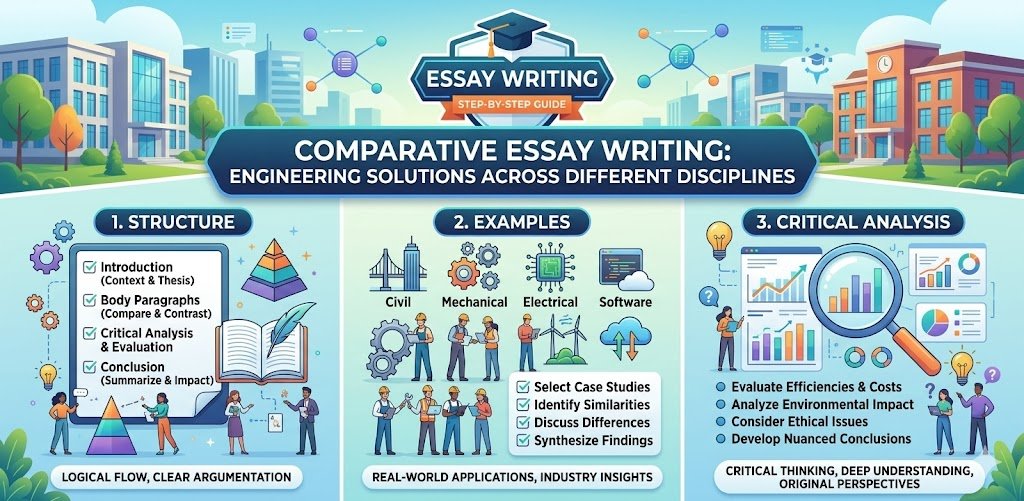
Comparative engineering essays require systematically analysing how different disciplines approach identical problems, evaluating methodologies, comparing technical solutions, and synthesising insights demonstrating cross-disciplinary understanding essential for modern engineering practice.
Engineering isn’t one discipline. It’s many.
Mechanical engineers design machines. Civil engineers build structures. Electrical engineers manage power systems. Chemical engineers optimise processes.
But here’s the interesting part: different disciplines often solve the same problem using completely different approaches.
Understanding these differences makes you a better engineer. Comparative essays test this understanding.
This guide shows you exactly how to write comparative engineering essays. Simple steps. Clear structure. Professional results.
What Makes Comparative Engineering Essays Different
Regular engineering essays explain one solution. Comparative essays analyse multiple solutions simultaneously.
In comparative essays, you’re not just describing how mechanical engineers approach heat transfer. You’re comparing mechanical, chemical, and electrical engineering perspectives on thermal management. You’re evaluating which approach works best under specific conditions.
What assessors want to see in your comparative essay:
- Deep understanding of multiple engineering disciplines, not surface-level knowledge.
- Systematic comparison using consistent criteria, not random observations.
- Critical evaluation explaining why differences exist, not just listing them.
- Synthesis producing insights neither discipline offers alone.
- Professional terminology from all disciplines was discussed accurately.
Cross-Disciplinary Engineering Problems
Some engineering problems naturally span multiple disciplines. These make excellent comparative essay topics.
Common cross-disciplinary problems:
Energy efficiency interests mechanical engineers (thermodynamic cycles), electrical engineers (power conversion efficiency), and chemical engineers (process optimisation).
Materials selection concerns civil engineers (structural strength), mechanical engineers (fatigue resistance), and chemical engineers (corrosion resistance).
System optimisation involves electrical engineers (control systems), mechanical engineers (mechanical efficiency), and software engineers (algorithmic optimisation).
Sustainability requires civil engineers (green building design), chemical engineers (waste minimisation), and environmental engineers (lifecycle analysis).
Safety systems engage electrical engineers (fail-safe circuits), mechanical engineers (pressure relief), and process engineers (hazard analysis).
Each discipline brings unique perspectives, methodologies, and solution approaches. Your comparative essay explores these differences systematically.
Choosing Comparison Criteria
Random comparisons produce random essays. Strategic criteria produce structured analysis.
Effective comparison criteria:
Theoretical foundations – What scientific principles does each discipline apply? Mechanical engineers use Newtonian mechanics. Electrical engineers apply Maxwell’s equations. Chemical engineers employ thermodynamic equilibrium.
Methodological approaches – How does each discipline solve problems? Civil engineers use structural analysis. Electrical engineers apply circuit theory. Software engineers implement algorithms.
Tools and techniques – What equipment does each discipline employ? Mechanical engineers use CAD and FEA. Electrical engineers use oscilloscopes and simulators. Chemical engineers use process flow diagrams.
Performance metrics – How does each discipline measure success? Structural engineers assess load capacity. Electrical engineers evaluate power efficiency. Chemical engineers optimise yield.
Constraints and limitations – What restricts each approach? Cost, materials, safety regulations, manufacturing capability, and environmental impact.
Application contexts – Where does each solution work best? Laboratory conditions, industrial scale, extreme environments, consumer products.
Pick 3-4 criteria. Apply them consistently across all disciplines compared.
For comprehensive guidance on structuring technical comparisons and analytical writing, explore our detailed resource on how to structure your engineering assignments, covering report formats and technical analysis.
Standard Comparative Essay Structure
Comparative engineering essays follow proven organisational patterns, ensuring clarity.
Introduction (10% of word count)
State the engineering problem being addressed. Identify disciplines being compared. Outline comparison criteria. Preview your conclusion.
Example introduction:
“Thermal management in electronic devices presents challenges addressed differently across engineering disciplines. This essay compares mechanical, electrical, and materials engineering approaches to heat dissipation in smartphones. Comparison criteria include theoretical principles, design methodologies, performance metrics, and manufacturing constraints. Analysis demonstrates mechanical solutions offer superior cooling capacity whilst electrical approaches provide better integration with existing components.”
Main body (80% of word count)
You have two organisational options:
#1: Block structure discusses each discipline completely before moving to the next. Good for complex technical details requiring sustained focus.
- Block 1: Mechanical engineering approach
- Block 2: Electrical engineering approach
- Block 3: Materials engineering approach
- Block 4: Comparative synthesis
#2: Point-by-point structure alternates between disciplines for each comparison criterion. Better for highlighting differences directly.
- Criterion 1: Theoretical foundations (all disciplines)
- Criterion 2: Design methodologies (all disciplines)
- Criterion 3: Performance metrics (all disciplines)
- Criterion 4: Manufacturing constraints (all disciplines)
Most engineering essays use a point-by-point structure. It makes comparisons clearer.
Conclusion (10% of word count)
Summarise key differences identified. Synthesise insights from comparison. State which approach suits which contexts. Suggest areas for interdisciplinary collaboration.
Writing Effective Comparisons
Good comparative writing does more than list differences. It analyses why differences exist and what they mean.
Weak comparison:
“Mechanical engineers use heat sinks. Electrical engineers use voltage regulators.”
Strong comparison:
“Mechanical engineers employ passive heat sinks exploiting conduction and convection for thermal management, whilst electrical engineers reduce heat generation at source through voltage regulation. This fundamental difference reflects disciplinary priorities: mechanical solutions optimise heat removal; electrical solutions minimise heat production. Each approach offers distinct advantages. Passive cooling requires no power but occupies significant space, whereas voltage regulation consumes energy but enables compact designs.”
Notice the difference?
Strong comparisons explain technical approaches, identify underlying principles, analyse trade-offs, and contextualise applications.
Use comparative language consistently:
“Whereas mechanical engineers prioritise…” “In contrast, electrical engineers emphasise…” “Unlike civil engineering approaches…” “Similarly, chemical processes also…” “Conversely, materials science suggests…”
These phrases signal comparison explicitly, guiding readers through your analysis.
When developing critical comparison skills across different assignment types, our guide on engineering exam revision strategies demonstrates analytical techniques applicable beyond assessments.
Using Technical Evidence
Comparative essays demand evidence from all the disciplines discussed. Vague generalisations undermine credibility.
Strong evidence includes:
Quantitative data comparing performance metrics. “Mechanical heat sinks achieve thermal resistance of 0.5 K/W whilst thermoelectric coolers reach 0.3 K/W but consume 50W additional power.”
Design specifications showing different approaches. “Civil engineers specify Grade 50 steel (yield strength 345 MPa) whilst aerospace engineers employ titanium alloys (yield strength 880 MPa) for equivalent applications.”
Case studies demonstrating real implementations. “Tesla’s battery thermal management combines mechanical liquid cooling with electrical heating elements, integrating multiple disciplinary approaches.”
Standards and codes reveal disciplinary norms. “BS EN 1993 governs structural steel design in civil engineering, whilst ASME Boiler Code regulates pressure vessels in mechanical engineering.”
Research findings supporting comparative claims. “Studies show FEA simulation accuracy varies: 95% for linear structural analysis (civil) versus 87% for nonlinear thermal analysis (mechanical) under identical mesh densities.”
Reference everything properly. Engineering uses numbered or author-date systems—check your module requirements.
Common Mistakes to Avoid
Mistake 1: Surface-level comparison. Don’t just say disciplines are “different.” Explain how, why, and what it means.
Mistake 2: Unbalanced coverage. Give equal attention to all disciplines compared. Don’t favour your own specialisation.
Mistake 3: Missing synthesis. Comparison isn’t the end goal. Synthesis producing new insights is.
Mistake 4: Ignoring context. No solution is universally “best.” Context determines appropriateness.
Mistake 5: Weak technical depth. Comparative essays still require rigorous engineering analysis, not superficial observations.
Avoid these costly mistakes entirely. Hire our CEng and IEng-qualified engineering assignment writers and get error-free comparative analysis, demonstrating proper cross-disciplinary methodology and balanced coverage across all engineering fields.
Sample Comparison Framework
Here’s a practical framework comparing structural analysis approaches:
Problem: Determining beam deflection under loading
Disciplines compared: Civil engineering, mechanical engineering, aerospace engineering
Criterion 1: Theoretical basis
- Civil: Euler-Bernoulli beam theory, assuming linear elasticity
- Mechanical: Timoshenko beam theory, including shear deformation
- Aerospace: Finite element analysis for complex geometries
Criterion 2: Accuracy vs. simplicity trade-off
- Civil: Simple hand calculations, 5-10% accuracy, suitable for preliminary design
- Mechanical: Moderate complexity, 2-5% accuracy, balances speed and precision
- Aerospace: High computational cost, <1% accuracy, necessary for safety-critical applications
Criterion 3: Application context
- Civil: Building design with regular geometries and standard loading
- Mechanical: Machine components with moderate complexity
- Aerospace: Aircraft structures requiring maximum precision
Synthesis: Method selection depends on required accuracy, available time, and safety criticality. Civil approaches suit preliminary design; aerospace methods are necessary for final validation.
Developing Cross-Disciplinary Thinking
Comparative essays aren’t just academic exercises. They develop crucial professional skills.
Modern engineering problems rarely fit single disciplines. Climate change requires civil, mechanical, and chemical engineers. Smart cities need electrical, software, and civil engineers. Medical devices demand mechanical, electrical, and biomedical engineers.
Understanding how disciplines approach problems differently enables:
- Better collaboration with engineers from other specialisations.
- Innovative solutions combining methodologies from multiple fields.
- Informed decisions about which approach suits specific contexts.
- Appreciation for diverse engineering perspectives beyond your specialisation.
- This cross-disciplinary thinking distinguishes exceptional engineers from adequate ones.
Conclusion
Comparative engineering essays analyse how different disciplines solve identical problems, revealing fundamental differences in theoretical frameworks, methodological approaches, and solution priorities. Effective comparison requires systematic criteria application, balanced discipline coverage, rigorous technical evidence, and synthesis producing insights beyond individual perspectives.
Structure comparisons using point-by-point organisation for clarity. Support claims with quantitative data, design specifications, and case studies. Move beyond description toward analysis, explaining why differences exist and what they mean practically.
Struggling with comparative analysis or unsure how to structure cross-disciplinary engineering comparisons? FQ Assignment Help connects you with CEng and IEng-qualified engineering specialists across mechanical, civil, electrical, and chemical disciplines who demonstrate proper comparative methodology, ensuring your essays showcase the analytical depth and cross-disciplinary understanding that distinction-level work requires.
Explore our blogs for practical engineering guides covering assignment strategies, revision techniques, and discipline-specific support. We publish weekly resources helping you succeed throughout your engineering studies. From first-year fundamentals through final-year projects.