
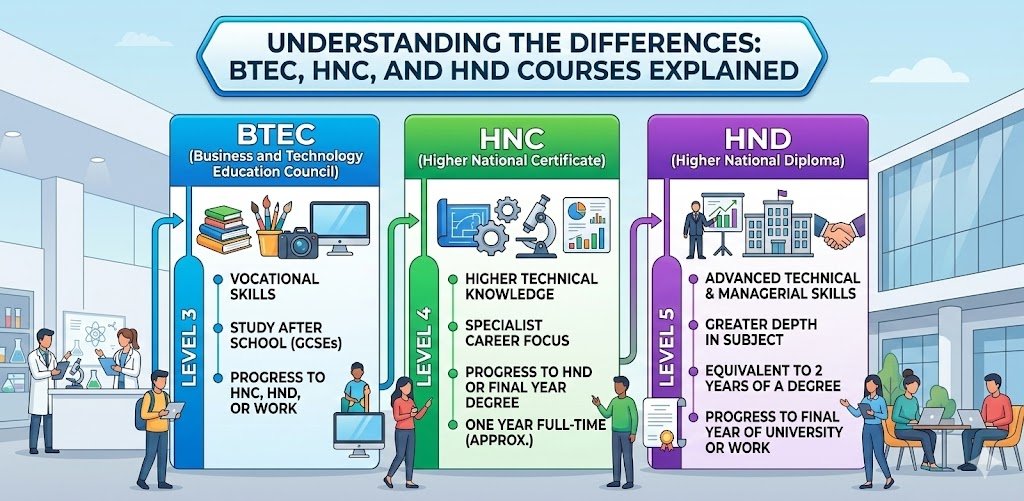
Firstly, BTEC qualifications are specialist, career-focused, work-related qualifications owned by Pearson combining practical learning with theory across 16 industry sectors.
HNC and HND represent different qualification levels within BTEC vocational education. HNC is level 4, equivalent to first-year university. On the other hand, HND is equivalent to a level 5, second-year university. Both are awarded by Pearson Edexcel across subjects like engineering, business, and computing.
HNC and HND selection proves crucial for students pursuing vocational education in the UK.
Understanding what these acronyms mean, how they differ, and which suits your career goals enables informed decisions about your educational pathway.
| BTEC | The qualification brand (owned by Pearson) |
| HNC | The shorter option (1 year, Level 4) |
| HND | The longer option (2 years, Level 5) |
| Subject | What you study (Engineering, Business, Computing, Health Care, etc.) |
BTEC HNC and BTEC HND in a Nutshell
Think of it like this.
Imagine you go to a bookshop:
- BTEC = The publisher brand (like Oxford University Press or Penguin Books)
- HNC or HND = The book size you choose (Paperback or Hardcover edition)
- Engineering, Business, Computing = What book topic you want (History, Science, Literature)
So you say:
“I want an Oxford University Press (BTEC) Hardcover edition (HND) about Science (Engineering)”
In Education Terms:
All are actually linked with Pearson hierarchy. The Pearson BTEC hierarchy consists of 3 distinct components:
- The Qualification Brand (BTEC)
- The Level (HNC/HND)
- The Industry Sector (Subject)
Pearson PLC owns the BTEC brand, providing vocational qualifications across 16 global industry sectors (listed later in this guide).
BTEC = The Qualification Brand
Think of BTEC like:
- “Cambridge University Press” for educational books
- “Samsung” for electronics
- “BTEC” for vocational qualifications
HNC and HND = The Levels You Choose
These are different qualification levels under BTEC.
You choose either:
Option 1: BTEC HNC
- Takes 1 year full-time
- Level 4 (like first year of university)
- Gives you 120 credits
- Good for getting a job quickly
OR
Option 2: BTEC HND
- Takes 2 years full-time
- Level 5 (like first + second year of university)
- Gives you 240 credits
- Better for higher-level jobs or going to university final year
Real Examples:
Wrong ways people say it:
- “I’m doing BTEC” (incomplete – BTEC what?)
- “I’m doing HNC” (incomplete – HNC in what?)
Correct ways to say it:
- “I’m doing a BTEC HNC in Engineering” (Brand + Level + Subject)
- “I’m doing a BTEC HND in Business” (Brand + Level + Subject)
Your Choice is Simple:
Qualification selection depends on specific career trajectories and academic timelines. Therefore, tou pick eitherHNC OR HND (not both at same time):
Pick BTEC HNC if you want:
- Finish in 1 year
- Get a job faster
- Study less time
- Lower cost (around £3,000-£6,000)
Pick BTEC HND if you want:
- Finish in 2 years
- Get better jobs
- Higher starting salary
- Go to university final year after (just 1 more year for full degree!)
So Your Full Course Name Looks Like:
BTEC (brand) + HNC or HND (level) + in Engineering (subject)
Examples:
- BTEC HNC in Computing
- BTEC HND in Health and Social Care
- BTEC HNC in Business
- BTEC HND in Construction
Let’s Get Deeper
What is BTEC?
BTEC (Business and Technology Education Council) identifies a suite of career-focused qualifications owned by Pearson that integrate practical learning with theoretical frameworks. Think of BTEC as a vocational qualification brand. Similar to how universities award academic degrees, Pearson awards BTEC qualifications.
Unlike traditional academic study, BTEC qualifications focus on hands-on, work-related learning preparing students directly for employment or further education.
BTEC qualifications span 16 industry sectors including the following:
- Applied Science
- Art and Design
- Business
- Children’s Play, Learning and Development
- Computing
- Construction and the Built Environment
- Engineering
- Health and Social Care
- Hospitality
- Information Technology
- Land-Based Industries
- Media
- Performing Arts
- Public Services
- Sport
- Travel and Tourism
These qualifications range from Level 1 (equivalent to GCSEs) through Level 7 (equivalent to postgraduate study), with HNC representing Level 4 and HND representing Level 5 within this framework.
Examples of how BTEC works:
- BTEC HNC in Engineering (like saying “Bachelor’s in Engineering from Cambridge”)
- BTEC HND in Business (like saying “Bachelor’s in Business from Oxford”)
- The subject can be Engineering, Business, Computing, Health and Social Care, Hospitality, Construction, and more
What is an HNC (Higher National Certificate)?
An HNC represents a Level 4 vocational qualification equivalent to the first year of a UK university honours degree. The curriculum delivers foundational knowledge and technical competencies and practical skills in a specific vocational area, equivalent to the first year of a university degree. HNC courses award 120 credits upon completion.
Real-world equivalent: Think of HNC as similar to completing your first year at university, but with more practical, job-focused content instead of pure theory.
What is HND (Higher National Diploma)?
The HND constitutes a Level 5 vocational qualification equivalent to the first two years of a university degree. It provides advanced technical knowledge and specialist expertise, equivalent to the first two years of a university degree. HND courses award 240 credits upon completion.
Real-world equivalent: HND is like completing two years at university with a vocational focus, positioning you closer to degree-level expertise whilst maintaining practical industry relevance.
HNC vs HND
Understanding the core differences requires comparing both qualifications side-by-side:
| Key Difference | HNC | HND |
| Qualification Level | Level 4 (First-year degree equivalent) | Level 5 (Second-year degree equivalent) |
| Study Duration | 1 year full-time / 2 years part-time | 2 years full-time / 4 years part-time |
| Credits Required | 120 credits total | 240 credits total |
| Number of Units | 8-10 units | 16-20 units |
| Assessment Depth | Foundational assignments and projects | Advanced research and dissertation-style projects |
| Career Entry Level | Technician or assistant positions | Senior technician or junior management roles |
| Starting Salary Range | £18,000-£24,000 | £22,000-£28,000 |
| University Progression | Enter year 2 of degree (2 more years to graduate) | Enter final year of degree (1 more year to graduate) |
BTEC HNC Explained in Detail
Higher National Certificate courses deliver practical vocational education, preparing students for employment or further study. HNC programmes combine classroom learning with real-world application, assessed through coursework rather than examinations.
Course Structure: UK students complete 8-10 units over one year, with each unit focusing on specific industry skills. For example, a BTEC HNC in Business might include units on:
- Marketing Principles
- Business Environment
- Human Resource Management
- Financial Accounting
- Managing Business Activities
Assessment Methods:
HNC assessment methods, including case studies, practical laboratory observations, and professional portfolios avoid traditional exams, instead using assignments, case studies, practical demonstrations, and group projects. This approach develops employability skills, including problem-solving, teamwork, and professional communication, valued by employers.
Who Should Choose HNC:
- School leavers wanting alternatives to A-levels
- Mature students returning to education
- Employees seeking professional development
- Students wanting faster entry to employment
- Those testing interest in a subject before committing to a longer study
Career Opportunities:
HNC graduates typically secure technician, assistant, or entry-level positions across industries, including civil engineering, digital marketing, and healthcare administration. Common roles include engineering technician, business administrator, IT support specialist, or healthcare assistant, depending on the subject studied.
Flexibility:
HNC courses offer flexible delivery, including full-time, part-time, evening classes, and distance learning options, accommodating students balancing work, family, or other commitments alongside study.
BTEC HND Explained in Detail
Higher National Diploma (HND) courses provide advanced vocational education, building specialist expertise over two years. HND programmes demand greater academic rigour, independent research, and complex problem-solving than HNC, whilst maintaining a practical industry focus.
Course Structure:
Students complete 16-20 units across two years. The first year covers foundational knowledge similar to HNC, whilst the second year introduces advanced concepts, specialist pathways, and extended research projects. For example, a BTEC HND in Engineering might include:
- Advanced Mathematics for Engineering
- Engineering Project Management
- Quality Systems and Management
- Specialist engineering applications (mechanical, electrical, civil)
- Major project or dissertation
Assessment Complexity:
HND assessments require critical evaluation, extended research, and sophisticated analysis. Second-year projects resemble university dissertations, demanding independent investigation, literature reviews, and evidence-based conclusions demonstrating higher-level thinking.
Who Should Choose HND:
- Students are committed to two years of full-time study
- Those seeking deeper subject expertise
- Students planning university degree afterwards
- Individuals wanting higher-level career entry positions
- Those requiring comprehensive vocational preparation
Career Opportunities:
HND graduates enter employment at higher levels, securing senior technician, junior management, specialist practitioner, or supervisory positions. The advanced qualification commands better starting salaries and faster career progression than an HNC.
University Progression:
HND holders access advantageous progression routes through “top-up degrees.” Universities accept HND students directly into the final year, enabling bachelor’s honours completion in just one additional year. This pathway proves cost-effective, reducing total degree costs and study duration significantly.
For comprehensive support with HND assignments across all subjects and achieving Merit or Distinction grades, our HND assignment help connects you with specialists understanding Pearson assessment criteria and unit requirements.
Key Differences Summarised
Time Investment: HNC requires one year commitment, HND demands two years. This difference impacts earning potential, as HNC graduates enter employment sooner, whilst HND graduates command higher starting positions, justifying the additional study year.
Academic Depth: HNC teaches foundational concepts and basic application. HND requires theoretical understanding, independent research, and complex problem-solving, mirroring second-year university expectations.
Career Impact: HNC positions graduates as competent technicians or assistants. HND positions graduates as advanced practitioners or junior managers, opening doors to supervisory responsibilities and specialist roles.
Cost Considerations: HNC costs approximately £3,000-£6,000 for one year. HND costs £6,000-£12,000 over two years. However, HND’s superior university progression route ultimately reduces total degree costs compared to HNC.
Study Intensity: HNC demands 15-18 hours weekly contact time plus independent study. HND requires 18-22 hours weekly contact time with substantially more independent research, particularly during second-year dissertation projects.
Making Your Choice
Choose BTEC HNC if you want:
- Quick entry to employment within one year
- Foundational qualifications whilst maintaining employment
- Testing commitment to a subject area
- Lower initial education costs
- Flexibility through part-time study options
Choose BTEC HND if you want:
- Advanced expertise commanding higher salaries
- Efficient university progression (one year to bachelor’s)
- Comprehensive vocational preparation
- Better career advancement opportunities
- Deeper subject knowledge before employment
Conclusion
BTEC is not a course you do. BTEC is the name of the qualification type.
You do either:
- BTEC HNC (1 year, Level 4) in your chosen subject
OR
- BTEC HND (2 years, Level 5) in your chosen subject
BTEC HNC and HND qualifications both provide valuable vocational pathways, differing primarily in duration, depth, and career outcomes. HNC offers faster employment entry with foundational skills, whilst HND provides advanced expertise enabling superior career positioning and efficient degree completion.
Understanding these distinctions, recognising BTEC as the qualification brand, HNC as level 4, and HND as level 5, enables matching educational choices to personal circumstances, career ambitions, and financial situations.
When BTEC coursework feels challenging or grading descriptors are unclear, FQ Assignment Help provides expert guidance across all vocational subjects, helping you achieve the Merit and Distinction grades your career ambitions deserve.