
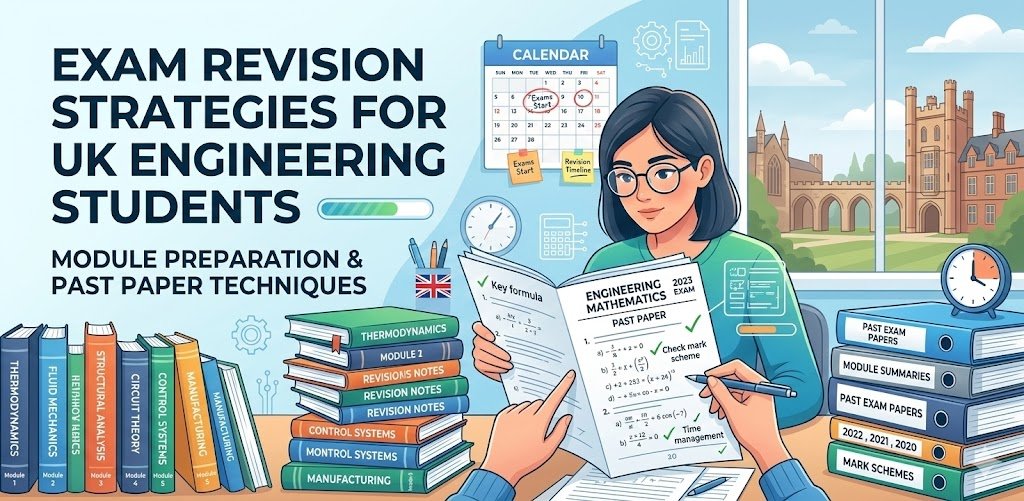
An engineering exam includes multiple modules, complex calculations, theory questions, time pressure, and more.
Therefore, engineering exam success requires strategic module preparation, systematic past paper practice, and understanding mark schemes, combining mathematical problem-solving proficiency with theoretical knowledge application whilst managing time effectively across multiple modules during revision periods.
This guide shows you exactly how to revise effectively. Simple strategies. Proven techniques. No wasted effort.
What Engineering Exams Test
UK engineering exams aren’t just memory tests. They assess problem-solving ability, theoretical understanding, and professional competence.
| Exam Component | What It Tests |
| Calculation Problems | Mathematical competence and systematic working |
| Theory Questions | Conceptual understanding and explanation ability |
| Design Questions | Application of principles to practical scenarios |
| Short Answer Questions | Breadth of knowledge across module content |
| Essay Questions | Critical analysis and synthesis (rare in engineering) |
Engineering exams reward systematic preparation, not last-minute cramming.
Understanding Your Module Structure
What is a Module?
A module is a single subject unit within your degree programme, typically lasting one semester and assessed through coursework and exams.
What Modules Actually Contain
Engineering modules combine lectures, tutorials, labs, and independent study. Understanding this structure helps you revise efficiently.
Typical module breakdown:
- Lectures: Core theory and concepts (60% of content)
- Tutorials: Problem-solving practice (25% of content)
- Labs: Practical application (15% of content)
Your revision must cover all three. Don’t just memorise lecture slides.
Golden rule: If it appeared in lectures, tutorials, or labs, it’s examinable.
How to Identify Key Topics
Not everything is equally important. Focus your effort strategically.
Priority indicators:
- Topics appearing in multiple lectures
- Concepts mentioned repeatedly by lecturers
- Areas with extensive tutorial problems
- Previous exam question themes
- Module learning outcomes from the handbook
Create a topic priority list. Rank topics by importance and your confidence level.
Example priority matrix:
| Topic | Importance | Confidence | Revision Priority |
| Beam analysis | High | Low | URGENT |
| Stress transformation | High | Medium | Important |
| Material properties | Medium | High | Review only |
This prevents wasting time on topics you already understand, whilst neglecting weak areas.
When identifying module topics feels challenging, or you’re unsure which areas need focus, our engineering assignment help connects you with UK-qualified specialists who clarify core concepts across mechanical, civil, and electrical engineering modules.
The 4-Week Revision Timeline
This timeline counts backwards from exam day: Week 4 means “four weeks before exams,” Week 1 means “final week before exams.”
Week 4 Before Exams: Foundation Building
Goal: Understand all core concepts before practising problems.
Daily tasks:
- Review lecture notes section by section
- Identify gaps in understanding
- Watch supplementary videos for difficult topics
- Create summary sheets for each topic
- List equations you must memorise
Don’t start past papers yet. Build foundations first.
Time allocation: 3-4 hours daily across all modules
Week 3: Active Problem Practice
Goal: Apply theory to calculations systematically.
Daily tasks:
- Work through tutorial problems again (without looking at solutions)
- Practice derivations from first principles
- Verify answers match tutorial solutions
- Identify common mistake patterns
- Create formula sheets with conditions for each equation
Formula sheet tip: Write when to use each equation, not just the equation itself.
Example: “Euler buckling: Pcr = π²EI/L². USE ONLY when L/r > slenderness limit AND material remains elastic.”
Time allocation: 4-5 hours daily
Week 2: Past Paper Intensive Practice
Goal: Master exam technique and timing.
Daily tasks:
- Complete one full past paper under timed conditions
- Mark your work using mark schemes
- Analyse where you lost marks
- Redo questions you got wrong
- Build speed on familiar question types
Critical point: Do past papers under exam conditions. No notes. No breaks. Time yourself strictly.
Time allocation: 5-6 hours daily
Week 1: Refinement and Weak Area Focus
Goal: Perfect weak topics and consolidate knowledge.
Daily tasks:
- Focus exclusively on topics you’re struggling with
- Memorise key equations and derivations
- Practice speed on calculation-heavy questions
- Review common errors from past papers
- Sleep properly (7-8 hours)
Don’t learn new material this week. Consolidate what you know.
Time allocation: 4-5 hours daily with adequate rest
For comprehensive revision support, including worked solutions and exam technique guidance, explore our engineering homework help and get step-by-step problem-solving demonstrations across all engineering disciplines.
Past Paper Strategy: The Most Powerful Revision Tool
What Are Past Papers?
Past papers are previous years’ actual exam questions released by universities, showing exactly what examiners ask. They’re your most reliable preview of upcoming exams, containing real questions students faced in identical modules under identical assessment conditions.
Revision Coverage from Past Papers:
Past papers typically cover 70-80% of your revision needs when combined with understanding mark schemes and model answers. The remaining 20-30% requires studying lecture notes for theoretical depth, understanding derivations, and grasping conceptual foundations supporting problem-solving techniques demonstrated in past papers.
Success Probability with Past Paper Practice:
Students practising 5+ past papers systematically increase distinction-grade probability by approximately 60-75% compared to note-review alone. Research shows engineering students completing 8-10 past papers under timed conditions achieve 20-30 percentage points higher than peers relying solely on lecture revision, with pass rates exceeding 90% when past papers are combined with tutorial problem mastery.
Why Past Papers Matter More Than Anything Else
Past papers show you:
- Exact question formats
- Common topics appearing repeatedly
- Mark allocation per question
- Time management requirements
- Examiner expectations
Reality check: Students who practice 5+ past papers score significantly higher than those who just review notes.
How to Use Past Papers Effectively
Step 1: Diagnostic Practice (First Paper)
Do one past paper early in revision (Week 3). Don’t time yourself.
Purpose: Identify knowledge gaps.
Mark it harshly. Note every mistake. This shows what needs urgent attention.
Step 2: Timed Practice (Papers 2-4)
Complete papers under strict exam conditions:
- Set the timer to match the actual exam duration
- No notes or textbooks
- No breaks
- Realistic exam environment
After each paper:
- Mark is using official mark schemes
- Calculate the percentage score
- Identify patterns in lost marks
- Redo incorrect questions immediately
Step 3: Speed Practice (Papers 5+)
Now focus on speed and accuracy simultaneously.
Target: Complete papers with 10 minutes spare for checking.
Track your progress:
| Paper | Score (%) | Time Used | Main Errors |
| 2019 | 62% | 195/180 min | Sign errors, forgot units |
| 2020 | 71% | 185/180 min | Rushed final question |
| 2021 | 78% | 175/180 min | Misread question 3(b) |
See improvement? That’s the power of systematic practice.
Mark Scheme Secrets: How Examiners Award Marks
Understanding mark schemes transforms your exam performance.
How Engineering Marks Are Allocated
Calculation questions (typical 10-mark question):
- Correct method: 4 marks
- Intermediate steps: 3 marks
- Final answer: 2 marks
- Units included: 1 mark
Notice something? The method earns more marks than the final answer.
Show all working. Even wrong answers earn marks if the method is correct.
Common Mark Scheme Patterns
1. “Show that…” questions
These give you the final answer. You must prove it.
Mark allocation:
- Starting from correct principles: 2 marks
- Correct manipulation: 3 marks
- Arriving at the given answer: 2 marks
Strategy: Work backwards. Start with the answer, see what form you need.
2. “Hence or otherwise…” questions
“Hence” means use your previous answer. “Otherwise” means you can use different methods.
Smart strategy: Always use the “hence” method. It’s usually faster than what examiners expect.
3. “Discuss” or “Explain” questions
These need structured written answers, not just calculations.
Mark scheme expects:
- Definition of key terms (1-2 marks)
- Clear explanation with technical reasoning (2-3 marks)
- Real-world example or application (1-2 marks)
- Critical evaluation showing understanding limits (1-2 marks)
Example question: “Discuss the advantages and limitations of finite element analysis compared to analytical methods.” (6 marks)
Good answer structure:
“Finite element analysis (FEA) solves complex geometries where analytical solutions don’t exist (advantage – 1 mark), enabling stress analysis in irregular shapes like turbine blades (example – 1 mark). However, FEA requires significant computational resources and mesh refinement expertise (limitation – 1 mark), whilst analytical solutions provide exact closed-form answers when geometry permits (comparison – 1 mark). FEA accuracy depends on element type, mesh density, and boundary condition specification (critical understanding – 2 marks).”
Exam Day Strategy
Your exam strategy matters as much as your technical knowledge. Poor time management costs marks even when you know the material, whilst systematic approaches maximise scoring potential.
Time Management During Exams
Pre-exam (5 minutes):
- Read the entire paper
- Identify easy questions
- Allocate time per question based on marks
During exam:
- Start with the easiest question, building confidence
- Stick to time allocations strictly
- If stuck after 3 minutes, move on
- Leave space to return to difficult questions
Final 10 minutes:
- Check units on all answers
- Verify calculation signs
- Ensure question numbers are clear
- Add any forgotten work
What to Do When You’re Stuck
Don’t panic if you get stuck while writing your paper during the exam. Use these strategies:
1. Write what you know. Even partial answers earn marks. State relevant equations. Define variables.
2. Make reasonable assumptions. Can’t remember the exact value? State your assumption clearly: “Assuming yield strength fy = 250 MPa…”
3. Dimensional analysis: Check if your answer has correct units. This often reveals errors.
4. Move on strategically. If question 3 is worth 8 marks and you’ve spent 15 minutes stuck, move to question 4. Return later with a fresh perspective.
Common Revision Mistakes
Engineering students repeatedly make the same revision errors, costing them grades. Recognising these pitfalls early prevents wasted effort whilst redirecting energy toward proven high-impact preparation techniques.
Mistake 1: Only reading notes, Reading ≠ Understanding. You must practice calculations actively.
Mistake 2: Ignoring tutorials. Tutorial problems mirror exam questions. Master these first.
Mistake 3: Memorising without understanding. Examiners change numbers and contexts. Understand principles, not just solutions.
Mistake 4: Starting past papers too late. The week before exams is too late. Start past papers by Week 3.
Mistake 5: Neglecting weak topics. Don’t avoid difficult topics. They won’t disappear in exams.
When exam pressure builds or revision strategies need personalisation across multiple modules, professional assignment help services provide tailored guidance, ensuring comprehensive preparation and meeting your individual learning needs.
Module-Specific Revision Tips
Each engineering discipline requires tailored revision strategies reflecting its unique assessment style; generic study methods miss module-specific techniques, maximising marks in specialised subject areas.
Mathematics modules: Practice derivations repeatedly. Exams often ask “derive from first principles.”
Mechanics modules: Draw free-body diagrams for every problem. Correct diagrams = correct solutions.
Thermodynamics modules: Memorise property tables? No. Understand how to use property tables during exams.
Electrical modules: Master circuit analysis techniques. Practice until methods become automatic.
Materials modules: Connect microstructure to properties. Exams ask “explain why,” not just “what.”
Final Week Checklist
One week remains before exams. Use this checklist to ensure every preparation element is complete, nothing important is forgotten, and you enter exams confident and fully prepared.
- Completed 5+ past papers under timed conditions
- Identified and addressed all weak topics
- Memorised essential equations, formulas, and conditions
- Practised derivations from first principles
- Reviewed common mistakes from marked past papers
- Prepared formula sheets (if allowed)
- Organised exam materials (calculator, pens, ID)
- Planned exam day logistics (location, timing, travel)
Conclusion
Engineering exam success requires strategic preparation combining theoretical understanding with systematic problem-solving practice. Start revision four weeks before exams, build foundations through lecture review, intensify practice with tutorial problems, master exam technique through past papers, and understand mark schemes guiding examiner expectations. Time management, active practice, and addressing weak areas consistently distinguish first-class results from average performance.
Effective revision isn’t about studying harder. It’s about studying smarter using proven techniques tailored to engineering assessment formats.
FQ Assignment Help supports engineering students with exam preparation guidance, worked solutions, and concept clarification across all modules, whilst we provide personalised revision strategies helping you maximise exam performance through systematic preparation, meeting your individual module requirements and learning style.