
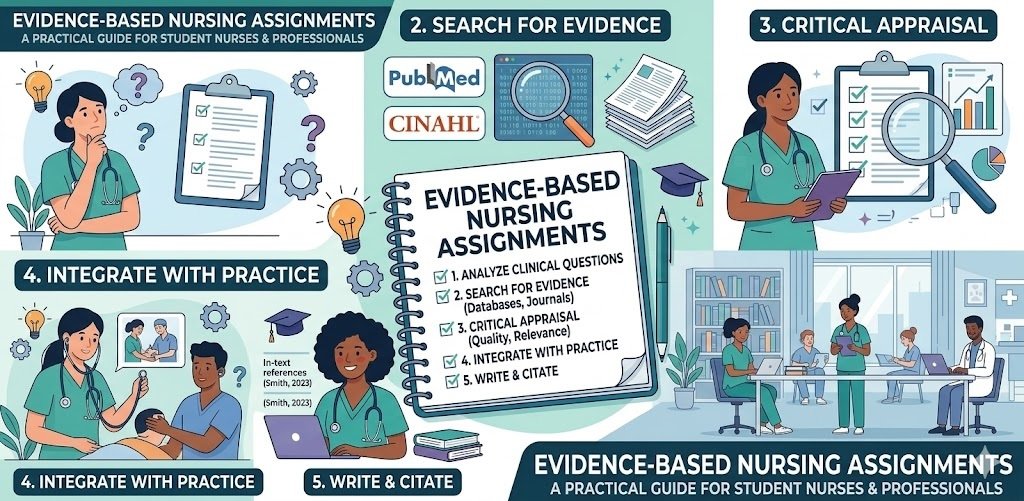
Evidence-based nursing assignments require integrating clinical research, patient-centred care principles, and theoretical frameworks, demonstrating critical appraisal skills, clinical reasoning, and adherence to NMC standards, essential competencies distinguishing proficient nursing students from basic practitioners.
Nursing isn’t guesswork. It’s science applied with compassion.
Every clinical decision needs evidence backing it. Every intervention requires justification. Every care plan demands research supporting it.
University nursing assignments test whether you can find evidence, evaluate it critically, and apply it to patient scenarios.
This step-by-step guide shows you exactly how.
Step 1: Understand What Evidence-Based Practice Means
Evidence-based practice (EBP) combines 3 elements to create optimal patient outcomes.
1. Best available research evidence from systematic reviews, randomised controlled trials (RCTs), cohort studies, and meta-analyses providing clinical effectiveness data.
2. Clinical expertise from experienced practitioners, understanding patient contexts, resource constraints, and care delivery realities.
3. Patient preferences and values respect individual choices, cultural backgrounds, and personal circumstances, influencing treatment acceptance.
Your assignments must integrate all three. Research alone isn’t enough. Clinical relevance matters. Patient-centredness is mandatory.
Step 2: Identify Appropriate Clinical Research Sources
Not all evidence is equal. Nursing assignments demand high-quality, peer-reviewed clinical research.
Hierarchy of evidence (strongest to weakest):
Systematic reviews and meta-analyses synthesising multiple studies providing strongest evidence for interventions.
Randomised controlled trials (RCTs) compare interventions with control groups, minimising bias.
Cohort studies follow patient groups over time, identifying associations and outcomes.
Case-control studies compare patients with conditions to those without, identifying risk factors.
Expert opinion and consensus statements from professional bodies like RCN, NMC, or NICE.
Where to find quality nursing research:
- CINAHL (Cumulative Index to Nursing and Allied Health Literature)
- PubMed/MEDLINE for biomedical and nursing journals
- Cochrane Library for systematic reviews
- NICE guidelines for UK clinical practice standards
- RCN journals for nursing-specific evidence
Search strategically: Use the PICO framework (Patient/Population, Intervention, Comparison, Outcome) to structure searches effectively. PICO is a structured format breaking clinical questions into Patient, Intervention, Comparison, and Outcome components, improving search precision and relevance.
Example: For pressure ulcer prevention in elderly patients:
- Patient: Elderly immobile patients
- Intervention: Two-hourly repositioning
- Comparison: Standard care
- Outcome: Pressure ulcer incidence reduction
Step 3: Critically Appraise Research Quality
Finding research isn’t enough. You must evaluate its validity, reliability, and applicability.
Critical appraisal questions:
Study design: Does the methodology suit the research question? Are RCTs used for intervention effectiveness? Are qualitative studies used for patient experiences?
Sample size: Is it large enough to produce statistically significant results? Were power calculations performed?
Bias and confounders: Were randomisation and blinding used appropriately? Were confounding variables controlled?
Outcome measures: Are outcomes clinically relevant? Are the measurement tools validated?
Clinical significance: Beyond statistical significance, do results matter practically? Would a 2% improvement change practice?
Applicability: Does the study population match your patient scenario? Are settings comparable?
Use critical appraisal tools like CASP (Critical Appraisal Skills Programme) checklists, systematically evaluating research quality.
Developing strong critical analysis skills across nursing assignments, our guide on applying critical thinking in research and writing demonstrates evaluation techniques, ensuring evidence-based arguments meet academic standards.
Step 4: Integrate Evidence into Nursing Frameworks
Nursing assignments require applying evidence within theoretical frameworks, demonstrating a holistic understanding.
Common nursing models:
The Roper-Logan-Tierney Model examines activities of daily living (maintaining a safe environment, communication, breathing, eating, elimination, etc.).
Orem’s Self-Care Deficit Theory assesses patient self-care abilities and nursing support requirements.
Roy’s Adaptation Model evaluates physiological, self-concept, role function, and interdependence modes.
Apply evidence systematically:
Identify patient needs using the chosen framework.
Find research evidence addressing those needs.
Demonstrate how evidence informs nursing interventions.
Justify why evidence-based approaches improve outcomes.
Example integration:
“Using Roper-Logan-Tierney’s activity of ‘maintaining safe environment,’ evidence from Henderson et al. (2023) demonstrates hourly rounding reduces patient falls by 52% (p<0.001) in acute care settings. Implementing standardised rounding protocols incorporating NICE fall prevention guidelines addresses this patient’s high-risk mobility status whilst promoting dignity through predictable, person-centred care.”
Step 5: Link Evidence to NMC Standards and Competencies
UK nursing assignments must demonstrate alignment with the Nursing and Midwifery Council professional standards.
Reference NMC Code explicitly:
“This evidence-based intervention reflects NMC Code section 8.1 (‘respect the skills, expertise and contributions of colleagues’) by incorporating multidisciplinary evidence from physiotherapy, occupational therapy, and nursing research, optimising patient mobilisation outcomes.”
Connect to Future Nurse Proficiencies:
Show how evidence-based application develops professional competencies in assessment, intervention, evaluation, and leadership.
Step 6: Write Using Academic Nursing Language
Professional nursing writing uses specific terminology demonstrating clinical competence.
Use precise clinical language:
“The patient was breathing badly”
“The patient exhibited dyspnoea with a respiratory rate of 28 breaths/minute and SpO₂ of 89% on room air”
“The nurse helped the patient”
“Nursing intervention included therapeutic communication, facilitating patient expression of anxiety whilst providing psychoeducation regarding pain management options”
Structure arguments using PEE format:
PEE is a paragraph structure which includes Point (assertion), Evidence (citation/data), and Explanation (critical analysis), demonstrating how evidence substantiates claims made.
Point: State your evidence-based claim
Evidence: Cite research supporting it
Explanation: Analyse how evidence applies to the patient scenario
Maintain professional objectivity:
Avoid first-person pronouns (“I think”). Use third-person or passive voice (“Evidence suggests,” “Research demonstrates”).
Acknowledge limitations and contradictions in evidence-based showing critical thinking.
Struggling with integrating clinical research or structuring evidence-based arguments professionally? Our nursing assignment help connects you with registered nurses and nurse educators who demonstrate proper research application across adult, mental health, paediatric, and community nursing assignments, ensuring your work reflects the clinical reasoning and evidence-based practice NMC competencies demand.
Step 7: Reference Using Health Sciences Standards
Nursing typically uses Harvard referencing, though some programmes require APA or Vancouver.
Journal article example (Harvard):
Smith, J., Brown, L. and Taylor, R. (2024) ‘Effectiveness of early mobilisation in preventing hospital-acquired pneumonia’, Journal of Clinical Nursing, 33(4), pp. 567-578. doi: 10.1111/jocn.12345.
NICE guideline example:
National Institute for Health and Care Excellence (2023). Pressure ulcers: prevention and management. Clinical guideline CG179. London: NICE.
Always cite:
- Research studies supporting interventions
- Clinical guidelines informing practice
- Theoretical frameworks guiding assessment
- Professional standards referenced
When managing multiple nursing assignments with clinical placements and demanding deadlines, our guide on managing assignment deadlines effectively provides time management strategies, ensuring quality across submissions.
Common Evidence-Based Nursing Assignment Mistakes
Mistake 1: Using outdated research or sources
Evidence older than 5 years is generally considered outdated unless discussing seminal studies or theoretical frameworks. Always search for recent evidence.
Mistake 2: Citing non-peer-reviewed sources
Wikipedia, general websites, and patient information leaflets aren’t acceptable academic evidence. Use peer-reviewed journals and clinical guidelines.
Mistake 3: Describing evidence without application
Don’t just summarise research findings. Explain how they inform nursing practice for your specific patient scenario.
Mistake 4: Ignoring contradictory evidence
Acknowledge when research shows conflicting results. Discuss why contradictions exist and which evidence is strongest for your context.
Mistake 5: Forgetting patient-centred care
Evidence-based practice isn’t just about research. Show how interventions respect patient autonomy, dignity, and preferences.
Final Words
Master all these evidence-based nursing assignments writing techniques. As a result, you’ll not only achieve distinction grades but also develop clinical reasoning skills essential for safe, effective nursing practice throughout your career.
Stop Submitting Assignments You’re Unsure About!
The difference between Pass and Distinction isn’t just grades. It’s about developing the evidence-based thinking that keeps patients safe. Our nursing coursework writing support from nursing experts shows you exactly how to find, appraise, and apply research meeting university standards whilst building the clinical reasoning skills your future patients deserve. Your next assignment could be where everything clicks. If you’re ready to stop guessing and start learning properly.
FQ Assignment Help delivers expert guidance from UK-qualified nursing professionals across adult, mental health, child, and learning disability nursing, ensuring your assignments demonstrate the evidence-based practice and professional competence distinction-level nursing work requires.