
Choosing a thesis topic shouldn’t feel like dragging a boulder uphill. Yet for most students, it does. The pressure to be “original,” “researchable,” “academic,” and still somehow interesting slows everything down.
Weeks pass. Stress builds.
And the fear of picking the wrong topic becomes bigger than the topic itself. That’s the real problem!
Then comes the anxiety students suffer from:
- What if my supervisor rejects it?
- What if there’s no data?
- What if it’s too broad?
- Too narrow?
- Has someone already worked on this topic?
This overthinking traps students before they’ve even started.
But here’s the solution. This guide cuts through the noise and shows you how to select a strong thesis topic that’s clear, feasible, impactful, and aligned with your academic goals. No jargon.
No vague advice. Just a straightforward process that actually works.
You’ll also recognise patterns from other high-impact thesis topic selection frameworks on choosing dissertation topics with long-term research value, because the principles overlap for a reason.
By the end, you’ll know exactly what to choose, why it works, and how to move forward with confidence.
1. Understand Your Academic Field and Interests
Picking a thesis topic starts with knowing your academic playground & the subject area. You can’t choose a topic in a vacuum. It has to fit your degree requirements while keeping you engaged. If you pick something purely “trendy” but boring to you, motivation will crash halfway through.
Start by mapping your interests. Ask yourself:
- Which modules did I enjoy most?
- Which topics made me curious enough to do extra reading?
- What skills do I want to build through this thesis?
Once you have a shortlist of interests, brainstorm ideas! Use techniques like:
- Mind-mapping
- Free-writing
- Or even discussing with peers and lecturers
Don’t censor yourself. Write everything down. Later, narrow it to ideas that are realistic and researchable.
For example:
If you’re in environmental science and love urban planning, your thesis should explore
- “The impact of green roofs on city heat islands”
- instead of a vague “Climate change effects.”
Next, read recent literature in your field. Skim the latest journal articles or conference papers to see what’s been done and where gaps exist. This ensures your topic is original, feasible, and academically valuable.
This combination of personal interest + degree alignment + literature awareness forms the foundation of a strong thesis topic.
2. Research Feasibility and Resources
Before you lock in a thesis topic, you need to check its research feasibility, whether it’s actually possible to study given your time, skills, and resources.
Feasibility is all about asking:
- Can I realistically complete this project?
- Can I collect enough reliable data?
- Can I do it within my deadlines?
Next, think about research resources. These are the tools, data, and literature you’ll need.
- Do you have access to databases, journals, or lab equipment?
- Are datasets publicly available, or will you need special permissions?
Knowing what’s at your disposal prevents nasty surprises later.
Consider these key aspects:
- Availability of data: If your topic requires rare surveys, interviews, or proprietary data, do you actually have access?
- Access to literature: Check if recent studies exist. A topic without current research will be interesting, but almost impossible to contextualise academically.
- Time constraints: Even a fascinating topic can become unmanageable if it requires years of data collection.
Avoid extremes:
- Overly broad topics, like “The impact of technology on society,” are impossible to cover in one thesis.
- Overly narrow topics, like “The effect of a single Twitter post on a local café’s revenue in 2025,” will lack enough data.
For Example:
- Instead of “Climate change,”
- Focus on “Urban heat islands in London: assessing green roof effectiveness using satellite data.” It’s specific, researchable, and doable within your degree timeline.
Assessing feasibility early saves weeks of wasted effort and ensures your thesis is both original and achievable.
3. Originality and Research Gap
A strong thesis isn’t just well-written, it’s original! Originality comes from identifying a research gap, which is essentially a question or area that hasn’t been fully explored yet. Your job is to spot where existing studies leave space for new insights.
- Start by reviewing the latest literature in your field.
- Use tools like Google Scholar, Scopus, and academic journals to scan recent publications.
- Look for repeated calls for further study in conclusions, contradictions between studies, or areas with limited data.
- These are clues to potential gaps.
Let’s Say:
If several papers analyse urban green spaces in London, but none examine their effects on mental health for university students specifically, that’s a gap you can explore.
Brainstorm ways your topic can add value through any of the following:
- A new methodology
- A unique population
- Or an underexplored angle
Keep a running list of potential research questions and compare them to existing literature to check novelty.
Remember:
Originality isn’t about reinventing the wheel. It’s about finding a niche that contributes meaningfully to your academic field. When you combine feasibility with a clear research gap, your thesis topic moves from “just an idea” to a strong, publishable research plan.
4. Consulting Supervisors and Mentors
A quick discussion can refine your ideas, focus your scope, and even suggest alternative angles you hadn’t considered. Supervisors can also help align your topic with departmental expectations and available resources, saving weeks of wasted effort.
Equally important:
Choosing a thesis topic isn’t a solo mission. Guidance from supervisors and mentors can make the difference between a mediocre topic and a strong, researchable one. They have experience spotting feasibility issues, over-researched areas, and potential gaps you will miss.
Mentors help you avoid topics that are already over-researched. Just because an idea seems exciting doesn’t mean it will earn originality points. Your supervisor can steer you towards areas where your contribution will truly stand out.
Here’s a scenario:
If you love “Social media and student wellbeing,” but if dozens of theses cover this already
Your supervisor will suggest narrowing it to “Impact of Instagram usage on UK postgraduate students’ study habits,” making it specific, feasible, and novel.
If you want better support in refining your thesis topic, ensuring originality, or structuring your research plan, our UK-qualified thesis writers will help you step by step, so you start your thesis with confidence and clarity.
5. Evaluating Potential Impact
A strong thesis topic isn’t just doable. It matters! Evaluating its potential impact ensures that your work contributes academically, practically, and professionally.
Think of it as asking: “Will this topic make a difference?”
Academic significance comes first. Your thesis should address a clear research gap, build on existing knowledge, and ideally be publishable or citable in future studies. A topic that pushes boundaries or tests new methods adds weight to your degree.
Practical relevance is equally important.
So, ask yourself: Can your findings solve real-world problems?
For example, a study on “Green roofs and urban heat reduction in London”
- This study won’t be just theoretical.
- City planners and environmentalists can use it.
- Practical value increases engagement and shows that your research has tangible applications.
Finally, consider future career benefits. Choose a topic that aligns with your ambitions, whether academic, industry, or consultancy. Topics related to emerging fields or skills in demand can boost employability and demonstrate expertise to potential employers.
Our guide on choosing dissertation topics with high research impact will help weigh these factors. When you combine feasibility, originality, and impact, you’re not just picking a topic. You’re laying the foundation for a thesis that stands out academically and professionally.
6. Common Pitfalls in Topic Selection
Choosing a thesis topic isn’t just about picking something interesting. It’s about picking something doable, clear, and academically strong. Many students fall into traps that derail their progress before they even start.
Overly ambitious topics are a classic mistake:
- A thesis isn’t a lifetime project
- It has deadlines and word limits.
- Trying to cover “The entire impact of climate change on global economies” in a single semester will lead to stress and rushed work.
Vague topics are another danger:
- Titles like “Technology and society” sound broad, but they give no focus.
- Without a clear angle, your research will drift, and your thesis will lack direction.
Unfeasible topics also waste time:
- If data is inaccessible, methods are too complex, or the scope is too large, you’ll hit dead ends.
- Checking feasibility early, data availability, resources, and timeframe, prevents last-minute disasters.
For Example:
- Instead of “Mental health in students worldwide,”
- Narrow it to “The impact of online learning on UK postgraduate students’ mental health during 2025.”
- The narroed on is specific, researchable, and manageable.
Avoid these pitfalls, and you’ll save countless hours of frustration. We’ve conducted a survey and found that there are many more common mistakes in students make in their university assignments. Avoiding those mistakes can help you refine your topic selection process effectively.
7. Finalising Your Topic
After brainstorming, researching feasibility, and evaluating impact, it’s time to finalise your thesis topic. The goal is to balance three key elements: personal interest, feasibility, and originality. A structured approach ensures you pick a topic that’s not only exciting but also practical and academically valuable.
One effective method is using a decision matrix. Assign scores to each potential topic based on factors like relevance to your degree, access to data, research gap, and alignment with career goals. Add them up and compare. The highest-scoring topic is your strongest candidate.
Here’s an Example Decision Matrix. However, you can tailor it as per your research:
| Topic Idea | Personal Interest (1-5) | Feasibility (1-5) | Originality (1-5) | Total Score |
| Green roofs & urban heat islands | 5 | 4 | 5 | 14 |
| Social media & student wellbeing | 4 | 3 | 3 | 10 |
| Climate change & global economy | 3 | 2 | 4 | 9 |
You can also use a checklist to finalise:
| Check/Tick | To check & confirm |
| Is it researchable within my timeframe? | |
| Do I have access to the necessary data/resources? | |
| Does it address a research gap? | |
| Am I genuinely interested in the topic? | |
| Will it add academic or practical value? |
Using this method ensures you select a strong, feasible, and original thesis topic, giving you confidence to start your research and writing without second-guessing.
8. Preparing for the Proposal Stage
Once your thesis topic is finalised, the next step is the proposal stage. A proposal is essentially a blueprint of your research. It is a formal document that outlines your topic, objectives, methodology, and expected outcomes. It shows your supervisor that your idea is clear, feasible, and academically valuable.
The proposal stage comes early in your final year or research period, before you dive into full-scale data collection and writing.
Submitting a strong proposal is crucial because it sets the tone for your entire thesis.
A research proposal is actually helpful in:
- Clarifying your research questions: Make them specific, measurable, and aligned with your topic.
- Choosing methodology: Decide whether qualitative, quantitative, or mixed methods best suit your research.
- Identifying sources and literature: Demonstrates that your topic is researchable and original.
- Planning timelines: Break down tasks into stages to ensure feasibility and avoid last-minute stress.
A well-chosen topic makes this stage much easier. If your thesis topic is focused, researchable, and impactful, filling out objectives, rationale, and methodology becomes straightforward rather than a headache.
For a detailed breakdown of each step, you can check our step-by-step guide to writing a dissertation proposal, which explains exactly what to include and how to get your proposal approved by your supervisor.
Conclusion
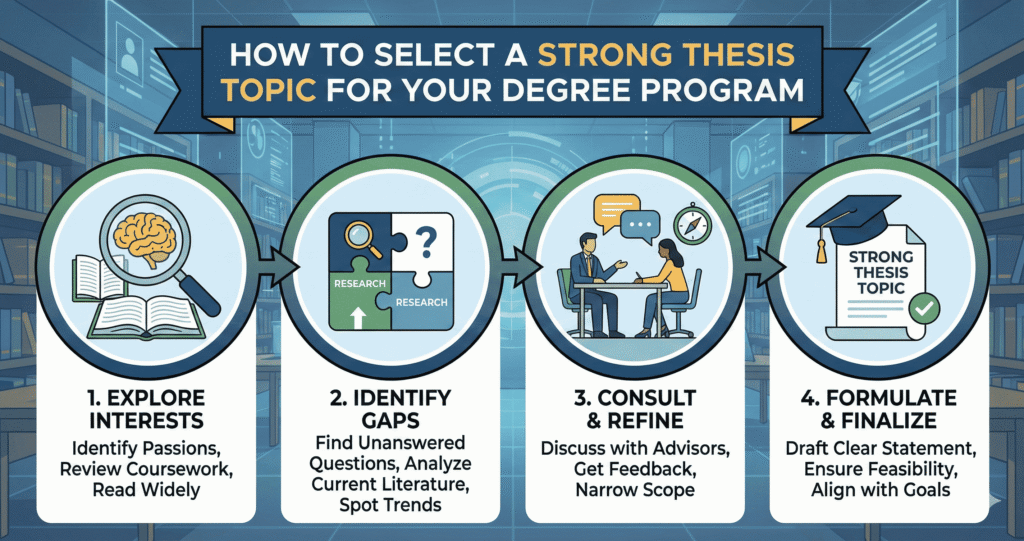
Selecting a strong thesis topic is the foundation of a successful degree project. Whenever you get stuck asking yourself, “how to select a strong topic for my thesis,” always start by:
- Understanding your academic field and personal interests
- Check research feasibility
- Identify original gaps
- And consult supervisors to refine your ideas
Also, evaluate potential impact and avoid common pitfalls like vague, overly ambitious, or unfeasible topics.
Tools like decision matrices and checklists can help finalise a topic that balances interest, feasibility, and originality, making the proposal and research stages far smoother.
If you need expert guidance in refining or approving your thesis topic, FQ Assignment Help can provide professional support, ensuring your research starts on the right path with confidence and clarity.