
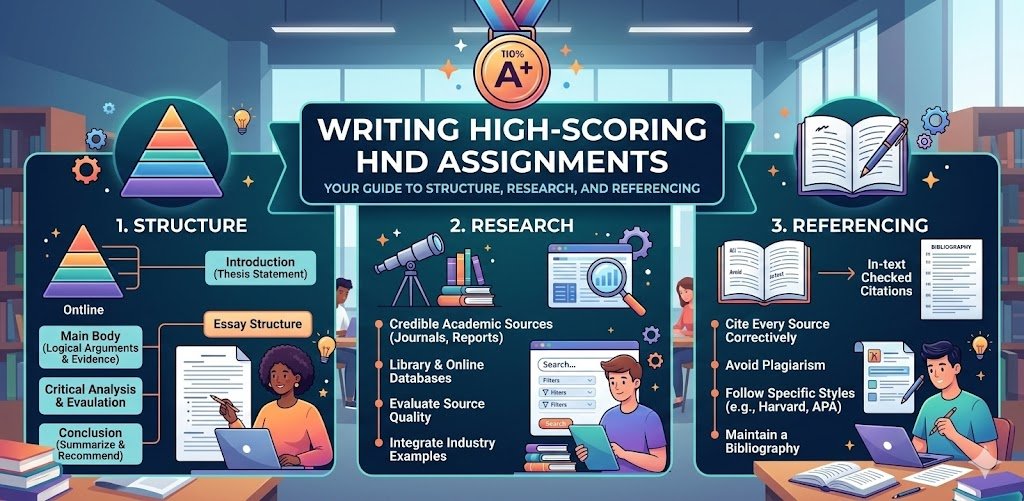
HND assignments require a 4-part structural framework, including an introduction, main body, conclusion, and bibliography. These assignments are evidence-based research, and accurate referencing to achieve Merit and Distinction grades. HND assignments are also required to follow Pearson assessment criteria across introduction, main body, conclusion, and bibliography sections whilst demonstrating critical analysis beyond descriptive writing.
HND assignment optimization becomes complex for students balancing multiple modules, such as Marketing Essentials, Human Resource Management, and Business Law, professional obligations, and personal commitments.
This guide categorizes HND assessment requirements and defines structural protocols for high-scoring submissions. From understanding what assessors want to structuring your work properly and referencing correctly.
What Makes HND Assignments Different?
HND assignments differ from traditional academic essays by prioritizing vocational application over theoretical abstraction through Pearson-specific assessment criteria.
Before diving deep, here’s what you need to know right now:
| Assessment Type | Summative assessment (counts toward final grade) |
| Grading | Pass, Merit, Distinction (not percentages) |
| Word Count | Strictly enforced (±10% tolerance) |
| Referencing | Harvard style (most common) |
| Submission | Electronic via learning platform |
| Plagiarism Check | Turnitin used (similarity must be <20%) |
HND assignments test whether you can apply theory to practice, not just repeat what your lecturer said. Assessors want critical thinking, real-world examples, and proper academic writing.
Understanding HND Assessment Criteria
What Are Grading Descriptors?
Think of grading descriptors like a recipe. They tell you exactly what ingredients (skills) you need for each grade level.
Pass grade needs:
- Basic understanding of topic
- Some relevant examples
- Simple structure
- Mostly correct referencing
Merit grade needs:
- Good understanding with analysis
- Industry examples showing application
- Clear logical structure
- Consistent accurate referencing
- Critical thinking (questioning ideas, not just describing)
Distinction grade needs:
- Excellent depth and breadth
- Independent research beyond reading list
- Sophisticated analysis comparing theories
- Perfect referencing throughout
- Original insights connecting theory with practice
Simple rule: Pass describes, Merit analyses, Distinction evaluates and synthesises.
For comprehensive guidance on achieving Merit and Distinction grades across all HND modules, avail our HND assignment help in the UK today.
The Essential HND Assignment Structure
HND assignment architecture utilizes a standardized academic structure to ensure compliance with Pearson RQF Level 4 and 5 standards. You need a strong foundation (introduction), solid walls (main body), and a proper roof (conclusion).
1. Introduction (10% of word count)
The HND assignment introduction functions as a strategic roadmap that defines the investigation scope, establishes industry context, and outlines the structural trajectory.
It tells readers:
- What the assignment covers (scope)
- Why it matters (context)
- How you’ll approach it (structure overview)
Example opening:
“This assignment examines the impact of digital marketing on small business growth, focusing on social media strategies. Drawing on contemporary marketing theories and UK business case studies, it evaluates how SMEs leverage digital platforms for customer engagement. The analysis proceeds through three sections: theoretical frameworks, practical applications, and strategic recommendations.”
What NOT to do:
- Don’t write about the assignment itself (“This assignment will discuss…”)
- Don’t include background history nobody asked for
- Don’t use personal pronouns (“I think…” or “In my opinion…”)
2. Main Body (80% of word count)
This is where your research, analysis, and critical thinking happen. The main body needs clear sections with descriptive headings.
Use this structure:
Section 1: Theoretical Foundation
- Define key concepts from your curriculum
- Explain relevant theories or models
- Cite academic sources (textbooks, journal articles)
Section 2: Critical Analysis
- Apply theories to real situations
- Compare different perspectives
- Question assumptions (this shows critical thinking!)
- Use industry examples, including Tesla’s supply chain, Amazon’s logistics model, and NHS patient data systems.
Section 3: Practical Application
- Real-world case studies
- Connect theory with workplace practice
- Show how concepts work in actual business situations
Pro tip: Paragraph optimization utilizes the PEE (Point, Evidence, Explanation) methodology to ensure analytical depth:
- Point: State your main idea
- Evidence: Provide research or examples supporting it
- Explanation: Analyse what the evidence means
3. Conclusion (10% of word count)
Your conclusion summarises key findings without introducing new information. Think of it as answering: “So what did we learn?”
Good conclusions:
- Recapitulation of primary arguments presented in the main body.
- Definitive evidence-based conclusions derived from the analysis.
- Synthesis of findings relative to the original assignment prompt.
- Link back to assignment question
- Suggest implications or recommendations
What not to include:
- New evidence or examples
- New arguments not discussed earlier
- Direct quotes or citations
- Personal opinions without evidence
4. References (Not included in word count)
Every source cited in your assignment must appear in your reference list. Most HND courses use Harvard referencing style.
Basic Harvard format:
Books:
Kotler, P. and Armstrong, G. (2021) Principles of Marketing. 18th edn. Harlow: Pearson.
Journal Articles:
Smith, J. (2022) ‘Digital transformation in UK retail’, Journal of Business Research, 45(3), pp. 234-250.
Websites:
Department for Business and Trade (2023) Small Business Statistics. Available at: https://www.gov.uk/business (Accessed: 15 January 2024).
Golden rule:
In-text citations require corresponding bibliography entries if the source appears within the assignment body. If it’s in references, it must be mentioned in your assignment.
Research Tips for High Scores
Where to Find Quality HND Sources
Your academic advisor or module tutor provides a reading list. Start there! But Distinction-level work needs independent research beyond the syllabus.
Best research sources:
- Google Scholar (free academic articles)
- University library databases (JSTOR, EBSCO, ProQuest)
- Government websites (.gov.uk for UK statistics)
- Professional bodies (CIPD for HR, ACCA for accounting)
- Industry reports (Mintel, IBISWorld)
Avoid:
- Wikipedia (use it to find sources, not as a source itself)
- Random blogs without author credentials
- Websites without clear publication dates
- Sources older than 5 years (unless classic theories)
How Much Research is Enough?
Pass level: 5-8 sources (mostly textbooks)
Merit level: 10-15 sources (mix of books, journals, credible websites)
Distinction level: 15+ sources (including recent journal articles and industry reports)
Time-saving tip: Create a research log. Write down each source with page numbers and key quotes immediately. This prevents last-minute reference hunting!
Critical Thinking: The Secret No One Tells You
Here’s what quality of HND assignment writing separates good students from great students: critical thinking. Distinction-level writing demonstrates evaluative synthesis by comparing conflicting theoretical perspectives.
Let’s take a look on some practical examples.
Descriptive writing (Pass level):
“Porter’s Five Forces model analyses industry competition through five factors.”
Analytical writing (Merit level):
“Porter’s Five Forces model provides a structured framework for competitive analysis, yet its static nature limits effectiveness in rapidly changing digital markets where traditional industry boundaries blur.”
Evaluative writing (Distinction level):
“Whilst Porter’s Five Forces remains valuable for established industries, contemporary scholars argue its relevance diminishes in platform economies where network effects and ecosystem dynamics supersede traditional competitive forces (Smith, 2023). This limitation necessitates supplementing Porter’s framework with dynamic capability theories when analysing digital business models.”
See the difference? Distinction-level writing questions theories, compares perspectives, and shows sophisticated understanding.
When developing critical analysis skills feels challenging or you need examples demonstrating Distinction-level thinking, our HND assignment writing service provides model answers showing proper analytical depth across all business, computing, and engineering modules.
Common Mistakes to Avoid
Plagiarism Pitfalls
Plagiarism means using someone else’s work without acknowledgment. Your university checks every assignment through Turnitin software.
Unintentional plagiarism happens when you:
- Copy-paste without quotation marks
- Paraphrase too closely to original text
- Forget to cite sources
- Submit work done by someone else
How to avoid it:
- Always cite sources immediately
- Use quotation marks for direct quotes
- Paraphrase properly (change both words and sentence structure)
- Check Turnitin report before final submission
Other Grade-Killing Mistakes are the following
- Exceeding word count (10% tolerance only)
- Missing submission deadlines (defer if necessary)
- Ignoring assessment brief requirements
- Using informal language or contractions
- Submitting without proofreading
- Forgetting page numbers or headers
Final Checklist Before an HND Assignment Submission
Before clicking submit, check these:
Content:
- Answers the assignment question directly
- Includes introduction, body, conclusion
- Uses relevant theories and examples
- Shows critical analysis, not just description
Structure:
- Clear headings and subheadings
- Logical flow between paragraphs
- Proper paragraph length (not too long or short)
Referencing:
- Every citation has corresponding reference
- Harvard format used consistently
- No missing publication dates or page numbers
Formatting:
- Correct font (usually Arial or Times New Roman, 12pt)
- Double-spaced or 1.5 line spacing
- Page numbers included
- Cover page with student ID
Technical:
- Spell-checked (British English)
- Grammar-checked
- Saved in correct format (usually PDF or Word)
- File named correctly (check submission guidelines)
Conclusion
Writing high-scoring HND assignments requires understanding assessment criteria, structuring work logically, conducting thorough research, and referencing accurately. The difference between Pass and Distinction lies in critical thinking—moving beyond description toward analysis and evaluation whilst connecting theory with real-world practice.
Start assignments early, use your reading list strategically, seek feedback during formative assessment opportunities, and always proofread before submission. Following these guidelines consistently positions you for Merit and Distinction grades throughout your HND programme.
When assignments feel unmanageable or HND grading descriptors are unclear, our professional assignment help services provide expert guidance clarifying requirements and improving academic writing skills. PhD writers at FQ Assignment Help always stay available to support your HND journey toward achieving the best grades you deserve in your HND career.