
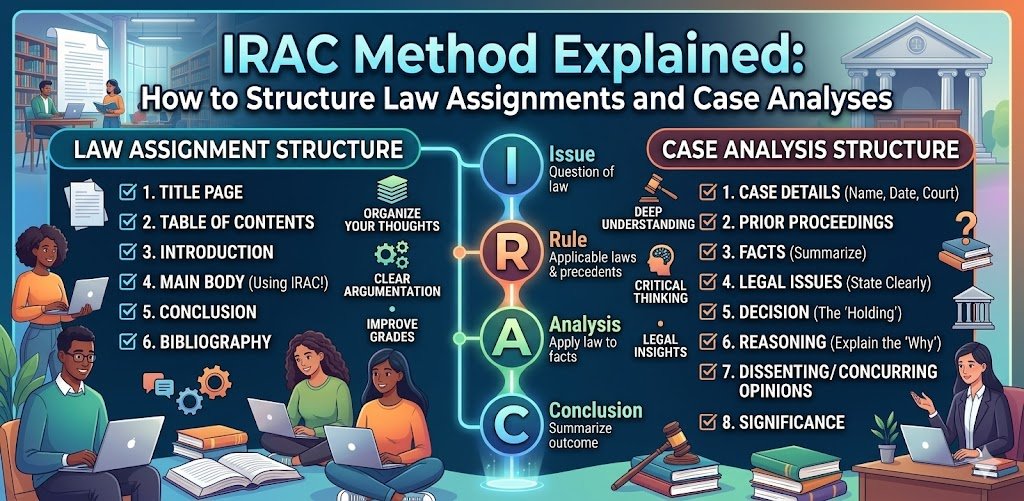
The IRAC methodology is a structure of legal analysis. IRAC stands for Issue, Rule, Application, Conclusion. IRAC provides a systematic legal reasoning structure enabling law students to analyse cases, construct arguments, and present legal advice professionally whilst demonstrating analytical rigor solicitors and barristers employ daily.
Law assignments intimidate students. Complex statutes. Confusing precedents. Dense judgments.
But legal professionals use simple frameworks to organise complex analysis.
IRAC is that framework. Master it, and your law grades transform.
This step-by-step guide shows you exactly how to apply IRAC to every law assignment, essay, and case analysis.
What is the IRAC Method?
IRAC stands for Issue, Rule, Application, Conclusion. It is a four-stage analytical structure that lawyers use to reason through legal problems systematically.
Issue: Identify the legal question requiring resolution.
Rule: State the relevant law (statutes, case law, legal principles) governing the issue.
Application: Apply the law to specific facts, analysing how rules operate in the scenario.
Conclusion: Reach a reasoned judgment answering the legal question posed.
For example, IRAC is your legal GPS. It guides you from problem to solution without getting lost in irrelevant details.
Why Law Lecturers Demand IRAC
Legal reasoning isn’t creative writing. It’s structured argumentation following professional conventions.
IRAC demonstrates:
Systematic thinking, identifying issues before attempting solutions—avoiding conclusions without a legal basis.
Legal knowledge, citing correct authorities (statutes, regulations, case law) supporting arguments.
Analytical skill applying abstract legal principles to concrete factual scenarios.
Professional competence mirrors how solicitors draft legal advice and barristers structure submissions to courts.
Assignments lacking IRAC structure appear disorganised, unsupported, and unprofessional, regardless of substantive legal knowledge.
Step 1: Identify the Issue
The Issue is the legal question your analysis must answer. It’s not the facts—it’s the legal problem arising from those facts.
How to identify issues:
Read fact patterns carefully, highlighting potential legal problems.
Ask: “What legal rights, duties, or liabilities are disputed here?”
Frame issues as precise questions requiring yes/no or qualified answers.
Weak issue identification: “This case involves a contract.”
Strong issue identification: “Did the defendant’s email constitute valid contractual acceptance under postal rule principles established in Adams v Lindsell [1818]?”
Common issue types in law assignments:
Contract law: Was there an offer and acceptance? Was the consideration sufficient? Were contract terms incorporated? Was there a breach?
Tort law: Did the defendant owe a duty of care? Was there a breach? Did the breach cause damage? Are defences available?
Criminal law: Did the defendant possess actus reus (guilty act) and mens rea (guilty mind)? Are defences applicable?
Constitutional law: Does the legislation violate constitutional principles? Is judicial review available?
Equity and trusts: Has a valid trust been created? Were fiduciary duties breached?
Public law: Was the administrative decision lawful, rational, and procedurally fair (Wednesbury reasonableness)?
Tip: Complex scenarios contain multiple issues. Number them clearly: Issue 1, Issue 2, Issue 3. Address each using separate IRAC structures.
Step 2: State the Rule
The Rule is the applicable law governing your identified issue, such as statutes, regulations, case law (precedent), or legal principles.
Sources of legal rules in UK law:
Primary legislation: Acts of Parliament (e.g., Sale of Goods Act 1979, Consumer Rights Act 2015).
Secondary legislation: Statutory instruments, regulations, orders made under enabling Acts.
Case law (common law): Binding precedents from superior courts establishing legal principles through ratio decidendi (the reason for deciding).
EU retained law: EU law retained in UK law post-Brexit under the EU (Withdrawal) Act 2018.
Legal principles: Doctrines like stare decisis (binding precedent), parliamentary sovereignty, rule of law.
How to state rules effectively:
Cite authority precisely: Case names with years in square brackets [2024] or round brackets (2024), plus court abbreviation.
Example: “In Donoghue v Stevenson [1932] AC 562, the House of Lords established the modern duty of care test requiring reasonable foreseeability of harm to proximate claimants.”
Quote key legal tests: Use quotation marks for exact judicial formulations or statutory provisions.
Example: “Section 2(1) Sale of Goods Act 1979 states goods must be ‘of satisfactory quality’ considering price, description, and other relevant circumstances.”
Explain the rule’s operation: Don’t just cite. Explain what the law means and when it applies.
Example: “The postal rule (Adams v Lindsell [1818]) provides acceptance is effective when posted, not when received, creating binding contracts even if letters are lost or delayed.”
Distinguish binding from persuasive authority:
Binding precedent: Must be followed (e.g., Supreme Court decisions bind all lower courts).
Persuasive precedent: May be considered but not binding (e.g., Court of Appeal decisions on other divisions, obiter dicta comments).
Struggling with identifying correct legal authorities or distinguishing binding precedent from persuasive dicta? Our law assignment help connects you with qualified solicitors and barristers who demonstrate proper legal research techniques across contract, tort, criminal, and constitutional law modules, ensuring your work cites appropriate authorities meeting academic and professional standards.
Step 3: Apply the Rule to Facts
Application is where legal analysis happens. You take abstract legal rules and apply them to specific factual scenarios, reasoning toward conclusions.
This is the longest, most critical IRAC section. It’s where you demonstrate legal reasoning ability.
How to apply the law effectively:
Match facts to legal elements systematically:
Break legal tests into constituent elements. Address each element separately using facts.
Example: Tort negligence:
- Duty of care: Does the defendant owe the claimant a duty? Apply the Caparo test (foreseeability, proximity, fairness).
- Breach: Did the defendant fall below a reasonable person standard? Compare conduct to expected standards.
- Causation: Did the breach cause harm? Apply the “but for” test and remoteness principles.
- Damage: What harm occurred? Is it a recognised damage type?
Use analogical reasoning:
Compare your scenario to decided cases. Are facts similar enough that precedents apply? Are there distinguishing features?
Example:
“Like in Carlill v Carbolic Smoke Ball Co [1893], the advertisement here constitutes a unilateral offer because it specifies conditions and promises rewards. However, unlike Carlill, which concerned consumer protection, this commercial context may invoke different consideration principles.”
Apply legal tests step-by-step:
Many legal rules involve multi-stage tests. Work through each stage methodically.
Example, Contract formation:
“Applying the objective test (Smith v Hughes [1871]), would a reasonable person interpret the defendant’s statement as an offer? The use of the words ‘I will sell’, combined with price specification, suggests definite intent. However, the absence of delivery terms may indicate this is merely an invitation to treat (Pharmaceutical Society v Boots [1953]).”
Acknowledge counterarguments:
Strong legal analysis considers alternative interpretations. Present opposing views before explaining why your interpretation prevails.
Example:
“The defendant may argue the exclusion clause is incorporated via course of dealing (Hollier v Rambler Motors [1972]). However, only three previous transactions over five years likely fail the ‘regular and consistent’ threshold established in Spurling v Bradshaw [1956].”
Use legal language precisely:
- Say “the claimant submits, not ‘the claimant thinks”
- Say “the defendant contends, not “the defendant says”
- Say “it is submitted that”, not “I believe”
- Say “on balance” or “arguably” when conclusions aren’t certain
Step 4: Reach a Conclusion
The Conclusion directly answers the Issue you identified in Step 1. It’s your reasoned judgment based on legal application.
How to write strong conclusions:
Answer the question posed: If the issue asks “Is there a valid contract?” your conclusion must say yes, no, or a qualified answer.
Be definitive where possible: “Therefore, there is a binding contract” is stronger than “there might be a contract.”
Qualify when appropriate: Law isn’t always black and white. Use “on balance,” “it is likely that,” “the better view is” when uncertainty exists.
Don’t introduce new arguments: Conclusions summarise reasoning from the Application section. No new cases or facts here.
Connect to practical outcomes: What does your conclusion mean legally? What remedies are available? What should parties do?
Example conclusions:
Definitive:
“Therefore, the defendant breached his fiduciary duty and holds the profit on constructive trust for the claimant under the no-profit rule (Boardman v Phipps [1967]).”
Qualified:
“On balance, whilst the claimant has established duty and breach, causation remains uncertain given intervening factors. Success likely depends on whether courts apply material contribution (Bonnington Castings v Wardlaw [1956]) or material increase in risk (McGhee v NCB [1973]) tests.”
Practical:
“Accordingly, the exclusion clause is likely unenforceable under UCTA 1977 s.3, entitling the claimant to damages for breach. The claimant should issue proceedings before the six-year limitation period expires.”
Understanding ethical legal writing and academic integrity expectations, our guide on academic integrity and ethical writing ensures your law assignments maintain professional standards, avoiding plagiarism whilst properly attributing legal authorities.
IRAC in Different Law Assignment Types
IRAC adapts to various law assignment formats, maintaining a consistent analytical structure.
Problem questions:
Apply the full four-stage IRAC to each legal issue identified in hypothetical scenarios.
Essay questions:
Use IRAC within paragraphs. Each paragraph: Issue (sub-question), Rule (relevant law), Application (analysis), Conclusion (mini-conclusion advancing overall argument).
Case commentaries:
Issue: What legal question did the court decide?
Rule: What law did the court apply?
Application: How did the court reason through facts?
Conclusion: Was the decision correct? What are the implications?
Legal advice:
Frame as a professional memo. The executive summary states the conclusions. The main body uses IRAC to analyse each issue. The recommendations section advises client action.
Conclusion
Mastering IRAC transforms vague legal discussions into professional analyses demonstrating the competence that solicitors and barristers employ when advising clients and arguing cases.
Practice IRAC across every law assignment, including contract formation, negligence claims, criminal liability, and judicial review. The framework remains consistent regardless of substantive law area, building analytical skills essential for legal practice and academic success.
Your law assignments deserve better than guesswork.
Every poorly structured argument, every misapplied precedent, every conclusion lacking legal foundation is a missed opportunity to develop the reasoning skills legal practice demands. Law isn’t about memorising cases. It’s about applying systematic thinking under pressure. Our law essay writing service from qualified solicitors and barristers demonstrates exactly how to structure IRAC analysis. So, stop submitting assignments you’re uncertain about. Get expert guidance from FQ Assignment Help, ensuring your work reflects the analytical rigour law schools and employers expect.