
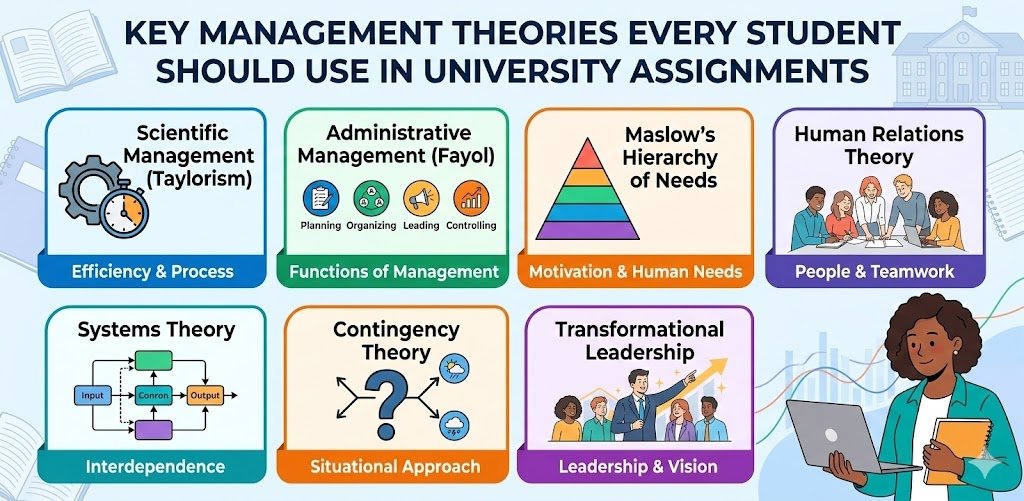
Management theories provide 8 primary analytical frameworks that demonstrate organisational operations, leadership motivation, and corporate efficiency. They’re essential tools for university assignments that require critical analysis, connecting theoretical concepts to real-world business scenarios across operations, leadership, and organisational behavior modules.
This guide categorises 8 fundamental management theories required for academic success in UK business modules. The guide also explains core concepts, practical applications, and how to use them effectively in coursework to achieve Merit and Distinction grades.
What is Management Theory?
Management theory constitutes a collection of systematic frameworks explaining organisational functions, managerial decision-making, and objective attainment. It also tells how organisations function, leaders make decisions, and businesses achieve objectives efficiently. Management theories are developed by scholars and practitioners analysing organisational behavior. Management theories deliver validated principles that guide managerial actions across planning and controlling functions.
Management theories evolved from an early 20th-century efficiency focus through a human relations emphasis toward contemporary systems thinking, including feedback loops, subsystem interdependence, and holistic modeling.
Benefits of Using Management Theory in Assignments
University assignments demand more than describing what happens in organisations. Lecturers expect students to apply established management theories, analyse business situations through theoretical lenses, and evaluate organisational effectiveness using academic frameworks. Understanding key management theories transforms assignments from descriptive accounts into critical analyses demonstrating sophisticated business thinking.
Applying management theories in university assignments demonstrates critical thinking beyond common-sense observations. Management theories provide credible academic foundations supporting arguments, enable systematic analysis of complex business situations, and show an understanding of scholarly management literature.
Theoretical application enables the comparison of diverse management approaches and organisational practices, evaluating organisational practices against established principles, and developing evidence-based recommendations. Assignments incorporating relevant theories score higher because they demonstrate analytical depth, academic rigor, and the ability to connect theoretical knowledge with practical business applications.
Classical Management Theories
1. Scientific Management Theory (Frederick Winslow Taylor)
Scientific Management focuses on improving economic efficiency and labor productivity by finding the “one best way” to perform each task through systematic observation and measurement.
Key Principles: Taylor introduced time and motion studies, analysing how workers complete tasks, identifying inefficient movements, and developing optimised work methods. The theory emphasises task simplification, matching jobs to employee abilities based on scientific assessment, standardised work procedures, piece-rate pay systems linking wages to output, and close supervision ensuring workers follow prescribed methods.
When to Use in Assignments: Apply Scientific Management principles if the assignment analyes operational efficiency, manufacturing processes, or productivity optimisation, manufacturing processes, productivity improvements, or discusses Taylorism’s historical impact. Use it for assignments examining production systems, quality control, or labor management in industrial contexts.
Practical Example: “Amazon warehouse operations exemplify Scientific Management principles through precise task standardisation, technology-guided worker movements, and productivity tracking systems. However, critics argue this approach reduces worker autonomy and job satisfaction, highlighting Scientific Management’s limitations in knowledge-based economies requiring creativity and flexibility.”
This example shows applying theory whilst demonstrating critical thinking by acknowledging both strengths and limitations.
2. Administrative Management Theory (Henri Fayol)
Administrative Management focuses on organisational structure and universal management functions applicable across all organisations regardless of industry or size.
Key Principles:
Fayol identified five management functions:
- Planning (setting objectives)
- Organising (allocating resources)
- Commanding (directing employees)
- Coordinating (harmonising activities)
- Controlling (monitoring performance)
He proposed 14 management principles, including division of work, unity of command, scalar chain (clear hierarchy), and esprit de corps (team spirit).
When to Use in Assignments: Apply Fayol’s theory when analysing management structures, organisational hierarchies, leadership roles, or discussing universal management principles. Effective for assignments examining how organisations coordinate departments or maintain managerial control.
Practical Example: “Tesco’s regional management structure reflects Fayol’s scalar chain principle, with clear reporting lines from store managers through regional directors to executive leadership. However, recent organisational flattening challenges traditional hierarchical assumptions, suggesting Fayol’s principles require adaptation for contemporary agile organisations.”
For comprehensive guidance on management assignment structure and theory application, contact and avail our management assignment writing service today.
3. Bureaucratic Management Theory (Max Weber)
Bureaucratic Management advocates structured, hierarchy-based organisations with clear rules, specialised roles, and impersonal relationships, ensuring consistency and fairness.
Key Principles: Weber proposed formal rules and regulations governing operations, strict hierarchical authority, clear division of labor with specialised roles, merit-based hiring and promotion, written documentation of decisions, and impersonal relationships separating personal feelings from professional decisions.
When to Use in Assignments: Apply Bureaucratic Theory when analysing large organisations, public sector institutions, governmental agencies, such as the Department for Work and Pensions (DWP) or the Home Office, or discussing organisational structures requiring consistency and accountability.
Practical Example: “The NHS exemplifies bureaucratic organisation through standardised procedures, clear hierarchies, and merit-based promotion systems, ensuring consistent patient care across regions. However, excessive bureaucracy creates inefficiencies, demonstrating Weber’s theory works best when balanced with flexibility, allowing frontline innovation.”
Neo-Classical Management Theories
“Neo-classical” means “new classical.” These theories emerged as a response to classical management’s limitations, which focused purely on efficiency and structure, whilst ignoring human psychological and social needs. Neo-classical theories shifted attention from mechanical task optimisation toward understanding human behavior, motivation, and social dynamics in the workplace.
Neo-classical management theories recognise that workers are not simply cogs in a machine but complex individuals influenced by emotions, relationships, and psychological needs.
These approaches emphasise employee satisfaction, group dynamics, informal organisation structures, and participative management styles, arguing that happy, engaged workers produce better results than those simply following standardised procedures under strict supervision.
4. Human Relations Theory (Elton Mayo)
Human Relations Theory prioritises social needs and group dynamics as the primary drivers of employee productivity and workplace morale that employees are motivated more by social needs, personal attention, and group dynamics than purely by money or working conditions.
Key Principles:
The following principles define Human Relations thinking:
- Impact of worker morale on aggregate productivity levels.
- Influence of informal groups on individual employee behavior.
- Effect of management attention on performance outcomes (The Hawthorne Effect).
- Equivalence of social needs to economic incentives regarding employee motivation.
- Correlation between communication and participation and heightened job satisfaction levels.
When to Use in Assignments: Apply Human Relations Theory when analysing motivation, employee engagement, team building, organisational behavior, or workplace culture topics. Particularly relevant for assignments examining leadership styles or employee satisfaction initiatives.
Practical Example: “Google’s emphasis on collaborative workspaces, employee wellbeing programs, and participative decision-making reflects Human Relations Theory principles. The company recognises that social satisfaction and feeling valued drive innovation more effectively than purely financial incentives, demonstrating Mayo’s insights remain relevant in knowledge economies.”
5. Theory X and Theory Y (Douglas McGregor)
Theory X and Theory Y describe contrasting assumptions managers hold about employee motivation, fundamentally influencing management style and organisational culture.
Key Principles: Theory X assumes employees are inherently lazy, dislike work, require coercion and control, avoid responsibility, and need close supervision. This assumption leads to authoritarian management styles with strict control mechanisms.
Theory Y assumes employees are self-motivated, seek responsibility, find work natural and satisfying, and demonstrate creativity when properly engaged. This assumption encourages participative management styles with delegation and empowerment.
When to Use in Assignments: Apply Theory X and Theory Y when analysing management styles, leadership approaches, motivational techniques, or organisational culture. Effective for comparing different leadership philosophies or evaluating workplace environments.
Practical Example: “Traditional call centers often operate under Theory X assumptions, implementing strict monitoring, rigid scripts, and punitive measures for deviation. Conversely, software development companies typically embrace Theory Y principles, offering autonomy, flexible working, and trusting employees to manage their productivity. Comparing these approaches reveals how managerial assumptions shape organisational outcomes.”
Confused about which theory fits your assignment or how to apply it critically?
Our online management assignment help provides clear examples demonstrating how to analyse Taylor, Fayol, and modern theories, helping you identify the theory that best fits your assignment, achieving the analytical depth Merit and Distinction grades require.
Modern Management Theories
6. Contingency Management Theory (Fred Fiedler)
Contingency Theory asserts there is no “one-size-fits-all” management approach. It tells that the most effective management style depends on specific situations, organisational contexts, technology, environment, and workforce characteristics.
Key Principles: Effective management requires situational analysis, leadership adaptability, matching management approaches to circumstances, recognising environmental influences, and flexible strategy application based on contingency factors.
When to Use in Assignments: Apply Contingency Theory when critically analysing why one strategy works in certain contexts but fails elsewhere. Particularly valuable for assignments requiring the evaluation of different management approaches or explaining organisational variations.
Practical Example: “Crisis management during COVID-19 required autocratic leadership, making rapid decisions with limited consultation. However, post-pandemic recovery demanded participative approaches incorporating employee input on hybrid working. This demonstrates Contingency Theory principles, effective leadership style depends on situational demands rather than universal prescriptions.”
7. Systems Theory (Ludwig von Bertalanffy)
Systems Theory views organisations as systems of interrelated parts (subsystems) that must work together harmoniously, constantly interacting with external environments for organisational success.
Key Principles: Organisations comprise interdependent subsystems where changes in one area affect others, synergy emerges when parts work together effectively, open systems exchange resources with environments, feedback loops enable adaptation, and holistic thinking prevents siloed decision-making.
When to Use in Assignments: Apply Systems Theory when analysing complex organisational issues, supply chain management, interdepartmental coordination, or holistic organisational analysis requiring understanding how different elements interconnect.
Practical Example: “Toyota’s production system exemplifies Systems Theory through tight integration between suppliers, manufacturing, quality control, and distribution. Disruptions in semiconductor supply chains demonstrate systems thinking, component shortages in one subsystem cascade through entire automotive production networks, proving organisations cannot be understood by analysing parts in isolation.”
8. Quantitative Management Approach
Quantitative Management uses mathematical modeling, statistics, and data-driven techniques to improve decision-making accuracy through objective analysis rather than intuition or experience alone.
Key Principles: The approach emphasises these analytical methods:
- Operations research optimising resource allocation
- Statistical analysis identifying patterns and trends
- Mathematical modeling predicting outcomes
- Simulation testing scenarios before implementation
- Data-driven decision-making reduces uncertainty
When to Use in Assignments: Apply a Quantitative Approach when analysing strategic planning, logistics, operations management, financial decisions, or any assignment requiring data analysis and evidence-based recommendations.
Practical Example: “Retailers use quantitative forecasting models predicting demand patterns, optimising inventory levels, and preventing stockouts or overstock situations. Marks & Spencer’s supply chain optimisation demonstrates how mathematical modeling reduces waste whilst ensuring product availability, validating Quantitative Management’s value in complex operational decisions.”
Unsure which essay type your management assignment requires? FQ Assignment Help delivers expert guidance, transforming theoretical understanding into high-scoring critical analysis throughout your management assignments.
Use Management Theories Effectively in Assignments
Don’t Just Describe, Analyse!
Avoid merely defining theories. Instead, explain how they apply to specific situations, what insights they provide, and what limitations they reveal.
Weak approach: “Taylor introduced Scientific Management, focusing on efficiency.”
Strong approach: “Taylor’s Scientific Management principles explain why Amazon achieves exceptional warehouse productivity through standardised processes. However, high employee turnover rates suggest efficiency gains come at human costs, revealing theory limitations in modern service economies valuing employee wellbeing.”
Management assignments appear in various formats, including argumentative essays, case study analysis, and reflective reports. Understanding the types of essays students encounter helps you apply theories appropriately to each assignment format.
Compare and Contrast Theories
Demonstrate critical thinking by showing how different theories offer competing perspectives on the same situation.
Example: “While Scientific Management emphasises task efficiency and standardisation, Human Relations Theory prioritises worker satisfaction and social needs. Modern organisations must balance both perspectives, achieving operational efficiency whilst maintaining employee engagement.”
Blend Multiple Theories
Real organisations rarely follow a single theory exclusively. Show understanding by discussing how businesses combine different approaches.
Example: “Google blends Theory Y assumptions about employee motivation with Systems Theory thinking about organisational integration and Quantitative approaches to data-driven decision-making. This theoretical synthesis creates an innovative yet analytically rigorous organisational culture.”
For additional support in developing sophisticated theoretical analysis and achieving distinction-level critical thinking, our professional assignment writing services guide all management modules and assignment types.
Conclusion
Mastering key management theories transforms university assignments from simple descriptions into sophisticated analyses demonstrating theoretical knowledge, critical thinking, and practical application.
Classical theories, including Scientific Management, Administrative Theory, and Bureaucratic Management, establish foundational efficiency principles.
Neo-classical theories like Human Relations and Theory X/Y emphasise human factors. Modern approaches, including Contingency, Systems, and Quantitative theories, provide flexible frameworks addressing contemporary organisational complexity.
Effective theory application requires understanding core concepts, recognising appropriate contexts, analysing real business situations through theoretical lenses, comparing different perspectives, and evaluating both strengths and limitations.
Students demonstrating these skills consistently achieve higher grades by showing analytical depth expected at the university level.