
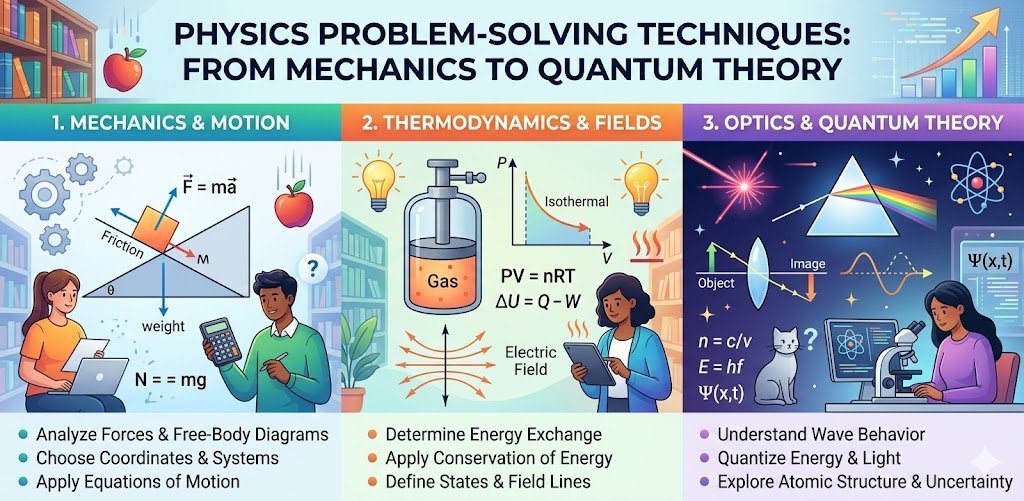
Physics problem-solving requires a systematic approach that combines conceptual understanding, mathematical proficiency, and logical reasoning across classical mechanics, electromagnetism, thermodynamics, and quantum theory. Mastering structured techniques transforms complex problems into manageable analytical challenges.
Physics problems filled with complex equations, abstract concepts, and multiple solution paths. They irritate students altogether.
But here’s the truth: physics problems follow patterns. If you master those patterns, you will solve physics problems confidently.
This guide shows you systematic techniques working across all physics topics. From basic mechanics to quantum theory.
So, let’s get started!
Essential Physics Reference: Save This Section
Before diving into problem-solving techniques, familiarise yourself with fundamental units and formulas appearing throughout your physics degree. Bookmark this section. You’ll reference it constantly.
SI Base Units (Memorise These)
| Quantity | Unit | Symbol | Pronunciation |
| Length | metre | m | MEE-ter |
| Mass | kilogram | kg | KIL-oh-gram |
| Time | second | s | SEK-und |
| Electric current | ampere | A | AM-peer |
| Temperature | kelvin | K | KEL-vin |
| Amount of substance | mole | mol | mohl |
| Luminous intensity | candela | cd | kan-DEL-ah |
Derived Units You’ll Use Daily
| Quantity | Unit | Symbol | Formula | Pronunciation |
| Force | newton | N | kg·m/s² | NEW-tun |
| Energy/Work | joule | J | N·m | jool |
| Power | watt | W | J/s | wot |
| Pressure | pascal | Pa | N/m² | pas-KAL |
| Frequency | hertz | Hz | s⁻¹ | hurts |
| Charge | coulomb | C | A·s | KOO-lom |
| Voltage | volt | V | J/C | vohlt |
| Resistance | ohm | Ω | V/A | ohm |
| Magnetic flux | tesla | T | Wb/m² | TES-lah |
Universal Constants (Never Memorise Wrong Values)
- Speed of light: c = 3.00 × 10⁸ m/s
- Gravitational constant: G = 6.67 × 10⁻¹¹ N·m²/kg²
- Planck’s constant: h = 6.63 × 10⁻³⁴ J·s
- Reduced Planck’s: ℏ = h/2π = 1.05 × 10⁻³⁴ J·s
- Elementary charge: e = 1.60 × 10⁻¹⁹ C
- Boltzmann constant: k = 1.38 × 10⁻²³ J/K
- Avogadro’s number: Nₐ = 6.02 × 10²³ mol⁻¹
Core Formulas Across All Physics Modules
Mechanics:
- F = ma (Newton’s Second Law)
- p = mv (Momentum)
- KE = ½mv² (Kinetic Energy)
- PE = mgh (Gravitational Potential Energy)
- W = Fd cos θ (Work)
- P = W/t (Power)
Electromagnetism:
- F = kq₁q₂/r² (Coulomb’s Law, k = 9.0 × 10⁹ N·m²/C²)
- V = IR (Ohm’s Law)
- P = IV (Electrical Power)
- F = qvB sin θ (Lorentz Force)
- Φ = BA cos θ (Magnetic Flux)
Thermodynamics:
- PV = nRT (Ideal Gas Law, R = 8.31 J/(mol·K))
- ΔU = Q – W (First Law)
- η = W/Qₕ (Efficiency)
Quantum Mechanics:
- E = hf (Photon Energy)
- λ = h/p (de Broglie Wavelength)
- ΔxΔp ≥ ℏ/2 (Heisenberg Uncertainty)
Keep this section in front of you during problem-solving. You’ll thank us later.
The Universal Problem-Solving Framework
Every physics problem, regardless of topic, benefits from systematic approaches that prevent errors and ensure complete solutions.
Step 1: Read and visualise
Read the problems multiple times to understand what’s asked. Don’t rush into equations immediately.
Draw diagrams showing physical situations. Free body diagrams for mechanics. Circuit diagrams for electricity. Energy level diagrams for quantum problems.
Visualisation clarifies problem structure, revealing solution approaches.
Step 2: Identify knowns and unknowns
List given information explicitly:
- Initial conditions
- Physical constants
- Measured quantities
- Constraints or boundaries
Identify what you’re finding. Sometimes problems hide the actual unknown within wordy descriptions.
Step 3: Choose relevant principles
Physics principles guide solutions:
- Conservation laws (energy, momentum, charge)
- Newton’s laws of mechanics
- Maxwell’s equations for electromagnetism
- Schrödinger equation for quantum mechanics
- Laws of thermodynamics for thermal systems
Selecting the correct principles is crucial. Wrong principle = wrong answer regardless of mathematical accuracy.
Step 4: Apply mathematics systematically
Set up equations from chosen principles. Substitute known values. Solve algebraically before inserting numbers when possible.
Show every step clearly. Assessors award marks for methodology, not just final answers.
Step 5: Check reasonableness
Does your answer make physical sense? Negative mass? Speeds exceeding light? Probabilities above 100%? These signal errors.
Verify units. Dimensional analysis catches many mistakes.
Classical Mechanics: Forces and Motion
Mechanical problems involve objects moving under forces. Newton’s laws provide foundations.
Key technique: Free body diagrams
Draw every force acting on objects separately. Include:
- Gravitational force (mg downward)
- Normal forces (perpendicular to surfaces)
- Friction forces (opposing motion)
- Applied forces
- Tension in strings/ropes
Label forces clearly with magnitudes and directions.
Apply Newton’s Second Law systematically:
ΣF = ma for each dimension independently.
Choose coordinate systems to simplify mathematics. Tilted ramps? Rotate axes parallel and perpendicular to surfaces.
Energy methods provide alternatives:
When forces vary with position or paths are complex, energy conservation often provides simpler solutions.
Total energy (kinetic + potential) remains constant in conservative systems.
Electromagnetism: Fields and Circuits
Electromagnetic problems involve charges, fields, and currents.
For electric fields:
Use Coulomb’s law for point charges: F = kq₁q₂/r²
Apply Gauss’s law for symmetric charge distributions.
Remember: field lines show the direction positive charges would move.
For circuits:
Draw complete circuit diagrams showing all components.
Apply Kirchhoff’s laws:
- Current law: Sum of currents entering any junction = sum leaving
- Voltage law: Sum of voltage changes around any closed loop = zero
Simplify complex circuits systematically. Combine series and parallel resistances stepwise.
Magnetic problems:
Use right-hand rules to determine force directions on moving charges or current-carrying wires.
Apply Faraday’s law for electromagnetic induction: changing magnetic flux induces EMF.
Thermodynamics: Heat and Energy
Thermodynamic problems involve temperature, heat transfer, and energy transformations.
First Law: Energy conservation
ΔU = Q – W
Change in internal energy = heat added – work done by system
Track energy carefully. Positive Q means heat absorbed. Positive W means the system works on the surroundings.
Ideal gas law:
PV = nRT connects pressure, volume, temperature, and amount.
Isothermal (constant T), isobaric (constant P), isochoric (constant V), and adiabatic (Q=0) processes each follow specific relationships.
Entropy and Second Law:
Entropy increases in spontaneous processes. Calculate using ΔS = Q/T for reversible processes.
Heat engines have maximum efficiency: η = 1 – Tc/Th (Carnot limit)
Quantum Mechanics: Probability and Uncertainty
Quantum problems abandon classical intuition. Particles behave as waves. Measurements affect systems. Uncertainty is fundamental.
Wave-particle duality:
Use de Broglie wavelength: λ = h/p, connecting particle momentum to wave properties.
Schrödinger equation:
Time-independent form: Ĥψ = Eψ gives energy levels and wavefunctions.
Don’t solve the Schrödinger equation from scratch in assignments. Use known solutions (particle in a box, harmonic oscillator, hydrogen atom), matching problem conditions.
Quantum operators:
Observables correspond to operators. Eigenvalues are measurable values. Eigenfunctions are states with definite values.
Heisenberg uncertainty:
ΔxΔp ≥ ℏ/2
Can’t simultaneously know position and momentum precisely. This isn’t a measurement limitation. It’s fundamental physics.
Probability interpretation:
|ψ|² gives the probability density of finding particles at locations.
Normalisation requires ∫|ψ|²dx = 1 over all space.
Example Problem Solved Step-by-Step:
“A 2kg block slides down a 30° frictionless ramp from a height of 5m. Find the final velocity.”
Given information:
- m = 2 kg (mass of block)
- h = 5 m (starting height)
- g = 9.8 m/s² (acceleration due to gravity)
- Frictionless (important: no energy is lost)
To Find:
Final velocity (v) at the bottom
Solution:
Choose your approach: Use energy conservation (simpler than forces here)
Energy at top = Energy at bottom
PE(initial) = KE(final)
Calculate starting energy (potential energy):
PE = mgh
PE = 2 × 9.8 × 5
PE = 98 J
This 98 joules will all become kinetic energy by the bottom
Set up the kinetic energy equation:
KE = ½mv²
98 = ½(2)v²
98 = v² (the 2 and ½ cancel)
Solve for velocity:
v = √98
v = 9.9 m/s ✓
Check reasonableness: A 2 kg object falling 5 m reaching about 10 m/s makes sense. Not too slow, not impossibly fast.
Note: We didn’t need the 30° angle! Energy methods often bypass the geometric details that force methods require.
Real Talk: Are You Actually Learning, or Just Surviving?
If you’re copying worked examples without understanding them, memorising formulas you can’t apply, or hoping exam questions match tutorial problems exactly. You’re not learning physics, you’re playing roulette with your degree. Our physics assignment help teaches you the problem-solving thinking that textbooks assume you already have. Stop pretending random YouTube videos will suddenly make everything clear. Connect with FQ Assignment Help & get actual expert guidance that builds real understanding.
Common Problem-Solving Mistakes
Mistake 1: Jumping to equations without understanding
Understand physics first. Equations follow understanding, not replace it.
Mistake 2: Ignoring units
Always include units in calculations. Unit mismatches reveal errors immediately.
Mistake 3: Memorising formulas without knowing when they apply
F=ma applies to constant mass. E=mc² for rest mass energy. Each formula has validity conditions.
Mistake 4: Poor diagram quality
Rushed diagrams cause errors. Draw carefully, showing all relevant features.
Mistake 5: Not checking reasonableness
Numbers don’t lie, but your calculation might. Always verify that answers make physical sense.
Conclusion
From classical mechanics using Newton’s laws and energy conservation through electromagnetism’s field equations to quantum mechanics’ probabilistic framework, all these structured techniques ensure comprehensive solutions.
Practice across physics topics builds pattern recognition, revealing when specific techniques work best. Some problems need force analysis. Others need energy methods. Some require wave mechanics. Some demand statistical approaches.
But remember
Every assignment you submit with uncertain methodology, half-understood concepts, or “close enough” calculations leaves marks on the table. The difference between 55% and 75% isn’t usually intelligence. It’s knowing exactly what assessors want to see and how to demonstrate it properly. Our physics assignment help show you precisely how to structure solutions, justify steps, and present work matching distinction-level standards. Contact us today if you’re ready to stop accepting mediocre grades. Make your next physics assignment the turning point of your educational journey.