
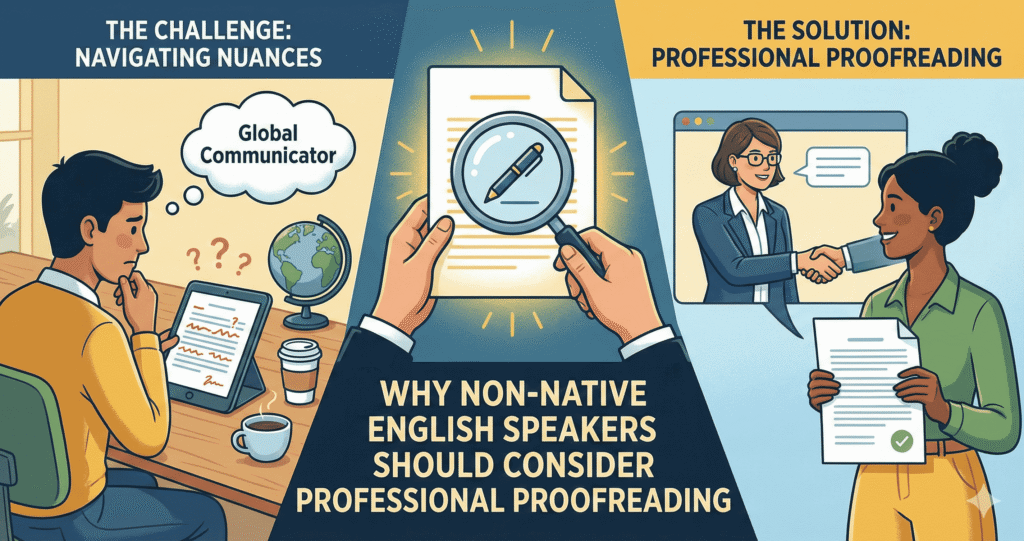
Non-native English speakers should consider professional proofreading because:
- It solves problems that automated spell-checkers and grammar tools cannot fix
- Identifies Homophonic Errors
- Corrects Idiomatic Errors
- And a lot more benefits that we’ll discuss in this guide
But why is professional proofreading so much emphasised for non-native speakers?
Non-native English speakers are individuals whose first language isn’t English. Students who grew up speaking Mandarin, Arabic, Spanish, Urdu, or any of hundreds of other languages, but now study or work in English-dominated environments, such as the United Kingdom (UK).
The challenge?
- English itself is already complicated.
- Non-native English speakers suffer more.
- British English makes it even harder.
According to the 2023/24 – 2024/25 academic year, over 2.5 million non-native English-speaking students are studying in the UK across all education levels. 1.6 million in schools. 730,000+ in higher education.
When in the UK, these students face unique linguistic pressures beyond basic language learning.
Because the UK English demands:
- Upper-class pronunciation standards
- Distinctive spelling conventions:
- -our instead of -or
- -re instead of -er
- -ise instead of -ize)
- Vocabulary that differs completely from American English:
- lift vs elevator
- pavement vs sidewalk
- Non-rhotic pronunciation:
- where the ‘r’ sound disappears from words like “water” or “better.”
These aren’t minor details. They’re marking criteria.
- When your literature essay uses “color” instead of “colour”
- When your business report says “analyze” instead of “analyse”
- When your nursing assignment sounds slightly casual rather than professional
Lecturers notice it! Examiners noticeit!
Your grades suffer not because your ideas are weak, but because your English doesn’t meet expected standards.
The solution > Professional Proofreading!
Why?
Because when non-native English speakers should consider professional proofreading, they:
- Achieve Nuanced Accuracy
- Improve Academic/Professional Credibility
- Correct Idiomatic and Literal Translation Errors
- Identify Homophonic Errors
- Eliminate Grammar and Spelling Errors
- Save Time and Reduce Stress
- Enhance Future Writing Skills
- Build Confidence in Your Writing
- Ensure Academic/Professional Standards Compliance
- Improve Clarity and Coherence
Let’s take a deeper look at it.
1. Achieves Nuanced Accuracy
Nuanced accuracy refers to identifying and correcting subtle language errors that basic grammar checkers miss, such as:
- Wrong Word Choices
- Incorrect Prepositions
- Misused Phrasal Verbs
- Contextually inappropriate expressions that non-native speakers commonly make
Benefits of Nuanced Accuracy
Native-level proofreaders understand how English actually works in professional and academic contexts. They easily spot:
- When you’ve used “discuss about” instead of “discuss.”
- When “make research” should be “conduct research”
- When “depend of” should be “depend .on”
These corrections transform technically correct sentences into genuinely natural English that meets UK academic expectations.
Example of Nuanced Accuracy
You write: “The study focuses about the effects of social media in teenagers.”
A proofreader corrects it to: “The study focuses on the effects of social media on teenagers.”
Both prepositions were wrong. Spell-check missed them completely because they’re real words. Just incorrectly used.
2. Improves Academic/Professional Credibility
Academic and professional credibility means your writing appears competent, trustworthy, and appropriately qualified for its context. Even minor language errors undermine this perception, causing readers to question your expertise regardless of your actual knowledge.
Benefits of Academic and Professional Credibility
In academic journals, business proposals, or professional reports, small errors create disproportionately negative impressions. Reviewers and clients judge your competence partly through language quality. Professional proofreading ensures your ideas receive fair evaluation without linguistic distractions suggesting carelessness, inexperience, or insufficient attention to detail.
Example of Academic and Professional Credibility
Your research might be brilliant, but if your journal submission contains phrases like “the datas shows” or “we have make analysis,” reviewers immediately doubt your thoroughness.
They reject papers not because the research is weak, but because poor English suggests inadequate preparation.
3. Corrects Idiomatic and Literal Translation Errors
Idiomatic errors occur when non-native speakers translate phrases directly from their first language into English, creating grammatically correct but unnatural sentences that native speakers would never use, making writing sound awkward or confusing.
Benefits of Correcting Idiomatic and Literal Translation Errors
Professional proofreaders recognise when you’ve literally translated expressions that don’t work in English. They replace these awkward constructions with natural alternatives that convey your intended meaning clearly.
This transformation makes your writing:
- Flow smoothly
- Sound professionally fluent
- Communicate ideas without the “translated” quality that immediately identifies non-native authorship.
Example of Correcting Idiomatic and Literal Translation Errors
You write: “I have 25 years” (direct translation from many languages).
Natural English: “I am 25 years old.”
Or: “I made a photo of the experiment.”
Natural English: “I took a photo of the experiment.”
Both versions communicate meaning, but one sounds native.
4. Identifies Homophonic Errors
Homophonic errors involve confusing words that sound identical but have different spellings and meanings, like there/their/they’re or your/you’re. These mistakes are particularly challenging for non-native speakers learning primarily through listening.
Benefits of Identifying and Correcting Homophones
Spell-checkers cannot catch homophonic errors because both words are spelled correctly. Just used incorrectly. Professional proofreaders identify these contextual mistakes that completely change your sentence’s meaning. Correcting homophones prevents embarrassing errors that make otherwise strong writing appear careless or demonstrate a fundamental misunderstanding of English mechanics.
Example of Identifying and Correcting Homophones
You write: “The students submitted there assignments on time, but there grades were lower then expected.”
Corrected: “The students submitted their assignments on time, but their grades were lower than expected.”
Every confused homophone was a real word. Spell-check found nothing wrong.
5. Eliminates Grammar and Spelling Errors
Grammar and spelling errors are mistakes in:
- Sentence structure
- Verb tenses
- Subject-verb agreement
- Article usage
- Pluralisation
- Word spelling that makes writing appear unprofessional and creates comprehension difficulties for readers
Benefits of Eliminating Grammar and Spelling Errors
Comprehensive error elimination ensures your writing meets basic linguistic standards before anyone evaluates your ideas. Professional proofreaders catch subject-verb disagreements (“the data shows” vs “the data show”), incorrect tenses, missing or extra articles, and British spelling requirements that distinguish UK academic writing from other English variants.
Example of Eliminating Grammar and Spelling Errors
You write: “The researches was conducted in three hospital over six month period.”
Corrected: “The research was conducted in three hospitals over a six-month period.”
Five errors in one sentence:
- Plural/singular confusion
- Article omission
- Hyphenation error
- Incorrect pluralisation
6. Saves Time and Reduces Stress
Time-saving refers to delegating the detailed, labour-intensive final editing stage to experts whilst you focus on content quality, research depth, and meeting other academic or professional deadlines without sacrificing submission quality.
Benefits of Saving Time and Reducing Stress
Proofreading long documents, such as:
- Dissertations
- Theses
- Comprehensive reports
All demand hours of concentrated attention when you’re already exhausted from research and writing. Professional proofreaders complete this work efficiently whilst you handle other urgent commitments, like:
- Exam revision
- Part-time work
- Additional coursework
- Recovering mentally from intense academic pressure
Example of Saving Time and Reducing Stress
You’ve spent three months researching and writing your 15,000-word dissertation. Self-proofreading would take another 20-30 hours, which you don’t have before Friday’s deadline. A professional completes thorough proofreading in two days whilst you revise for upcoming exams.
7. Enhances Future Writing Skills
Writing skill enhancement means learning from corrections and feedback provided during professional proofreading, allowing you to recognise your recurring mistakes, understand why they’re errors, and avoid repeating them in future work.
Benefit of Professional Proofreading in Writing Skill Enhancement
Professional proofreaders don’t just fix errors. They explain patterns in your mistakes. You discover you consistently misuse particular prepositions, confuse specific tenses, or structure sentences in ways that sound unnatural. This awareness accelerates your English improvement far more effectively than simply receiving unmarked corrected documents.
Example of Professional Proofreading in Writing Skill Enhancement
After three proofread assignments, you notice you always write “according with” instead of “according to.”
Now you consciously correct this before submitting future work. Professional feedback has taught you something grammar books never clarified effectively through abstract rules.
8. Builds Confidence in Your Writing
Writing confidence means trusting that your submitted work represents your abilities accurately without linguistic errors undermining your ideas, reducing the anxiety and self-doubt that often accompany non-native English writing.
Benefits of Building Confidence in Your Writing
Knowing a native-level expert has reviewed your writing eliminates the persistent worry that embarrassing errors might damage your grade or professional reputation. This confidence allows you to submit work proudly rather than anxiously, to participate more actively in academic discussions, and to focus on developing ideas rather than obsessing over language correctness.
Example
Before proofreading, you submit essays while thinking, “I hope my English is okay.”
After professional proofreading, you submit confidently knowing your language quality matches your ideas’ quality. This mental shift reduces stress and allows you to focus on actual learning rather than linguistic anxiety.
9. Ensures Academic/Professional Standards Compliance
Standards compliance means your writing adheres to:
- Specific formatting conventions
- Citation styles, such as:
- Harvard
- APA
- MLA
- Chicago
- OSCOLA
- and more
- British English spelling
- Disciplinary expectations that UK universities and professional organisations require for acceptance and credibility
Role of Professional Proofreaders in Ensuring Academic/Professional Standards Compliance
Different fields demand different standards. Law requires OSCOLA referencing. Psychology uses APA. Business often prefers Harvard. Professional proofreaders understand these variations and ensure your work meets field-specific requirements perfectly, preventing automatic rejections due to technical non-compliance regardless of content quality.
Referencing right also saves you from plagiarism. How? Read our guide How to Reference and Avoid Plagiarism.
Example of Ensuring Academic/Professional Standards Compliance
Your nursing assignment uses American spellings (“analyze,” “color”) and inconsistent referencing.
UK nursing programmes require British English and strict Harvard referencing. Without compliance, your assignment loses marks before anyone reads your clinical analysis. Professional proofreading ensures complete standard adherence.
10. Improves Clarity and Coherence
Clarity means readers understand your intended meaning immediately without confusion. Coherence means your ideas connect logically with smooth transitions, creating unified arguments that flow naturally from introduction through conclusion without awkward jumps.
Benefits
Non-native speakers sometimes structure sentences in ways that obscure meaning or organise paragraphs illogically due to different rhetorical traditions in their first languages. Professional proofreaders restructure unclear sentences, add transitional phrases, and improve logical flow, ensuring your intelligent ideas communicate effectively rather than confusing readers.
Example
You write: “Social media affects teenagers. Mental health problems increase. Parents should monitor usage. Schools can help with education programmes.”
Proofread: “Social media negatively affects teenagers’ mental health. Consequently, parents should monitor usage whilst schools implement education programmes addressing these concerns.”
Same ideas. Vastly improved clarity and coherence.
Taking Your Writing Further
Understanding these ten benefits shows why professional proofreading proves invaluable for non-native English speakers navigating UK academic or professional environments. However, knowing when to use proofreading versus comprehensive editing, or understanding what preparation maximises proofreading effectiveness, requires deeper knowledge of the entire editing process.
Explore our detailed guide on editing and proofreading techniques, and:
- Distinguishing between editing and proofreading
- Understand what each service addresses
- Learn techniques to improve your writing before a professional review
This guide will help you make informed decisions about which services best suit your specific needs and how to prepare your documents for maximum improvement.
Conclusion
Professional proofreading transforms your writing from functional to exceptional, ensuring your ideas receive the recognition they deserve without linguistic barriers holding you back.
Your English skills don’t define your intelligence or capability.
Non-native speakers bring valuable perspectives, rigorous research abilities, and innovative thinking to UK academia and professional environments.
Language shouldn’t prevent you from demonstrating your genuine expertise.
Your ideas matter. Your research matters. Your English shouldn’t hold you back.
That’s why, at FQ Assignment Help, known as the best assignment writing service in London, UK, we provide comprehensive proofreading services specifically designed for non-native English speakers. Our UK-qualified proofreaders understand the unique challenges you face, from preposition confusion to idiomatic awkwardness, and refine your writing while preserving your voice and ideas.
Whether you need support with:
- Essay writing
- Dissertation preparation
- Coursework completion
- thesis development
- Research paper refinement
We offer proofreading integrated throughout the writing process or as a standalone final check.