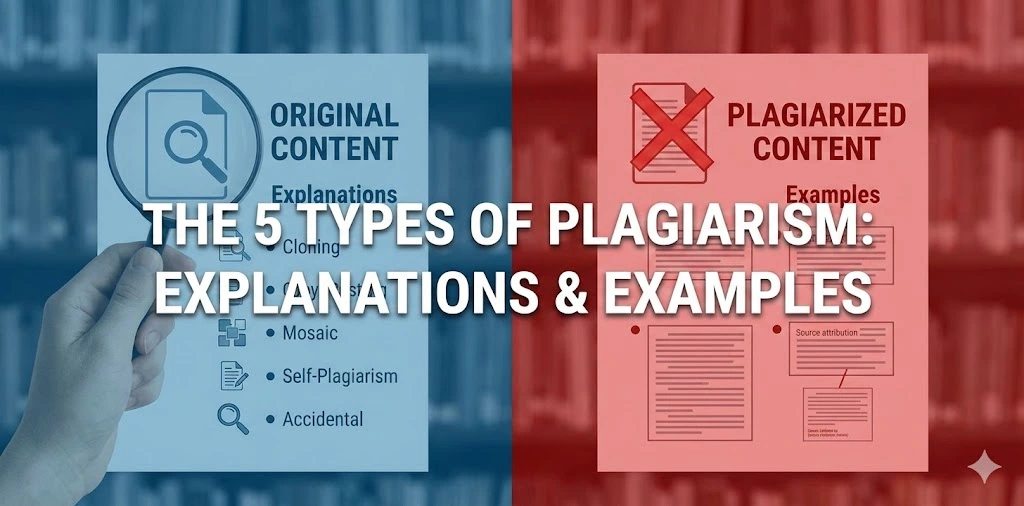
Plagiarism occurs in 5 distinct forms: global, verbatim, paraphrasing, patchwork, and self-plagiarism. Each carries specific academic penalties under UK university misconduct policies.
UK universities apply academic misconduct penalties regardless of which plagiarism type students commit. Understanding all 5 types protects your academic record and prevents unintentional violations that damage degree prospects.
1. Global Plagiarism
Global plagiarism involves the submission of complete external works, such as purchased essays, downloaded assignments, or peer-authored papers.
This includes submitting a friend’s work under your name, purchasing assignments from essay mills, or downloading pre-written essays from internet sources.
Example of Global Plagiarism:
You find a complete essay on “Sustainable Business Practices” online, change the name to yours, and submit it. That constitutes global plagiarism regardless of whether you paid for it, found it free, or received it from someone.
Consequences of Global Plagiarism
Global plagiarism is the most severe form of academic misconduct because it constitutes deliberate cheating.
UK universities apply 6 specific penalties:
- Immediate assignment failure with 0% mark awarded
- Module failure regardless of other assessment performance
- Formal academic misconduct hearing with permanent record notation
- Suspension or expulsion from the university
- Degree classification reduction or complete degree revocation
- Professional career implications, including license revocation, in fields such as Law, Engineering, and Medicine
Plagiarism detection software, such as Turnitin, SafeAssign, and Copyleaks, compares submissions against billions of documents, including essay mill databases, previous student work, and internet sources. Detection is near-certain.
How to Avoid Global Plagiarism:
- Compose original analysis for every assignment
- Reject offers from commercial essay mills
- Submit only self-authored documents
- Start assignments with sufficient time for completion
- Utilise institutional writing centres for legitimate support
- Request deadline extensions from your department if personal circumstances prevent original work completion
Understanding proper academic integrity and plagiarism standards in the UK helps you navigate acceptable support versus misconduct.
2. Verbatim Plagiarism
Verbatim plagiarism means copying text word-for-word from sources without quotation marks or proper citation.
Example of Verbatim Plagiarism:
Original source: “Climate change represents the defining challenge of our generation, requiring immediate coordinated global action.”
Your submission: Climate change represents the defining challenge of our generation, requiring immediate coordinated global action.
Even with a citation at the end, this constitutes verbatim plagiarism without quotation marks indicating these are the author’s exact words, not yours.
Consequences of Verbatim Plagiarism
Severity depends on the extent. UK universities apply progressive penalties:
- Mark deductions ranging from 10-50%, depending onthe extent
- Required resubmission with capped maximum marks
- Academic misconduct warning on the student’s record
- Escalating penalties for repeat offences
- Module failure when verbatim plagiarism is extensive
- Suspension for severe or repeated cases
Detection software like Turnitin highlights exact text matches. Five consecutive words matching a source trigger investigation.
How to Avoid Verbatim Plagiarism:
Step 1: Distinguish note types
- Use quotation marks when copying any text
- Record complete citation information with every note
- Separate direct quotes from paraphrased content
Step 2: Quote properly or paraphrase genuinely
- Apply quotation marks to any copied phrases
- Cite the source after the quoted material
- Minimise direct quotes to instances where exact wording matters
Step 3: Paraphrase with complete reconstruction
- Read the source, close it, then write your understanding
- Restructure sentences, not just swap synonyms
- Cite the source even when paraphrasing ideas
3. Paraphrasing Plagiarism
Paraphrasing plagiarism occurs when you rewrite ideas too close to the original wording, or paraphrase without citing the source.
Example of Paraphrasing Plagiarism:
Original: “Social media platforms have fundamentally transformed political communication by enabling direct politician-to-voter engagement.”
Poor paraphrase (plagiarism): Social media has fundamentally changed political communication by allowing direct engagement between politicians and voters.
This keeps too much original structure and wording despite synonym swaps.
Consequences of Paraphrasing Plagiarism
Paraphrasing constitutes the majority of unintentional academic misconduct cases.
UK universities apply these penalties:
- Mark deductions proportional to the extent (10-40%)
- Academic misconduct notation for extensive or repeated instances
- Required plagiarism awareness training completion
- Resubmission with reduced maximum achievable mark (often capped at 40%)
- Escalating penalties for subsequent offences
- Module failure when paraphrasing plagiarism constitutes the majority of the work
Detection software analyses sentence structure and word patterns, not just exact matches. Similar phrasing triggers flags even when individual words differ.
How to Avoid Paraphrasing Plagiarism:
The read-understand-close-write method:
- Read the source material
- Ensure genuine understanding of the concept
- Close the source
- Write your explanation from memory in your own words
- Verify your version differs in structure and wording
- Cite the source, even when paraphrased
Additional strategies:
- Change sentence structure (active to passive, reorder clauses)
- Use different vocabulary whilst maintaining meaning
- Combine information from multiple sources into a single explanation
- Express ideas through different examples or explanations
- Remember: cite any idea that isn’t originally yours
Learning comprehensive referencing techniques and plagiarism avoidance strategies ensures proper paraphrasing and citation.
4. Patchwork Plagiarism (Mosaic Plagiarism)
Patchwork plagiarism means piecing together phrases, sentences, or ideas from multiple sources without proper quotation or citation, creating a mosaic of others’ work presented as your own writing.
Example of Patchwork Plagiarism:
Sentence 1 from Source A: “Renewable energy technologies have advanced.”
Sentence 2 from Source B: “However, implementation challenges remain substantial.”
Sentence 3 from Source C: “Government policy support proves crucial for adoption.”
Your submission combining these: Renewable energy technologies have advanced. However, implementation challenges remain substantial. Government policy support proves crucial for adoption.
Each sentence comes from different sources, creating patchwork plagiarism even if cited, because the writing isn’t genuinely yours.
Consequences of Patchwork Plagiarism
Modern detection software analyses writing patterns across submissions, identifying when text doesn’t flow or when style shifts in an inconsistent way.
UK universities apply these penalties:
- Substantial mark penalties (20-50%)
- Academic misconduct proceedings with formal warnings
- Required rewrite demonstrating genuine original writing
- Capped maximum marks on resubmission (often 40%)
- Module failure when patchwork comprises the majority of the work
- Degree classification impact for repeated occurrences
How to Avoid Patchwork Plagiarism:
Write-first, research-second approach:
- Draft initial thoughts and arguments
- Research to find evidence supporting your ideas
- Integrate sources as evidence, not as primary text
- Ensure transitions and explanations use your voice
Additional prevention:
- Limit direct quotes to an absolute minimum
- Synthesise multiple sources into your explanation when paraphrasing
- Use sources to support points you’ve made, not to make points
- Read your work aloud to verify a consistent voice
- Ensure every paragraph contains substantial original analysis, not stitched citations
5. Self-Plagiarism
Self-plagiarism means reusing your own previous submissions without permission or proper citation, including submitting the same essay to different modules or recycling paragraphs from old assignments.
Example of Self-Plagiarism:
You wrote an essay on “Marketing Ethics” for the Business Ethics module last year. This year, the Marketing Strategy module assigns a similar topic. You submit the same essay or large sections of it.
That constitutes self-plagiarism, even though the work is originally yours.
Consequences of Self-Plagiarism
Academic misconduct panels categorise self-plagiarism as a violation of dual submission policies.
UK universities apply these penalties:
- Assignment failure for both current and previous submissions
- Academic misconduct charges with a permanent record notation
- Mark penalties or capped grades on resubmission
- Required rewrite of the new original work
- Module failures when extensively self-plagiarised
Universities maintain databases of all submissions. Detection software compares current work against everything you’ve submitted, flagging matches.
How to Avoid Self-Plagiarism:
- Create new work, from scratch, for every assignment without explicit permission to reuse
- Write new analyses from different angles when topics overlap
- Cite your previous work, like any source, if referencing it
- Seek permission before building on previous assignments
- Approach similar topics from fresh perspectives with new research
- Demonstrate new learning and development in each assignment
Frequently Asked Questions
What is global plagiarism?
Global plagiarism involves the submission of complete external works, including purchased essays, downloaded assignments, or peer-authored papers. It’s the most severe plagiarism type because it constitutes deliberate cheating rather than citation errors. Consequences include immediate failure, academic misconduct hearings, and potential expulsion.
What is verbatim plagiarism?
Verbatim plagiarism means copying text word-for-word from sources without quotation marks or proper citation. Even with a citation at the sentence’s end, failing to use quotation marks around copied text constitutes verbatim plagiarism because you’re presenting the author’s exact words as your writing.
Is paraphrasing considered plagiarism?
Paraphrasing itself isn’t plagiarism. It’s required for academic writing. However, paraphrasing becomes plagiarism when done with errors: keeping too much original structure or wording (even with synonyms), or paraphrasing without citing the source. Proper paraphrasing means rewriting in your own words while citing the original author.
What is patchwork plagiarism?
Patchwork plagiarism (mosaic plagiarism) means piecing together phrases, sentences, or ideas from multiple sources without proper quotation or citation, creating a mosaic of others’ work. Even with eventual source citations, stringing together their text rather than writing genuine original analysis constitutes patchwork plagiarism.
Can you plagiarise yourself?
Yes. Self-plagiarism means reusing your own previous submissions without permission or citation. Submitting the same essay to different modules, recycling substantial paragraphs from old assignments, or republishing your work as new all constitute self-plagiarism. Universities consider this academic misconduct because each assignment must demonstrate new learning.
Are there more than 5 types of plagiarism?
These 5 categories (global, verbatim, paraphrasing, patchwork, self-plagiarism) represent the main classifications. Some sources identify additional specific types like accidental plagiarism (unintentional citation errors), incremental plagiarism (citing some sources but not all), or source-based plagiarism (citing non-existent sources). All fall under these 5 broader categories.
Is using ChatGPT and other AI plagiarism?
Yes. Submitting AI-generated content as your own work constitutes plagiarism, similar to global plagiarism. UK universities prohibit submitting AI-written work without a declaration. You’re presenting external work (the AI’s output) as your intellectual effort. AI detection tools are sophisticated, and consequences mirror traditional plagiarism penalties, including failure and misconduct charges.
What is the rule of 5 in plagiarism?
The Rule of 5 is a practical heuristic where 5 consecutive matching words trigger a similarity flag in plagiarism software. Four words are acceptable in context, but 5 raise concerns. However, copying unique phrases of any length without attribution constitutes plagiarism regardless of word count. Context matters more than arbitrary numbers.
How many words in a row constitute plagiarism?
There’s no definitive threshold. Five consecutive words represent the common standard triggering plagiarism concerns, but 4 words are also plagiarism if they’re distinctive phrasing. The key isn’t word count. It’s whether you’re copying a unique expression without attribution.
Is 5 per cent plagiarism bad?
5% similarity is acceptable when it represents quoted and cited material, common phrases, or reference lists. However, context matters. 5% verbatim plagiarism without citations is serious, whilst 5% similarity from legitimate quotes and references is fine. Most universities consider below 10-15% acceptable, but investigate the nature of similarities, not just percentages.
What is 1% plagiarism?
1% similarity represents standard academic nomenclature or bibliographic entries. This level comprises quoted citations, common phrases, or reference list matches. Most plagiarism detection software flags matches, but 1% rarely warrant investigation. However, even 1% uncited verbatim copying constitutes plagiarism. Percentage doesn’t determine whether plagiarism occurred, just its extent.
How many levels are there in plagiarism?
UK universities categorise plagiarism severity by similarity percentage into 4 levels: Level 0 (up to 10% – minor, no penalty), Level 1 (10-40% – moderate penalties, mark deductions), Level 2 (40-60% – severe penalties, possible failure), Level 3 (above 60% – extremely severe, potential expulsion). Specific percentages and consequences vary by institution.
Is 25% plagiarism acceptable?
No. 25% similarity triggers Level 2 academic misconduct proceedings in UK universities. Consequences include assignment failure or substantial mark deductions (40-50% reduction minimum). Acceptable similarity sits below 10-15%, excluding quoted and cited material. 25% indicates extensive copying or failure to paraphrase and cite sources.
How can I check my plagiarism?
Most UK universities provide students access to plagiarism detection software (Turnitin) through virtual learning environments before final submission. Submit drafts to check similarity reports, then revise. Free alternatives include Grammarly’s plagiarism checker (limited), Quetext, or Scribbr. However, university-provided tools are most reliable because they compare against the same databases lecturers use.
Is 2% plagiarism okay?
Yes. 2% similarity represents quoted citations, common phrases, reference lists, or coincidental matches with standard academic language. Most universities don’t investigate similarity below 10%. However, review what comprises that 2%. If it’s uncited direct copying rather than legitimate matches, it’s plagiarism regardless of low percentage. Context matters more than numbers.
How do teachers detect plagiarism?
Lecturers use 4 detection methods: (1) Plagiarism detection software like Turnitin comparing submissions against billions of sources, previous student work, and internet content; (2) Recognising inconsistent writing styles, sudden sophistication changes, or formatting inconsistencies within papers; (3) Identifying citations that don’t match reference lists; (4) Experience spotting unusual phrasing or advanced vocabulary misuse.
Conclusion
Understanding all 5 plagiarism types, including global, verbatim, paraphrasing, patchwork, and self-plagiarism, protects your academic integrity and degree prospects.
Each type carries serious consequences. Detection software is sophisticated. Claiming ignorance provides no defence when universities discover plagiarism.
Prevention requires: writing your own work, quoting and citing, responsible paraphrasing, integrating sources in a thoughtful way, and creating new content for every assignment.
FQ Assignment Help supports students in maintaining academic integrity whilst developing strong writing skills. We don’t encourage plagiarism. We help you avoid it by demonstrating proper research integration, citation techniques, and original writing development.
We provide examples of proper citation, teach effective paraphrasing, and help you develop research and writing skills that make plagiarism unnecessary through essay writing, dissertation support, coursework assistance, and research paper development.
Your academic integrity matters. Your degree matters. We help you protect both.