
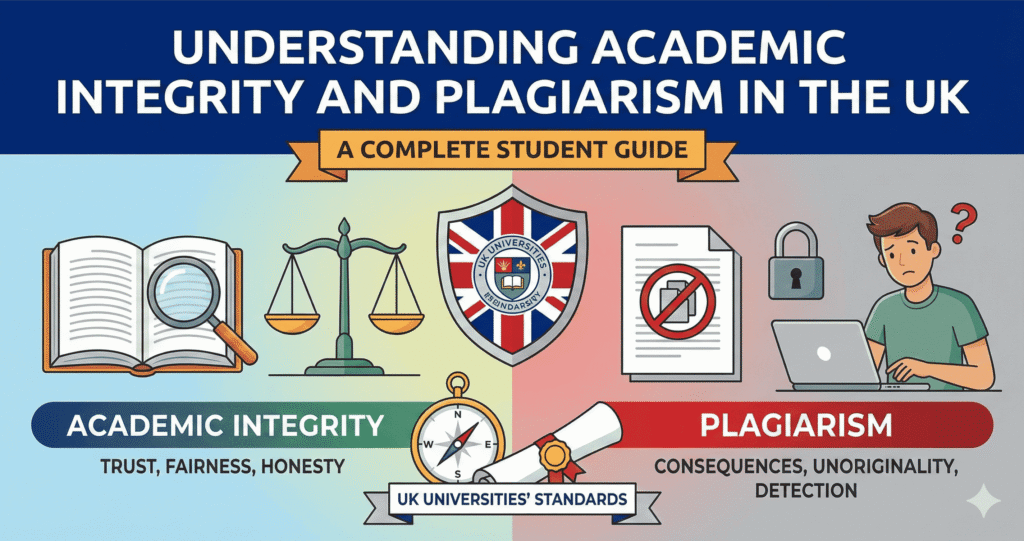
Understanding academic integrity and plagiarism in the UK isn’t just a box to tick. It can make or break your university career. One careless citation, one unattributed quote, and suddenly you’ll be facing warnings, mark deductions, or worse. Yet, most students barely glance at the rules until it’s too late.
Here’s the reality:
UK universities take academic honesty seriously. Assignments aren’t just about getting words on a page; they’re about:
- Showing your thinking
- Supporting your arguments ethically
- And giving credit where it’s due
If you’re an international student, you must stumble first because expectations differ from your home country. Even common mistakes in university assignments, like paraphrasing poorly, forgetting a reference, or reusing old work without declaration, can land you in unfavorable consequences.
This guide is your all-in-one roadmap. From what counts as plagiarism to understanding UK integrity policies, spotting common pitfalls, and learning practical strategies to write ethically, we cover everything you need.
By the end, you’ll not only avoid mistakes but also write smarter, more confident, and academically stronger work.
What Is Academic Integrity?
[heading linked to our other guide: What Is Academic Integrity? A Student-Friendly Guide to Ethical Writing]
Academic integrity is about being honest and responsible in your university work. It’s about showing your thinking clearly, giving credit to others’ ideas, and producing work that’s genuinely yours.
For example, a rulebook for fair play in learning.
- Follow it, and your grades, reputation, and confidence all benefit.
- Ignore it, and even small mistakes will take you into serious trouble.
Universities in the UK expect students to adhere to high standards. That means no cheating, no copying, no buying essays, and no sneaky shortcuts. Every argument you make should be backed by evidence, every quote properly cited, and every idea clearly attributed. Even when paraphrasing counts, you must show where the original thought came from.
Why is Academic Integrity So Important?
Academic integrity isn’t just about avoiding penalties. It’s bigger than that. It’s about trust.
- Your lecturer trusts that the work you submit is genuinely yours.
- Your peers trust that grades are earned fairly.
- And most importantly, you trust yourself to grow, learn, and develop real skills.
Ignoring academic integrity seems harmless at first. A missed citation here, a quick copy-paste there. But it results spiral into lost marks, formal warnings, or even serious disciplinary action.
Upholding academic integrity builds more than just safety; it builds credibility, sharpens critical thinking, and strengthens confidence. It teaches you how to structure arguments, use evidence properly, and express ideas in your own voice.
Mastering academic honesty will make everything you write later easier and more respected. Assignments, dissertations, and even professional work, the skills stick for life.
Types of Academic Misconduct
Academic misconduct is any action that breaches university rules and academic honesty. It’s not just one thing; there are several ways students can slip up, knowingly or unknowingly. Each type of academic misconduct has its own pitfalls and ways to stay on the safe side.
1. Plagiarism
Plagiarism is using someone else’s words or ideas without proper credit.
For example: Copying a paragraph from a website or book without citation.
What’s the right way?
- Always cite your sources, paraphrase properly, and include a reference list.
- Use tools like Zotero or EndNote to organise citations.
2. Self-Plagiarism
Self-plagiarism is about submitting your own previous work as if it’s new, without citing it. This happens when students reuse essays or assignments from past courses. Even though it’s your work, presenting it as original breaches academic integrity.
For example, handing in a report you wrote last year for a different module.
How to Avoid?
- Always create fresh content for new assignments.
- If you must reference previous work, cite it properly.
3. Collusion
Collusion happens when working with others on work meant to be individual.
For example, two students submit very similar essays.
How to Avoid?
- Collaborate only when allowed
- and make sure your work is independently written.
4. Contract Cheating
Contract Cheating is paying or asking someone else to complete your assignment.
For example, you can buy an essay online or have a friend write it for you.
The Right Way:
- Do your own work.
- Seek help only for guidance or editing, not writing.
5. Falsification of Data
Falsification of Data is about making up or manipulating research results or information.
For example, fabricating survey responses or experiment results.
How to Avoid?
- Record results honestly.
- Double-check numbers and sources.
6. Misconduct During Examinations
Misconduct during examinations is when you cheat in tests or exams.
For example, bringing notes into a closed-book exam, copying from peers.
How to Avoid?
- Prepare thoroughly and follow all exam rules.
7. False Declarations
False declaration is about providing untrue statements in your assignments or forms submitted to the university. This includes claiming you did work you didn’t or exaggerating your contributions. It undermines trust between you and your lecturers.
For example, signing a cover sheet stating the work is entirely your own when it wasn’t.
How to Avoid?
- Be honest about your contributions and any collaborative efforts.
8. Impersonation
Impersonation is having someone else complete work or attend an exam on your behalf. This is a serious breach because the work submitted does not reflect your own knowledge or skills.
For example, asking a friend to sit an online test for you.
How to Avoid:
- Always complete assessments personally. Universities have strict identity verification measures for a reason.
9. Unauthorised Use of AI Tools
Using AI-generated content without permission or proper attribution in assignments. Even if the tool provides ideas, presenting it as entirely your own work counts as misconduct.
For example, copy-pasting paragraphs generated by an AI essay writer without citing it.
How to Avoid:
- Use AI only as a guide for research or brainstorming.
- Always write in your own words and acknowledge AI use if allowed.
Consequences on Grades and Academic Record
Breaking these rules can have serious effects:
- Failing the assignment
- Losing marks
- Receiving formal warnings
- Or a permanent note on your academic record
In severe cases, suspension or expulsion is possible. Following ethical practices isn’t just safe. It protects your grades, reputation, and academic future.
Common Causes of Plagiarism
Plagiarism isn’t always done consciously or intentionally. Many students fall into it without realising the consequences. Understanding the common triggers helps you avoid slipping up.
Poor Referencing:
Not knowing how to cite properly is a major cause. Students forget in-text citations, misformat references, or mix styles. Even small mistakes can be flagged as plagiarism.
Time Pressure:
Leaving assignments to the last minute forces rushed writing. Under stress, it’s tempting to copy-paste from online sources instead of paraphrasing and citing correctly.
Misunderstanding the Rules:
International students face challenges adapting to UK academic integrity expectations. Differences in academic culture or assumptions about “common knowledge” can lead to unintentional misconduct.
Other Causes:
Lack of planning, over-reliance on sources, or using AI tools without proper attribution can also contribute.
To prevent these issues, focus on careful note-taking, structured planning, and understanding what constitutes ethical academic writing. For practical insights on where students commonly go wrong, our guide on common mistakes in university assignments breaks down these pitfalls and shows how to avoid them effectively.
How to Avoid Plagiarism
Avoiding plagiarism isn’t about being “extra careful.” It’s about following a clear, simple system every time you write. Start with proper paraphrasing. This means rewriting ideas fully in your own words and with your own structure.
Changing a few phrases isn’t paraphrasing. It’s patchwriting, and UK universities flag it instantly.
When you need to keep an author’s exact wording, use direct quotes with quotation marks and a citation. For large sections of meaning, use summarising, where you condense the main idea in a shorter form, still with a citation.
| Quoting | Summarising |
| Use the author’s exact words | Use your own wording |
| Short extracts only | Condensed version of a large idea |
| Always use quotation marks | No quotation marks |
| Best for definitions, strong statements | Best for long explanations or theories |
Understanding citation styles also helps.
- APA: Common in psychology, education, social sciences. Example: (Smith, 2024).
- Harvard: Popular across UK universities. Example: Smith (2024).
- MLA: Used in humanities and literature. Example: (Smith 24).
- Chicago: Preferred in history and arts disciplines. Example: footnotes or endnotes.
No matter the style, the rule is the same: cite every idea that isn’t originally yours.
For a deeper breakdown of citation rules and ethical writing, you can always revisit our detailed guide on how to reference and avoid plagiarism, especially when polishing your assignment before submission.
Using Reference Management Tools
Reference management tools are simple software programs that store, organise, and automatically format your citations and references. Instead of manually typing every source, these tools keep all your research in one place and generate perfectly formatted reference lists in seconds.
They are as your personal “citation assistant.”
- Fast
- Accurate
- And well-organised
The most widely used tools among UK university students include:
- Zotero: Free, beginner-friendly, perfect for quick saving of articles and PDFs.
- Mendeley: Great for organising research papers and adding notes inside PDFs.
- EndNote: More advanced; ideal for large research projects and dissertations.
- RefWorks: Cloud-based option widely supported by universities.
- Paperpile: Smooth, distraction-free tool for Google Docs users.
What do these tools actually help with?
They:
- Save sources automatically from Google Scholar, JSTOR, or library databases
- Create in-text citations in any style (APA, Harvard, MLA, Chicago, etc.)
- Build reference lists with one click
- Sync across devices so your research stays organised
- Reduce the risk of plagiarism caused by missing or incomplete citations
Benefits? A lot.
- You write faster because you’re not scrambling for source details.
- You stay accurate because the tool formats everything properly.
- You stay organised because all your readings, notes, and citations live in one clean library.
Maintaining Academic Integrity in Group Work
Group assignments look simple, until they aren’t. Everyone has different work habits, writing styles, and levels of understanding. That’s where academic integrity becomes crucial.
In UK universities, collaboration is allowed, but only within the boundaries of the assignment brief. Step outside those boundaries, and it quickly turns into unintentional collusion. A misconduct many students don’t even realise they’re committing.
One essential tool to prevent this is a Group Work Log.
It’s a shared document where every team member records:
- What task they completed
- When they completed it
- How they contributed
- Any sources or materials they used
This log protects the group by creating a clear, transparent record of individual contributions. If a lecturer ever questions authorship, you have proof. It also keeps the workload fair and prevents that one teammate from quietly disappearing into thin air.
Still, every group face one common problem:
- The collusion!
It happens in without anyone realising. Someone shares a “draft,” another copies a paragraph just to save time, and suddenly the whole group is submitting the same wording. No one plans to cheat, but the outcome looks exactly like it.
To avoid unintentional collusion:
- Share ideas, not completed answers
- Write your own parts individually
- Use shared documents only for planning, not copying
- Always cite external sources, even within group drafts
When everyone understands their role and keeps evidence of their work, group projects become safer, smoother, and academically honest.
Role of Universities and Policies
Most UK universities adopt formal academic integrity and misconduct policies that define acceptable behaviour, referencing requirements, and what counts as misconduct. Institutions follow standards set out by regulatory bodies to ensure fairness and consistency.
As part of these guidelines, students are asked to sign or acknowledge codes of conduct or honesty declarations before submitting assessed work. This reinforces the expectation that all submitted work must be original and properly referenced.
How integrity is monitored?
Many UK institutions use the software Turnitin UK to screen submitted assignments. The tool checks your text against a huge database of published sources and previously submitted student work, producing an “originality report” that flags matching passages.
But detection isn’t automatic guilt. Markers review flagged matches carefully. Quotations, references, and correctly cited passages generate matches too. Final decisions rely on academic judgment.
Besides software, some departments perform random or selective checks; some ask for drafts or previously submitted materials. For serious concerns, like suspected fake work or “contract cheating” universities hold interviews or viva-voce sessions to confirm authorship.
Penalties and Appeals
Consequences for academic misconduct vary depending on severity and whether it’s a first offence. Many universities treat minor mistakes (e.g. poor referencing) as “poor academic practice,” offering feedback instead of punishment.
For confirmed plagiarism, collusion or more serious misconduct, penalties can include: a zero mark for the assignment, resubmission with mark cap, failing the module, suspension, or even loss of degree.
Institutions also provide a right to appeal. If you believe a decision is unfair, you can request a review. Normally through the university’s formal appeals or academic misconduct office.
Practical Tips for Ethical Writing
Ethical writing means producing work that is genuinely yours. Your ideas, your voice, your interpretation, while giving proper credit to any source you use. No secret copying. No recycled paragraphs. No “mix-and-match from Google.”
It’s about honesty, clarity, and academic responsibility. Simple but not always easy when deadlines breathe down your neck.
Here’s how to keep your writing clean and credible:
1. Master your time before it masters you
Most plagiarism happens when deadline fears student the night before submission and students grab “shortcuts.” Better planning eliminates that trap. Break your assignment into research > outline > draft > edit.
If you struggle with structuring your study schedule, practical strategies in our guide will teach you the best ways to improve time management for writing assignments and will help you stay ahead instead of scrambling behind.
2. Plan Your Work So Ideas Flow Naturally
When you understand your topic deeply, you don’t feel the urge to copy. Create mind maps, bullet outlines, or section-based plans. This gives your writing direction and reduces “blank page stress.”
3. Proofread & Edit Your Paper
Ethical writing isn’t just about avoiding plagiarism. It’s about accuracy. Rushed work leads to accidental patchwriting, uncited paraphrasing, and duplicated lines without noticing.
A quick, sharp editing routine or effective techniques from practical proofreading and editing methods can help you refine sentences, clean citations, and catch accidental overlaps before Turnitin does.
4. Avoid Last-Minute Shortcuts.
If something feels off, it is off! Don’t “borrow a friend’s paragraph,” don’t spin texts, don’t rely on AI summaries without proper citation.
Ethical writing = confidence + clarity + credibility. Keep it clean. Keep it yours.
Conclusion
Understanding academic integrity and plagiarism in the UK isn’t just a rule to follow. It’s a foundation for trust, fairness, and genuine academic growth. When you know how to reference correctly, write ethically, and manage your work with confidence, you’re not just avoiding penalties, you’re building long-term skills that stay with you beyond university.
Academic integrity protects your credibility, strengthens your writing, and ensures your degree reflects your effort. Not shortcuts or borrowed work. And once you learn to work honestly, plan ahead, and cite properly, every assignment becomes easier, cleaner, and far less stressful.
For better guidance with your referencing and plagiarism-free assignments, FQ Assignment Help can help you stay compliant and submit confidently.