
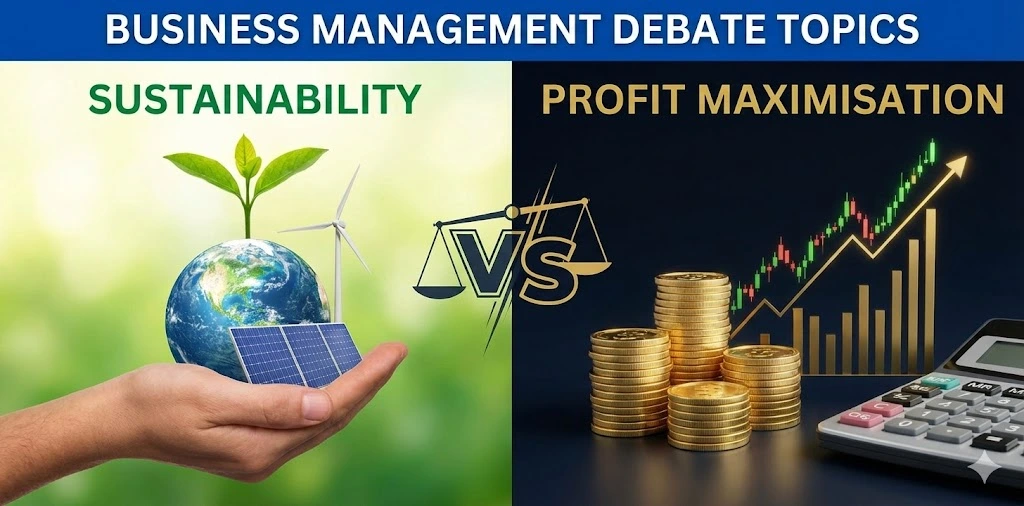
Strategic integration of sustainability and profit maximisation balances environmental responsibility and financial returns within the sustainability versus profit maximisation debate.
Boardrooms, academic discussions, and policy forums prioritise the sustainability debate globally. Business students, MBA candidates, and corporate strategists grapple with questions about corporate responsibility, shareholder value, stakeholder interests, and long-term viability in resource-constrained environments.
Understanding both perspectives and the middle ground equips students to analyse complex business dilemmas, develop nuanced arguments, and propose solutions addressing economic, environmental, and social dimensions.
Understanding the Core Debate
The debate evaluates the tension between long-term environmental survival and short-term shareholder returns. Businesses achieve financial success by integrating sustainability into their core strategy if they utilise innovation and stakeholder engagement.
Profit maximisation proponents contend businesses exist primarily to generate shareholder returns, with social issues addressed by governments and non-profit organisations.
The middle ground suggests businesses can integrate sustainability into core strategy, achieving financial success whilst addressing environmental and social challenges through innovation, efficiency, and stakeholder engagement.
This debate extends beyond theoretical discussion into practical business decisions: supply chain management, product development, marketing strategies, employee relations, and investment priorities.
25 Debate Topics on Sustainability vs. Profit Maximisation
Corporate Strategy and Governance
1. Should corporations prioritise shareholder value or stakeholder value in decision-making?
Examines Milton Friedman’s shareholder primacy theory versus stakeholder capitalism models, balancing 5 core interests, such as investors, employees, customers, suppliers, and communities.
2. Do environmental regulations drive innovation or reduce competitiveness?
Strict environmental standards force beneficial innovation according to the Porter Hypothesis or increase costs, reducing global competitiveness, particularly for SMEs.
3. Can businesses achieve genuine sustainability without sacrificing profitability?
Investigate whether sustainability initiatives represent cost centers or revenue opportunities through brand differentiation, operational efficiency, and market access.
4. Should companies face legal penalties for greenwashing?
Debates appropriate consequences for 3 misleading environmental claims, including carbon-neutral assertions, plastic-free labeling, and non-toxic certification, and whether regulatory enforcement or market mechanisms better address deceptive sustainability marketing.
5. Do sustainability-focused companies outperform profit-focused competitors long-term?
Examines empirical evidence comparing the financial performance of ESG-committed companies versus traditional profit-maximisers over 10-20 year periods.
Supply Chain and Operations
6. Should companies prioritise circular economy models over linear production systems?
Explores whether resource recovery, recycling, and regenerative design create competitive advantages offsetting implementation costs.
7. Can sustainable supply chains remain profitable in developing economies?
Investigates tension between environmental standards and economic development in regions where strict sustainability requirements threaten livelihoods.
8. Should businesses eliminate planned obsolescence despite revenue implications?
Debates whether extending product lifespans through durable design and software updates serves long-term business interests despite reducing replacement sales.
9. Do carbon pricing mechanisms effectively balance profit and sustainability?
Analyses whether carbon taxes and cap-and-trade systems incentivise emission reductions without excessive economic disruption.
10. Should companies prioritise local sourcing over cost-efficient global supply chains?
Examines trade-offs between reduced transportation emissions, local economic support, and potentially higher production costs affecting competitiveness.
Investment and Financial Performance
11. Should institutional investors prioritise ESG criteria over financial returns?
Debates fiduciary responsibility in sustainable investing: whether asset managers must maximise financial returns or can accept lower returns for environmental/social benefits.
12. Do sustainable investment funds consistently outperform traditional portfolios?
Investigates evidence comparing ESG fund performance against conventional indices, considering market conditions, timeframes, and measurement methodologies.
13. Should governments subsidise green technology adoption by corporations?
Examines whether public funding for renewable energy, sustainable materials, and clean manufacturing accelerates transition or distorts markets.
14. Can SMEs afford sustainability investments without threatening survival?
Debates whether small and medium enterprises operating on thin margins can implement environmental measures without risking bankruptcy.
15. Should companies disclose full environmental impact in financial reporting?
Analyses whether mandatory sustainability reporting improves accountability or creates compliance burdens disproportionately affecting smaller businesses.
Consumer Behavior and Marketing
16. Do consumers actually purchase sustainable products despite stated preferences?
Examines the “attitude-behavior gap” where consumers express environmental concern but select cheaper, less sustainable alternatives when purchasing.
17. Should premium pricing for sustainable products be accepted as necessary?
Debates whether higher costs for ethically produced goods are justified and sustainable in price-sensitive markets.
18. Can sustainability-focused marketing increase brand loyalty and revenue?
Investigates whether authentic environmental commitment strengthens customer relationships sufficiently to offset implementation costs.
19. Should governments mandate sustainability labeling on all consumer products?
Examines whether required environmental impact disclosure informs better purchasing decisions or creates information overload and compliance costs.
20. Do fast fashion business models fundamentally conflict with sustainability?
Debates whether rapid trend cycles and disposable clothing can coexist with environmental responsibility through material innovation and recycling.
Innovation and Technology
21. Should businesses invest in unproven green technologies despite financial risk?
Analyses whether early adoption of emerging sustainable technologies creates competitive advantage or wastes resources on unviable solutions.
22. Can artificial intelligence optimise both profitability and sustainability?
Examines AI applications in resource efficiency, supply chain optimisation, and predictive maintenance balancing cost reduction with environmental benefits.
23. Should energy-intensive industries transition completely to renewable power?
Debates feasibility and timeline for manufacturing, data centers, and heavy industry converting to wind, solar, and other clean energy sources.
24. Do electric vehicle mandates benefit the environment and business simultaneously?
Investigates whether forced EV adoption accelerates beneficial innovation or creates economic disruption through stranded assets and job losses.
25. Should companies develop biodegradable alternatives despite higher production costs?
Examines business case for sustainable materials replacing conventional plastics and packaging when margins are compressed.
Review the guide on How to Do Assignments in the UK for structured business management assignment guidance.
How to Approach These Debate Topics
Effective debate analysis requires empirical evidence and a thorough understanding of opposing viewpoints.
- Research both the sustainability and profit perspectives thoroughly.
- Support positions with empirical data and case studies.
- Analyse context and nuances specific to industry or geography.
- Identify middle-ground solutions through technological innovation.
- Evaluate the impact on all stakeholder groups.
1. Research Both Perspectives Thoroughly
Strong arguments require understanding opposing viewpoints. Research sustainability advantages (brand reputation, risk mitigation, regulatory compliance, talent attraction) and profit maximisation benefits (shareholder returns, competitive pricing, market share growth, reinvestment capacity).
2. Use Evidence and Case Studies
Support positions with empirical data: financial performance comparisons, market research, regulatory impact studies, and corporate case examples. Companies like Unilever, Tesla, Patagonia, and Interface provide sustainability success stories. Traditional profit-focused firms offer comparison points.
3. Consider Context and Nuance
Answers vary by industry, geography, company size, and market conditions. Sustainability approaches feasible for large multinationals may threaten SME survival. Developed economy regulations may devastate developing country manufacturers.
4. Explore Middle Ground Solutions
Most business debates benefit from integrated solutions rather than binary choices. Carbon pricing, gradual transitions, government subsidies, and technological innovation can align sustainability with profitability.
5. Address Stakeholder Perspectives
Consider impacts on shareholders, employees, customers, suppliers, communities, and future generations. Comprehensive analysis examines how decisions affect multiple stakeholder groups with competing interests.
For comprehensive guidance on structuring business essays and research papers, consult our essay writing specialists in the UK.
Why This Debate Matters for Business Students
The sustainability versus profit maximisation debate represents the central tension in 21st-century business management.
Students mastering this debate develop skills applicable across business disciplines:
Strategic thinking: Balancing competing priorities with limited resources and imperfect information.
Stakeholder analysis: Understanding diverse interests and developing solutions addressing multiple constituencies.
Risk assessment: Evaluating long-term risks (climate change, resource depletion, reputation damage) against short-term profit pressures.
Innovation mindset: Identifying opportunities where sustainability creates competitive advantages rather than costs.
Ethical reasoning: Developing frameworks for corporate responsibility beyond legal compliance and profit generation.
MBA programmes, business ethics courses, corporate strategy modules, and sustainability management classes explore these debates through case studies, simulations, and research projects.
Key Frameworks for Analysing This Debate
Triple Bottom Line
Measures corporate success through three dimensions: profit (economic), people (social), and planet (environmental). Companies like Ben & Jerry’s and The Body Shop pioneered this approach.
ESG Criteria
Environmental, Social, and Governance factors increasingly guide investment decisions. Institutional investors managing trillions assess companies on 4 ESG factors, such as carbon emissions, labor practices, board diversity, and financial transparency.
Stakeholder Theory
Edward Freeman’s framework argues businesses serve multiple stakeholders beyond shareholders. Success requires balancing investor returns with employee welfare, customer satisfaction, supplier relationships, and community impact.
Shared Value Creation
Michael Porter’s concept identifies business opportunities addressing social problems. Companies generate profit whilst tackling environmental or social challenges through core business activities, not philanthropy.
Circular Economy
Optimises resource recovery by replacing take-make-dispose models with regenerative design. Companies like IKEA and H&M experiment with circular approaches reducing environmental impact whilst maintaining profitability.
Common Arguments in the Debate
Pro-Sustainability Position
Sustainability advocates present 6 arguments emphasising environmental responsibility as essential for long-term business survival and competitive advantage.
- Climate change threatens long-term business viability and economic stability
- Resource depletion creates supply chain risks and cost volatility
- Consumer preferences increasingly favor sustainable brands
- Regulatory trends globally enforce stricter environmental standards
- Sustainable practices reduce operational costs through efficiency
- Strong ESG performance attracts investment and talent
Pro-Profit Maximisation Position
Profit maximisation proponents offer 6 counterarguments prioritising shareholder returns and market efficiency over regulatory environmental mandates.
- The primary business duty is generating shareholder returns
- Profitability enables investment in innovation and growth
- Market mechanisms allocate resources more efficiently than regulations
- Governments and non-profits should address social issues
- Sustainability mandates threaten jobs, particularly in developing economies
- Cost-competitive products serve consumers better than premium sustainable alternatives
Middle Ground Position
The integrated approach identifies 6 strategies demonstrating how sustainability and profitability can coexist through innovation and strategic planning.
- Strategic sustainability creates competitive advantages
- Innovation aligns environmental and financial goals
- Gradual transitions balance economic stability with environmental progress
- Government policy can incentivise sustainable practices without excessive disruption
- Long-term profitability requires addressing sustainability risks
- Businesses can lead sustainability whilst maintaining financial health
Conclusion
Sophisticated business thinking identifies sustainability and profitability as complementary goals. The 25 debate topics presented cover corporate strategy, supply chain management, investment decisions, consumer behavior, and technological innovation within the sustainability versus profit maximisation framework.
Business students engaging with these debates develop analytical skills, ethical reasoning, and strategic thinking essential for modern management careers. No single answer suits all contexts. Solutions depend on industry characteristics, geographic factors, company resources, and stakeholder priorities.
The most sophisticated business thinking recognises that sustainability and profitability represent complementary rather than competing goals when approached strategically through innovation, efficiency, and stakeholder engagement.
When business management assignments require deep analysis of sustainability debates, complex case study evaluation, or strategic recommendation development, FQ Assignment Help connects management students with Strategic Analysts who understand UK university expectations and corporate responsibility frameworks.
We provide business essay writing, dissertation support, case study analysis, and research paper development for management students at every academic level.
Your business management success requires both analytical rigor and practical insight. We help develop both.