
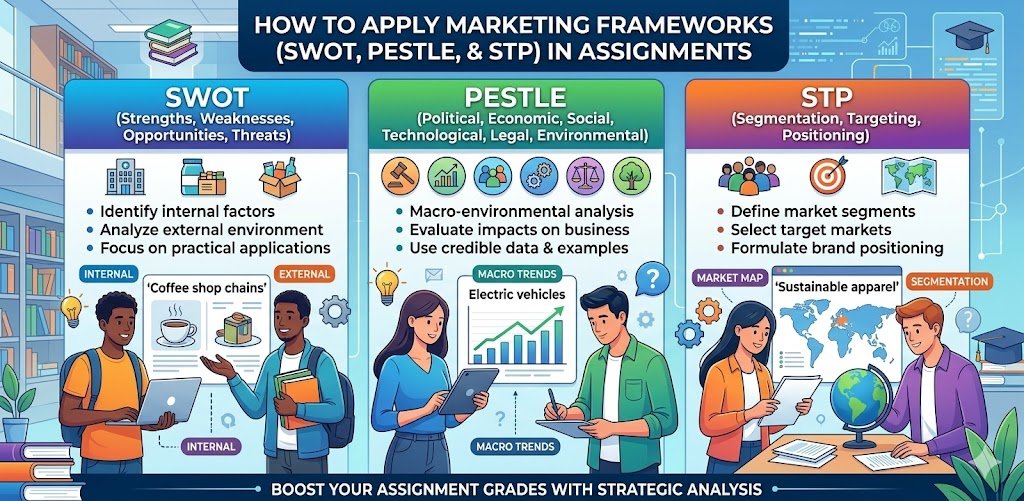
Marketing frameworks, including SWOT analysis, PESTLE environmental scanning, and STP segmentation, provide systematic analytical structures transforming vague marketing observations into rigorous strategic assessments, essential tools demonstrating analytical competence universities reward with distinction grades.
Marketing assignments demand more than describing what companies do. They require systematic analysis using proven frameworks.
SWOT, PESTLE, and STP are the most common marketing frameworks appearing in university assignments. Lecturers expect you to apply them properly, not just mention them superficially.
This guide shows you exactly how to use each framework effectively. When to apply them. How to structure analysis. What assessors want to see.
Master these three frameworks, and your marketing grades will improve dramatically.
Why Marketing Frameworks Matter
Frameworks aren’t bureaucratic boxes. They’re thinking tools preventing overlooked factors and ensure comprehensive analysis.
Without frameworks, students analyse randomly. They mention strengths but ignore weaknesses. Notice opportunities but miss threats. Describe markets without understanding segments.
With frameworks, analysis becomes systematic. You examine all relevant factors. Structure thinking logically. Produce insights that superficial observation misses.
Assessors’ reward framework usage because it demonstrates:
Systematic thinking approaches problems comprehensively rather than randomly.
Theoretical knowledge and understanding of established marketing concepts.
Professional competence using the tools practitioners employ daily.
Analytical depth moving beyond description into strategic evaluation.
Critical thinking, questioning assumptions and weighing alternatives.
For comprehensive guidance on structuring marketing assignments meeting university standards, explore our detailed resource on how to structure and plan your essay, covering academic writing conventions.
SWOT Analysis: Evaluating Strategic Position
SWOT analysis examines internal Strengths and Weaknesses plus external Opportunities and Threats, providing a holistic strategic assessment identifying competitive advantages and vulnerabilities requiring attention.
SWOT is the most widely used marketing framework globally. Every marketing student must master it.
When to use SWOT in assignments:
Use SWOT analysis when you’re:
- Evaluating a company’s competitive position relative to rivals.
- Assessing brand health and identifying areas requiring strengthening.
- Developing marketing strategies matching capabilities to opportunities.
- Analysing case studies requiring situational assessment.
How to conduct a rigorous SWOT analysis:
Strengths: Internal Positive Factors
Strengths are internal attributes providing competitive advantages. Don’t just list random positives. Identify genuine differentiators.
Strong brand reputation built through consistent quality and customer satisfaction.
Superior product features offering functionality that competitors lack.
Efficient distribution networks ensure product availability.
Skilled workforce possessing capabilities difficult to replicate.
Financial resources enabling investment competitors cannot match.
Support each strength with evidence. Don’t say “strong brand,” quantify it: “Brand awareness of 78% versus 45% industry average (Nielsen, 2024).”
Weaknesses: Internal Negative Factors
Weaknesses are internal limitations undermining the competitive position. Honesty matters. Don’t ignore obvious problems.
Limited geographic presence restricting market access.
Outdated technology is reducing operational efficiency.
High cost structures are preventing competitive pricing.
Weak online presence is limiting digital engagement.
Inconsistent quality damages reputation and loyalty.
Link weaknesses to impacts. Explain how each weakness affects performance or opportunities.
Opportunities: External Positive Possibilities
Opportunities are favourable external conditions that companies exploit. These come from market changes, not internal capabilities.
Growing market segments with unmet needs.
Technological advances are enabling new product development.
Regulatory changes favouring certain business models.
Competitor weaknesses create market gaps.
Changing consumer preferences align with the company’s strengths.
Connect opportunities to strategies. How can the company capitalise? What capabilities are needed?
Threats: External Negative Factors
Threats are unfavourable external conditions that potentially harm performance. Identify them early, enabling proactive responses.
Intense competition is eroding margins and market share.
Economic downturns are reducing consumer spending.
Technological disruption is making products obsolete.
Regulatory restrictions limiting operational freedom.
Changing consumer tastes are reducing demand for existing products.
Assess threat severity. Which are immediate? Which are long-term? How likely are they to materialise?
Common SWOT mistakes to avoid:
Listing factors without explanation or evidence supporting claims.
Confusing internal factors (strengths/weaknesses) with external factors (opportunities/threats).
Treating SWOT as the endpoint rather than the foundation for strategic recommendations.
Providing generic analysis applicable to any company rather than case-specific insights.
Missing relationships between SWOT elements—how strengths address opportunities, how weaknesses amplify threats.
Struggling with applying SWOT rigorously or developing strategic insights from analysis? Our marketing assignment help connects you with marketing specialists who demonstrate proper framework application across brand management, consumer behaviour, and strategic marketing modules.
PESTLE Analysis: Scanning External Environment
PESTLE analysis systematically examines 6 macro-environmental factors, including Political, Economic, Social, Technological, Legal, & Environmental, affecting business operations and strategic decisions beyond company control.
PESTLE helps understand external forces shaping markets. Essential for strategic marketing planning.
When to use PESTLE in assignments:
Analysing market entry decisions requiring environmental understanding.
Evaluating how external changes affect marketing strategies.
Understanding macro trends influencing consumer behaviour.
Assessing long-term strategic positioning considering environmental shifts.
How to conduct a comprehensive PESTLE analysis:
Political Factors
Political factors include government policies, political stability, trade regulations, taxation policies, and political ideologies that affect business operations.
Examples: Brexit impacts on UK-EU trade, government infrastructure spending, public sector procurement policies, and trade tariffs affecting import costs.
Economic Factors
Economic factors in PESTLE analysis include economic growth rates, inflation, interest rates, exchange rates, unemployment levels, and disposable income, which affect purchasing power and market demand.
Examples: Cost-of-living crisis reducing discretionary spending, interest rate rises affecting mortgage affordability, wage growth influencing consumer confidence.
Social Factors
Social factors include demographics, cultural trends, lifestyle changes, education levels, and social attitudes, are shaping consumer preferences and behaviours.
Examples: Ageing population, increasing healthcare demand, health consciousness driving organic food markets, and remote working changing commercial property needs.
Technological Factors
Macro-environment technological factors include innovation rates, automation, digital transformation, R&D activity, and technology adoption, are affecting how businesses operate and compete.
Examples: AI enabling personalised marketing, mobile commerce growth, social media influencing purchase decisions, and blockchain transforming supply chains.
Legal Factors
Legal factors that PESTLE analysis focuses on are laws, regulations, industry standards, consumer protection, employment law, and intellectual property, which affect business compliance requirements.
Examples: GDPR data protection requirements, advertising standards regulations, product safety legislation, and employment rights.
Environmental Factors
Environmental factors include climate change, sustainability concerns, carbon emissions regulations, resource scarcity, and environmental activism, are influencing business practices and consumer choices.
Examples: Net-zero commitments affecting operations, plastic reduction regulations, sustainable packaging demand, and carbon taxes.
PESTLE application tips:
Focus on factors relevant to the specific assignment question. Don’t list everything. Select significant factors affecting the case.
Explain impacts clearly. How does each factor affect marketing decisions? What strategic responses are appropriate?
Use current examples with recent data showing you understand contemporary business environments.
Link to company strategy. How should the organisation respond to identified trends?
When managing multiple marketing assignments requiring PESTLE analysis, our guide on managing assignment deadlines effectively provides time management strategies, ensuring quality across submissions.
STP: Segmentation, Targeting, and Positioning
STP framework guides market selection and positioning through Segmentation (dividing markets into groups), Targeting (selecting segments to serve), and Positioning (defining how offerings are perceived versus competitors).
STP is fundamental to marketing strategy. It ensures customer-focused approaches rather than product-centric thinking.
When to use STP in assignments:
Developing marketing strategies for new products or markets.
Analysing how companies identify and serve customers.
Evaluating brand positioning effectiveness.
Creating marketing plans requires customer segmentation.
How to apply STP systematically:
Segmentation: Dividing Markets
Segmentation splits heterogeneous markets into homogeneous groups with similar needs, characteristics, or behaviours.
Segmentation bases:
Demographic: Age, gender, income, education, occupation, family size.
Geographic: Region, urban/rural, climate, population density.
Psychographic: Lifestyle, personality, values, interests, attitudes.
Behavioural: Usage rate, loyalty status, benefits sought, purchase occasion.
In assignments, explain:
What segmentation criteria are used, and why they’re appropriate.
How segments differ meaningfully from each other.
Whether segments are measurable, accessible, substantial, and actionable.
Targeting: Selecting Segments
Targeting evaluates segment attractiveness and selects which to serve based on organisational capabilities and strategic fit.
Targeting strategies:
Undifferentiated: Single offering for entire market (mass marketing).
Differentiated: Different offerings for multiple segments.
Concentrated: Focusing on a single segment exclusively (niche marketing).
Micromarketing: Tailoring to individuals or specific locations.
Evaluation criteria:
Segment size and growth potential.
Competitive intensity within the segment.
Compatibility with organisational capabilities and resources.
Strategic fit with company objectives.
Positioning: Defining Perception
Positioning determines how you want customers to perceive your offering versus competitors, creating a distinctive place in customers’ minds.
Positioning strategies:
Attribute-based: Emphasising specific product features.
Benefit-based: Highlighting customer benefits delivered.
Use/application: Focusing on specific usage contexts.
User-based: Targeting specific customer types.
Competitor-based: Defining position relative to rivals.
Quality/price: Positioning on value proposition.
In assignments, demonstrate:
Clear positioning statement defining target segment, frame of reference, point of difference, and reason to believe.
How positioning connects to marketing mix elements (product, price, place, promotion).
Whether positioning is credible, sustainable, and differentiated from competitors.
STP application mistakes, avoiding the following:
- Creating segments without clear differences or strategic value.
- Selecting targets without justifying why they’re attractive or achievable.
- Vague positioning statements lacking specificity or differentiation.
- Failing to connect STP to actionable marketing strategies.
- Ignoring implementation feasibility or resource requirements.
Combining Marketing Frameworks Strategically
Professional marketers rarely use single frameworks. They combine them to gain comprehensive insights.
Effective combinations:
PESTLE + SWOT: PESTLE identifies external opportunities and threats feeding into SWOT analysis, whilst internal strengths and weaknesses come from company analysis.
SWOT + STP: Strengths and opportunities inform which segments to target and how to position offerings, leveraging advantages.
All three together: PESTLE reveals market trends, SWOT assesses strategic position, and STP defines customer approach, providing a complete strategic picture.
When integrating multiple frameworks feels complex, contact us without wasting more time and avail the best assignment writing service in the UK, where our expert guidance demonstrates proper framework combination across strategic marketing, consumer analysis, and brand management assignments.
Conclusion
Apply these marketing frameworks systematically with evidence supporting every claim. Connect analysis to strategic recommendations showing how insights inform decisions. Combine frameworks when appropriate, providing comprehensive perspectives.
These marketing frameworks appear throughout marketing modules and professional practice. Understanding when and how to apply them distinguishes basic description from sophisticated strategic thinking, which assessors reward with top grades.
FQ Assignment Help connects you with experienced marketing coursework help specialists holding advanced marketing qualifications who demonstrate proper framework application, ensuring your assignments showcase the analytical depth and strategic thinking distinction-level marketing work demands.
Explore our blog regularly for marketing strategies, assignment writing techniques, business theory applications, and more. We publish valuable guides supporting your academic journey from first-year modules through final dissertations.