
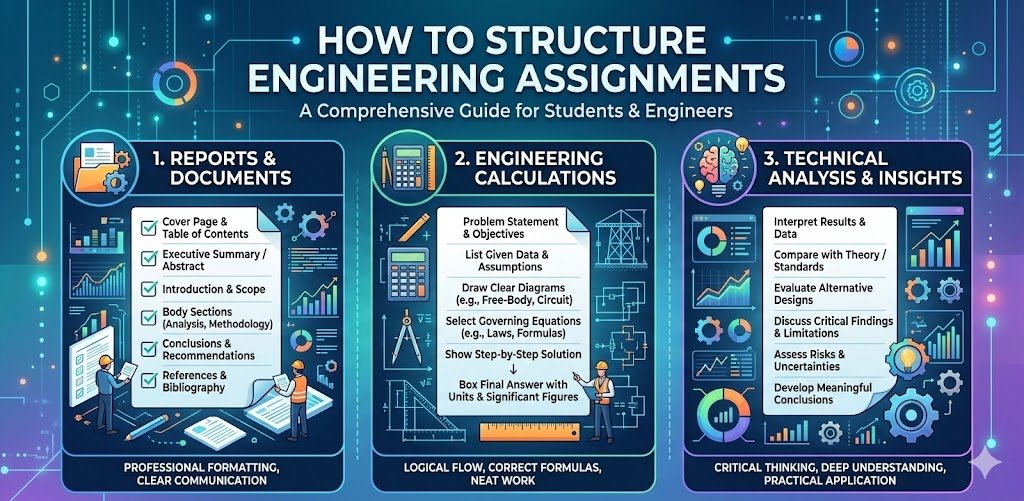
Engineering assignments require a precise structure combining theoretical knowledge, mathematical calculations, and technical analysis. These assignments follow academic conventions across problem-solving, laboratory reports, design projects, and technical documentation, whilst demonstrating analytical rigor expected at the university level.
Engineering students encounter 3 primary assignment challenges, including calculation precision, data synthesis, and technical report standardisation.
You need to remember that:
You’re not just writing essays.
You’re solving complex problems:
- Presenting calculations clearly
- Analysing technical data
- Producing professional reports.
This guide breaks down exactly how to structure engineering assignments. Simple steps. Clear examples. No confusion.
What Makes Engineering Assignments Different?
Engineering assignments differ from humanities essays by requiring integrated mathematical derivations, technical data visualizations, and adherence to international ISO standards.
| Assignment Type | What It Involves |
| Technical Reports | Professional documentation with methodology, results, and analysis |
| Calculation Problems | Step-by-step mathematical solutions with units and assumptions |
| Lab Reports | Experimental procedure, data collection, analysis, and conclusions |
| Design Projects | Technical drawings, specifications, and feasibility analysis |
| Case Studies | Real-world engineering problem analysis with solutions |
Engineering assignments test your ability to solve problems systematically, present solutions clearly, and justify decisions technically.
Understanding Engineering Assignment Structure
Why Structure Matters in Engineering
Poor structure loses marks. Even if your calculations are correct.
Think of structure like building foundations. Without it, everything collapses.
A good engineering report structure facilitates the logical flow of technical evidence from problem identification to actionable recommendations.
A good engineering report structure includes the following:
- Makes complex information clear
- Shows logical thinking process
- Helps assessors follow your work
- Demonstrates professional competence
Remember:
Engineering is about precision. Your assignment structure must reflect that precision.
Technical Report Structure
Technical reports follow strict conventions established by professional engineering bodies and academic institutions, ensuring consistency, clarity, and reproducibility across technical documentation. Engineering report structure selection determines technical clarity and academic success.
The standard technical report format provides a 7-part architecture designed for data reproducibility and professional accountability in industrial contexts. It is necessary from university assignments to professional practice. Poor report structure loses marks even when calculations are correct, as tutors evaluate both technical competence and communication ability. On the other hand, well-structured reports demonstrate professional competence, make complex information accessible, and show systematic thinking processes.
Standard Technical Report Format:
1. Title Page
- Assignment title
- Your name and student ID
- Module code and name
- Tutor Name
- Submission date
- Word count
2. Executive Summary (10% of word count)
Write this last, even though it appears first.
Summarize:
- What problem are you addressing
- What methods did you used
- What you found (key results)
- What you conclude
Example: “This report evaluates the structural integrity of a steel cantilever beam under distributed loading. Finite element analysis using ANSYS software determined the maximum stress of 245 MPa occurring at the fixed support. Factual results indicate the beam satisfies BS EN 1993-1-1 structural safety requirements with a factor of safety of 1.8. Recommendations include optimizing beam cross-section to reduce material costs whilst maintaining structural performance.”
Keep it factual. No opinions. Just results.
3. Introduction
Set the context. State the problem clearly.
Include:
- Background information
- Problem statement
- Objectives
- Scope (what you’re covering and what you’re not)
Bad introduction: “This assignment will discuss beams and stress.”
Good introduction: “Cantilever beams are common structural elements in civil engineering applications, including building overhangs and bridge supports. This analysis investigates stress distribution in a 4-meter steel cantilever beam (Grade S275) subjected to uniformly distributed loading of 15 kN/m. The objective is to determine whether the beam satisfies Eurocode 3 structural safety requirements.”
See the difference? Good introductions are specific, technical, and clear.
But you don’t need to struggle with structuring your engineering assignment alone. FQ Assignment Help is available 24/7 to provide you with detailed engineering assignment help, structuring your engineering assignments across all formats, such as preliminary designs, feasibility studies, and maintenance manuals.
4. Methodology
Explain how you approached the problem.
Include:
- Theoretical principles applied
- Equations used (with references)
- Software or tools employed
- Assumptions made
- Calculations performed
Critical point: Someone should be able to replicate your work from your methodology.
Example methodology paragraph: “Beam deflection was calculated using the differential equation method for distributed loads. The governing equation d²y/dx² = M/EI was solved with boundary conditions at the fixed support (y = 0, dy/dx = 0). Material properties for S275 steel were obtained from BS EN 10025-2, with Young’s modulus E = 210 GPa and yield strength fy = 275 MPa. Analysis verification employed ANSYS Workbench 2023 finite element software using 10-node tetrahedral elements with 0.05m mesh size.”
Always state assumptions explicitly. Nothing is “obvious” in engineering.
5. Results
Present findings clearly. Use appropriate formats.
Tables for numerical data:
| Load Case | Max Stress (MPa) | Max Deflection (mm) | Location |
| Case 1 | 245 | 18.3 | Fixed support |
| Case 2 | 312 | 24.7 | Fixed support |
Figures for visual data:
- Graphs showing relationships
- Diagrams illustrating concepts
- CAD drawings showing designs
- FEA stress contour plots
Caption everything properly: “Figure 1: Von Mises stress distribution in cantilever beam under 15 kN/m distributed loading (ANSYS output).”
Never just drop tables or figures without explanation. Reference them in text: “Table 1 shows maximum stress values for different load cases…”
6. Analysis and Discussion
This is where critical thinking happens.
Don’t just repeat results. Interpret them.
Ask yourself:
- What do these results mean?
- Do they make physical sense?
- How do they compare to theoretical predictions?
- What factors might affect accuracy?
- What are the limitations?
Example analysis: “The maximum stress of 245 MPa remains below the yield strength of 275 MPa, indicating elastic behavior. However, the safety factor of 1.12 (275/245) is marginal for permanent structures. BS EN 1993-1-1 recommends minimum factors of safety between 1.5 and 2.0 for structural steel under static loading. The discrepancy between analytical calculations (238 MPa) and FEA results (245 MPa) likely stems from stress concentration effects at the fixed support, which simplified beam theory does not capture. Mesh refinement studies confirm convergence to within 2% accuracy.”
This paragraph demonstrates:
- Interpretation of results
- Comparison with standards
- Critical evaluation
- Understanding of limitations
- Professional engineering judgment
Struggling with technical analysis or unsure how to interpret engineering results? Our engineering homework help connects you with specialists demonstrating proper analytical techniques across mechanical, civil, and electrical engineering modules.
7. Conclusions and Recommendations
Summarise findings. Provide actionable recommendations.
Conclusions should:
- Answer the objectives stated in the introduction
- Be supported by evidence from results
- Be specific and quantitative
Example conclusions: “Analysis demonstrates the S275 steel cantilever beam experiences maximum stress of 245 MPa under design loading, with deflection of 18.3 mm at the free end. While stress remains below yield strength, the marginal safety factor of 1.12 necessitates design modifications. Recommended actions include: (1) increasing beam depth from 200mm to 250mm, achieving a safety factor of 1.6 whilst adding 12% to material costs; (2) implementing continuous deflection monitoring during service life; (3) conducting fatigue analysis for cyclic loading scenarios.”
Good recommendations are specific, justified, and practical.
8. References
Engineering uses numbered or Harvard referencing. Check your module guidelines.
Standards:
British Standards Institution (2005) BS EN 1993-1-1: Eurocode 3 – Design of Steel Structures. London: BSI.
Textbooks:
Hibbeler, R.C. (2018) Mechanics of Materials. 10th edn. Harlow: Pearson.
Journal articles:
Smith, J.A. (2022) ‘Finite element analysis of composite beams’, Journal of Structural Engineering, 148(6), pp. 04022067.
Always cite the standards used. Engineering isn’t just calculations. It’s following codes and regulations.
Structuring Calculation Problems
Calculation-based assignments demand a systematic presentation demonstrating logical problem-solving processes. Assessors award marks for methodology, not just final answers. Proper structure earns partial credit even with incorrect solutions.
Clear step-by-step working, consistent units, stated assumptions, and verified results distinguish high-scoring submissions from basic attempts lacking professional rigor.
The Golden Rule: Show ALL Working
Never just write the final answer. Show every step.
Standard calculation format:
1. Given Information
List what you know:
- Beam length L = 4.0 m
- Distributed load w = 15 kN/m
- Young’s modulus E = 210 GPa
- Second moment of area I = 8.4 × 10⁻⁶ m⁴
2. Required
State what you’re finding:
- Maximum bending moment Mmax
- Maximum stress σmax
- Maximum deflection δmax
3. Assumptions
List any assumptions:
- The beam behaves elastically
- Loading is uniformly distributed
- Self-weight is negligible
- Material is homogeneous and isotropic
4. Solution
Present step-by-step:
Step 1: Calculate maximum bending moment
For a cantilever with a uniformly distributed load:
- Mmax = wL²/2
- Mmax = (15 × 10³ N/m)(4.0 m)²/2
- Mmax = 120 × 10³ N⋅m
- Mmax = 120 kN⋅m
Always include units at every step.
Step 2: Calculate maximum stress
Using the bending formula:
- σmax = Mmax × c / I
- Where c = distance to extreme fiber = 0.1 m
- σmax = (120 × 10³ N⋅m)(0.1 m) / (8.4 × 10⁻⁶ m⁴)
- σmax = 1.43 × 10⁹ Pa
- σmax = 1430 MPa
Check if this makes sense. Does the magnitude seem reasonable?
Step 3: Compare with the yield strength
σmax / fy = 1430 MPa / 275 MPa = 5.2
Conclusion: Stress exceeds yield strength by a factor of 5.2. Beam will fail. Redesign required.
This systematic approach:
- Makes your thinking transparent
- Helps you spot errors
- Shows professional competence
- Makes marking easier (you get partial credit even if the final answer is wrong)
Laboratory Report Structure
Laboratory reports document experimental procedures and analytical findings demonstrating practical engineering competence. Assessors penalise missing sections or inadequate error analysis heavily. Strong reports include complete methodology, uncertainty quantification, and insightful theoretical comparisons, distinguishing competent engineers whilst securing Merit and Distinction grades through systematic experimental documentation. Strong reports also include uncertainty analysis if the assignment requires laboratory data documentation.
Standard lab report sections are:
1. Objectives: What you’re investigating.
2. Theory: Relevant equations and principles.
3. Apparatus: Equipment used with specifications.
4. Procedure: Step-by-step method (past tense).
5. Results: Raw data in tables, processed data in graphs.
6. Discussion: Analysis, error sources, comparison with theory.
7. Conclusions: Summary of findings.
Key tips:
- Use past tense (“The beam was tested…”)
- Include uncertainty analysis
- Discuss error sources
- Compare experimental vs theoretical results
Example discussion: “Experimental Young’s modulus of 195 GPa differs from the theoretical value of 210 GPa by 7.1%. Discrepancies likely stem from: (1) measurement uncertainty in strain gauge readings (±0.5%); (2) non-uniform material properties in the test specimen; (3) temperature variations during testing affecting material stiffness. The percentage difference falls within acceptable experimental error ranges for mechanical testing.”
Understanding different assignment formats helps you choose appropriate structures. Learn about the types of essays students encounter across engineering modules.
Common Mistakes to Avoid
Engineering assignments fail not just from technical errors but from presentation mistakes that undermine professional credibility. Understanding these common pitfalls helps you avoid unnecessary mark deductions whilst demonstrating the attention to detail that engineering practice demands.
Calculation Errors:
These technical mistakes cost marks even when your overall approach is correct:
- Missing units: Every numerical value needs units (kN, MPa, mm, etc.)
- Inconsistent unit systems: Never mix SI and imperial (converting between N and lbf)
- Not showing working: Final answers without steps earn zero marks
- Unrealistic results without questioning: 500 MPa deflection should raise red flags
- Rounding errors: Round only at the final answer, not intermediate steps
Remember: Assessors award marks for methodology. Show every calculation step.
Report Errors:
Structural and content mistakes that damage report quality:
- Vague problem statements: “Analyse the beam” vs “Determine maximum stress in 4m cantilever beam.”
- Missing assumptions: Never assume assessors know what you’re assuming
- Poor figure quality: Blurry screenshots or illegible diagrams lose marks
- Uncaptioned tables/figures: Every visual needs a “Figure 1: Description” format
- No reference to figures in text: Don’t just insert figures. Discuss them.
- Conclusions not supported by results: You can’t conclude what you haven’t proven.
Professional rule: If you can’t justify it with data, don’t conclude it.
Professional Presentation:
Formatting mistakes signaling unprofessional work:
- Handwritten calculations: Type them unless explicitly allowed otherwise
- Missing page numbers: Assessors need to reference specific pages for feedback
- Inconsistent formatting: Pick one font, one heading style, one referencing format
- Spelling errors in technical terms: “steal” instead of “steel” shows carelessness
- Missing nomenclature: Define symbols first use (E = Young’s modulus = 210 GPa)
Engineering demands precision. Your presentation must reflect that precision.
Understanding UK university assignment conventions helps engineering students meet academic expectations. Learn how to do assignments in the UK, covering structure, formatting, and submission guidelines.
Check These Things Before Submission
Before clicking submit, systematically verify every technical and presentation element. This final quality check catches errors, ensures completeness, and confirms professional standards. The difference between losing marks unnecessarily and achieving the grade your engineering work deserves.
Content:
- All required sections included
- Calculations shown step-by-step
- Results presented clearly
- Analysis demonstrates critical thinking
- Conclusions answer stated objectives
Technical:
- Units included throughout
- Significant figures appropriate (3-4 for engineering)
- Equations formatted properly
- Symbols defined
- Standards cited
Presentation:
- Figures numbered and captioned
- Tables formatted professionally
- References complete
- Appendices included if needed
- PDF format (preserves formatting)
Accuracy:
- Spell-checked
- Calculations verified
- Results make physical sense
- Cross-references correct
Conclusion
Engineering assignments demand precise structure, systematic problem-solving, and professional presentation. Technical reports follow strict formatting conventions, including executive summaries, methodology sections, and results presentation. Calculation problems require showing complete working with proper units and assumptions. Laboratory reports document experimental procedures with error analysis and theoretical comparisons.
Start with clear problem statements, work systematically through solutions, present results professionally, and analyze findings critically. These skills serve you throughout your engineering career, not just university assignments.
When technical assignments feel challenging or calculation presentation unclear, FQ Assignment Help provides assignment help services across mechanical, civil, electrical, and software engineering, ensuring your work demonstrates the professional standards and analytical strength that distinction-level engineering requires.