
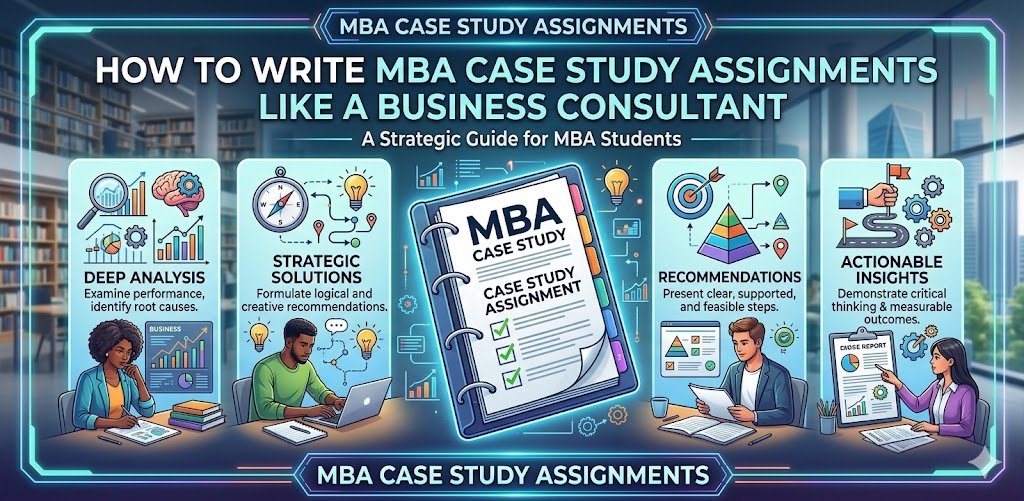
MBA case study assignments require systematic business problem analysis through strategic frameworks and evidence-based recommendations. Business schools prioritise professional business thinking over academic essays to simulate management consultancy engagements at firms like McKinsey, BCG, and Bain.
These assignments test the ability to solve 5 core business challenges: problem definition, structured analysis, evidence-based reasoning, practical recommendation, and professional communication.
Business schools don’t want academic essays. They want professional business thinking.
MBA case studies test whether you can solve real business problems. Like a consultant would.
This means analysing situations critically. Applying frameworks strategically. Making recommendations confidently. Justifying decisions with evidence.
This guide shows you exactly how consultants approach case studies. Their thinking process. Their analytical tools. Their presentation standards.
Master this approach and witness your MBA grades improving dramatically.
Understanding the Consultant Mindset
Management consultants solve complex business problems using 5 specific thinking patterns. This methodology ensures consistency across industries like software, manufacturing, and healthcare.
- Define the problem to distinguish root causes from 5 severe clinical symptoms before selecting solutions.
- Apply structured analysis using 6 proven frameworks such as SWOT, PESTLE, and Porter’s Five Forces.
- Utilise evidence-based reasoning to replace subjective opinions with data-driven insights.
- Develop implementation-focused recommendations that address specific financial and resource constraints.
- Execute professional communication through executive summaries and visual data presentation.
The consultant’s thinking process:
Problem definition before jumping to solutions. What’s actually wrong? What are the symptoms versus the root causes? What’s the scope of the problem?
Structured analysis using proven frameworks. Don’t reinvent analytical wheels. Apply established models systematically.
Evidence-based reasoning supporting every claim. Consultants never say “I think” or “I feel.” They say “Data shows” or “Analysis indicates.”
Client-focused recommendations addressing real business constraints. Solutions must be practical, implementable, and justified financially.
Professional communication using executive summaries, clear structure, and visual data presentation. Time is money. Get to the point quickly.
This mindset transforms how you approach MBA case studies.
The Consultant’s Four-Step Approach
Professional consultants follow systematic processes, ensuring comprehensive analysis and actionable recommendations.
Step 1: Understand the Problem (20% of your time)
Never start analysing immediately. Understand the problem thoroughly first.
Questions consultants ask:
What problem needs solving? Is this the real problem or just a symptom of deeper issues?
Who are the stakeholders? What do they want? What constraints do they face?
What’s the business context? Industry dynamics? Competitive landscape? Regulatory environment?
What data is available? What’s missing? What assumptions must we make?
What does success look like? How will we measure whether the solution works?
For case study assignments:
Read the case multiple times. First read for overall understanding. Second read, taking detailed notes. Third read, identifying key data points.
Highlight critical information: financial data, market statistics, competitive positions, stakeholder statements.
Identify what the assignment question actually asks. MBA assignments test specific skills. Make sure you’re answering what’s asked, not what you want to discuss.
Step 2: Analyse Systematically (40% of your time)
Strategic frameworks provide the structural precision required for comprehensive business analysis. Consultants utilize 6 essential models to eliminate random analytical errors:
Essential frameworks for MBA case studies:
SWOT Analysis examines 4 situational factors: internal strengths, internal weaknesses, external opportunities, and external threats.
Porter’s Five Forces calculates competitive intensity through supplier power, buyer power, competitive rivalry, threat of substitutes, and threat of new entrants.
PESTLE Analysis evaluates 6 macro-environmental factors: Political, Economic, Social, Technological, Legal, and Environmental.
Value Chain Analysis identifies specific activities where an organisation creates value or incurs unnecessary costs.
BCG Matrix categorises product portfolios into 4 quadrants: Stars, Cash Cows, Question Marks, and Dogs.
Ansoff Matrix determines 4 growth strategies: market penetration, market development, product development, and diversification.
For a comprehensive understanding of management frameworks beyond case studies, explore our detailed guide on key management theories every MBA student should know.
Which framework to use?
The assignment question guides framework selection. Strategic positioning problems need Porter’s Five Forces. Internal capability questions need Value Chain Analysis. Growth strategy cases need the Ansoff Matrix.
You’ll use multiple frameworks providing different analytical angles. Consultants call this “triangulation.” Using multiple methods to reach consistent conclusions increases confidence in findings.
Apply frameworks rigorously, not superficially. Don’t just list SWOT elements—analyse relationships between them. How do strengths address opportunities? How do weaknesses amplify threats?
Step 3: Develop Recommendations (30% of your time)
Actionable solutions constitute the primary objective of MBA case study analysis. Effective recommendations adhere to 6 consultant principles:
Consultant recommendation principles:
Specific, not vague. Quantify every instruction by replacing vague phrases like “improve marketing” with specific targets, such as “launch a £150K quarterly LinkedIn campaign targeting C-suite executives.”
Prioritised clearly based on 3 levels of urgency: Critical, Important, and Optional.
Financially justified. Every recommendation needs a cost-benefit analysis. What’s the investment? What’s the expected return? What’s the payback period? Justify finances through cost-benefit analysis, payback periods, and Return on Investment (ROI) calculations.
Implementation-focused. Who implements? What resources are needed? What’s the timeline? What are the key milestones? Define implementation milestones to identify specific resource requirements and delivery timelines.
Risk-aware. What could go wrong? What contingencies address risks? How do we monitor effectiveness? Mitigate risks by establishing contingency plans for potential technical or market failures.
Evidence-based. Link every recommendation to your analysis. “Given our Porter’s Five Forces analysis showing high supplier power, we recommend vertical integration, acquiring key suppliers, and reducing cost exposure by an estimated 18%.”
Struggling with developing professional-quality recommendations or applying frameworks correctly? Our MBA assignment help service connects you with business strategy specialists who demonstrate proper analytical techniques across strategic management, marketing, and operations modules.
Step 4: Present Professionally (10% of your time)
Consultants present findings to busy executives. MBA assignments must reflect this professionalism.
Professional presentation elements:
The executive summary at the beginning (despite being written last) summarises the problem, key findings, and primary recommendations in 200-250 words. Executives must understand your conclusion without reading the full report.
Clear structure using descriptive headings and subheadings, enabling quick navigation. Consultants use the “pyramid principle,” conclusions first, supporting analysis after.
Visual data presentation through tables, charts, and graphs communicates quantitative information faster than text. Label everything properly with titles, axis labels, units, and data sources.
Concise writing, eliminating unnecessary words. Consultants write in short sentences. Active voice. Present tense where appropriate. No fluff.
Proper referencing using Harvard, APA, or specified styles. Consultants cite industry reports, financial data, academic research, and company documents supporting claims.
Professional formatting with consistent fonts, spacing, and styling throughout. This signals attention to detail. Crucial in business consulting.
When balancing multiple MBA assignments with tight deadlines, our guide on managing multiple assignment deadlines provides time management strategies, ensuring quality across all submissions.
Using Data Like Consultants Do
Quantitative data analysis transforms raw case study information into strategic insights. Consultants utilise 5 specific mathematical techniques:
Consultant data analysis techniques:
Calculate financial ratios, including profitability (ROE, ROA), liquidity (current ratio), and efficiency (inventory turnover).
Perform trend analysis to identify performance patterns over 3-5 year periods.
Execute comparative benchmarking against 3-5 primary industry competitors.
Model scenario analysis to test decision robustness under 20% sales drops or 15% cost increases.
Conduct a break-even analysis to determine the exact point of investment recovery.
Present data visually. Consultants use:
- Line graphs for trends over time
- Bar charts for comparisons between categories
- Pie charts for showing proportions
- Tables for detailed numerical data
- Scatter plots for showing correlations
Always interpret data. Don’t just present numbers. Explain what they mean. For example, “Revenue declined 12% year-over-year primarily due to pricing pressure from new market entrants, evidenced by 8% average selling price reduction despite 4% volume growth.”
Common MBA Case Study Mistakes
Structural errors reduce the academic authority of case study submissions. Avoid these 6 specific mistakes to secure distinction grades:
Mistake 1: Descriptive, not analytical
Weak assignments summarise the case. Strong assignments analyse it. Don’t just repeat what happened. Explain why it matters and what must be done.
Mistake 2: Theory without application
Knowing Porter’s Five Forces is insufficient. You must apply it to the specific case, analysing actual competitive dynamics with company-specific evidence.
Mistake 3: Recommendations without justification
Never make suggestions without explaining why they’ll work. Link recommendations explicitly to your analysis, showing logical reasoning.
Mistake 4: Ignoring implementation
“The company needs to expand internationally” isn’t enough. How? Where? With what resources? Over what timeline? What risks exist?
Mistake 5: Poor prioritisation
MBA cases have multiple valid recommendations. Consultants prioritise by impact, urgency, feasibility, and resource requirements. Do the same.
Mistake 6: Generic solutions
Avoid cookie-cutter recommendations applicable to any company. Solutions must address the specific case’s unique circumstances, industry context, and organisational capabilities.
The Consultant’s Toolkit: Quick Reference
Selecting appropriate frameworks separates superficial analysis from rigorous business thinking. Use this quick reference to match business problems to proven analytical tools that professional consultants apply systematically.
For competitive strategy: Porter’s Five Forces, competitor analysis, market share analysis
For internal capabilities: Value Chain Analysis, VRIO framework, resource-based view
For growth decisions: Ansoff Matrix, BCG Matrix, product lifecycle analysis
For external environment: PESTLE analysis, scenario planning, industry lifecycle
For financial assessment: Ratio analysis, cash flow analysis, break-even analysis
For organisational issues: McKinsey 7S, stakeholder analysis, change management models
Understanding UK university assignment conventions beyond case studies is necessary; therefore, our comprehensive guide on how to do assignments in the UK teaches you all the essentials and fundamentals of structuring, referencing, and submission standards across all formats.
Professional Polish: The Final Check
Before submission, consultants always review deliverables. You should too.
Final checklist:
- The executive summary captures the problem, analysis, and recommendations concisely.
- All claims are supported by evidence from case or external sources.
- Frameworks applied rigorously, not just mentioned superficially.
- Recommendations are specific, prioritised, and implementation-focused.
- Financial analysis was included where relevant, with proper calculations.
- Data presented visually with proper labels and sources.
- Writing is concise, professional, and error-free.
- Structure follows logical flow with clear headings.
- References are formatted consistently using the required style.
- Word count within specified limits.
Conclusion
Adopt the consultant mindset: understand problems deeply before analysing, apply proven frameworks structuring thinking, develop evidence-based recommendations, and communicate findings clearly to busy stakeholders.
Master this approach consistently across case studies. You’ll notice grades improving whilst simultaneously developing analytical skills employers value. Consultancy firms don’t hire people who memorise theories. They hire people who solve business problems using structured thinking.
Contact FQ Assignment Help if you ever find yourself stuck with management assignments or framework applications. We connect you with experienced specialists who’ll provide MBA homework help, ensuring your assignments showcase the strategic thinking and professional presentation distinction-level MBA work demands.
Stay connected with us for more MBA success strategies. We publish guides covering assignment techniques, exam preparation, and business framework applications supporting your journey from the first semester through graduation.