
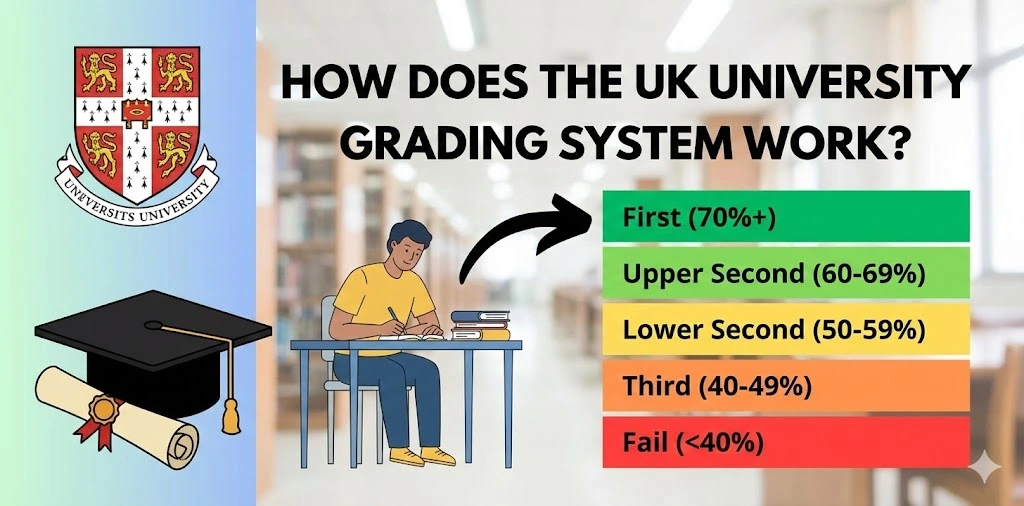
The UK university grading system classifies undergraduate degrees into 4 honours categories, which are First (70%+), 2:1 (60–69%), 2:2 (50–59%), and Third (40–49%). On the other hand, postgraduate degrees use Distinction, Merit, and Pass classifications.
Understanding the UK grading system is essential for both domestic and international students navigating higher education. Unlike the American GPA system or European ECTS grading, the UK employs percentage–based classifications that determine degree outcomes, career prospects, and postgraduate eligibility.
This guide explains undergraduate and postgraduate grading structures, assessment methods, and how final grades are calculated.
Undergraduate Degree Classifications
UK universities classify undergraduate honours degrees into four main categories based on overall percentage achievement across the entire course.
Final grades result from cumulative performance throughout the degree programme, not single examinations. However, final year modules typically carry substantially more weight than earlier years.
The four undergraduate classifications:
| Classification | Percentage Range | Description |
| First-Class Honours (1st) | 70% and above | Exceptional academic performance demonstrating mastery and deep understanding |
| Upper Second–Class Honours (2:1) | 60–69% | Strong performance, the most common degree class, is required for competitive postgraduate programmes |
| Lower Second-Class Honours (2:2) | 50–59% | Satisfactory performance, widely accepted by employers, though less competitive for further study |
| Third–Class Honours (3rd) | 40–49% | Minimum passing grade for an honours degree indicates basic subject knowledge with scope for improvement |
| Fail | Below 40% | Does not qualify for a degree award without reassessment |
First–Class Honours (70%+):
Represents exceptional ability. Graduates with First–Class degrees are highly sought by employers and competitive postgraduate programmes, including PhDs and research positions.
Upper Second-Class Honours (60–69%):
The most common degree classification. A 2:1 opens doors to most postgraduate courses and graduate employment schemes. Many employers and Master’s programmes specify 2:1 as the minimum entry requirement.
Lower Second-Class Honours (50–59%):
Demonstrates satisfactory understanding. A 2:2 (colloquially called “Desmond” after Desmond Tutu – 2:2) remains acceptable to many employers but limits postgraduate options, requiring higher classifications.
Third-Class Honours (40–49%):
The minimum passing grade. Indicates basic knowledge with significant improvement needed. Career progression may require additional qualifications or substantial work experience.
For comprehensive guidance on meeting UK university academic standards, review our resource on how to do assignments in the UK.
Postgraduate Grading System
Postgraduate degrees use a simplified three–tier classification, including Distinction, Merit, and Pass, focusing on mastery of complex concepts and independent research skills.
The postgraduate system differs between Integrated Masters (following directly from undergraduate), Taught Masters (MA, MSc, MEng), and Research Masters (MRes, MPhil).
Postgraduate classifications:
| Classification | Percentage Range | Description |
| Distinction | 70% and above | Highest achievement, comparable to First–Class honours, demonstrates exceptional analytical skills and research originality |
| Merit | 60–69% | Strong performance producing high–quality academic work |
| Pass | 50–59% | Meets basic course requirements with room for improvement |
| Fail | Below 50% | Does not qualify for degree award, requires reassessment or module retakes |
Key differences from undergraduate grading:
Postgraduate programmes typically last one year for full–time study, meaning every module contributes to final classification without “buffer” years. Dissertations or final projects often account for 50% or more of the total grade, carrying substantial weight.
Integrated Masters (MChem, MEng) following four-year pathways are graded identically to undergraduate degrees using the four honours classifications.
Research Masters (MRes, MPhil), focusing on independent research skills, are graded as Pass or Fail rather than percentage classifications.
How Final Grades Are Calculated
UK universities calculate final grades using weighted averages, where later years typically carry more significance than earlier years.
Weighting varies by institution and programme but follows common patterns:
Typical undergraduate weighting structure:
Calculate final degree classification through 3 weighted year contributions, where the first year often doesn’t count, the second year contributes 30-40%, and the final year contributes 60–70%.
Example calculation:
- Year 1: Modules completed, but marks don’t contribute to final classification
- Year 2: Average 65% (weighted at 30% of final grade)
- Year 3: Average 70% (weighted at 70% of final grade)
- Final degree classification: (65 × 0.30) + (70 × 0.70) = 68.5% = Upper Second–Class Honours (2:1)
Some universities allow borderline cases, students within 2% of the next classification boundary, to be reviewed by examination boards considering extenuating circumstances, overall trajectory, or performance in specific modules.
Assessment Methods in UK Universities
UK universities assess student performance through diverse methods, measuring different skills and knowledge dimensions.
Assessment approaches combine multiple formats, ensuring comprehensive evaluation:
Apply 6 assessment methods throughout UK degree programmes to measure theoretical knowledge, practical application, research capability, and communication skills.
- Written examinations: Timed assessments testing knowledge recall, analytical thinking, and subject understanding
- Coursework assignments: Essays, reports, and projects demonstrating research, analysis, and argumentation skills
- Dissertations: Extended research projects showcasing independent inquiry, critical thinking, and original contributions to the field
- Practical assessments: Laboratory work, clinical placements, or performance–based evaluation in vocational subjects
- Oral presentations: Group or individual presentations assessing communication skills and subject mastery
- Portfolio compilation: Collection of work throughout the programme, common in creative disciplines like art, design, and architecture
Weighting varies by module and programme. Science degrees may emphasise examinations and practical work, whilst humanities programmes focus more on essays and dissertations.
What Happens If You’re Failing?
Students approaching failure have multiple options, including module retakes, referral assessments, deferrals for extenuating circumstances, and grade appeals.
UK universities provide support mechanisms preventing complete degree failure:
Access to 4 intervention options when academic performance falls below passing standards to recover credits and complete degree requirements.
Module retakes: Undergraduate students can retake failed modules in subsequent years. Failing a Film Studies module in Year 1 allows retaking it in Year 2 alongside current modules.
Referral assessments: Similar to resits, allowing students to resubmit failed assignments or retake examinations. Capped marks (usually 40% maximum) apply to referral attempts.
Deferrals: Permit students to postpone assessments or extend deadlines when personal circumstances (illness, bereavement, mental health) affect performance. Require formal applications with supporting evidence.
Academic appeals: Students believing grades unfairly reflect their work can request re-marking by examination boards. Requires evidence of procedural irregularity, extenuating circumstances not previously considered, or marking inconsistency.
For strategies managing academic pressure and deadline challenges, explore our guide on the best ways to improve time management for writing assignments.
Understanding UCAS Tariff Points
UCAS tariff points convert various qualifications (A-levels, BTECs, IB) into standardised points determining university course eligibility.
The UCAS system enables universities to compare students from different educational backgrounds fairly. Each qualification grade converts to specific point values. Universities specify minimum UCAS points for course entry alongside subject-specific requirements.
Even with required grades, insufficient UCAS points may prevent course enrollment. International students must understand how their qualifications convert to UCAS points for UK university applications.
Conclusion
The UK university grading system provides clear, standardised classifications measuring academic achievement through percentage–based honours degrees at the undergraduate level and Distinction/Merit/Pass at the postgraduate level.
Understanding this system enables realistic goal–setting, informed postgraduate decisions, competitive job applications, and international qualification comparisons. Final grades reflect weighted performance across the degree, with later years typically carrying more significance.
When academic challenges feel frustrating, assignment requirements seem unclear, or grades fall below expectations, FQ Assignment Help connects you with UK academic specialists who understand university grading systems, marking criteria, and what examiners expect.
We provide essay examples demonstrating First-Class standards, dissertation structure models, coursework reference materials, and research paper templates for students targeting higher classifications.
Your degree classification matters for your future. We help you achieve the grades you need.