
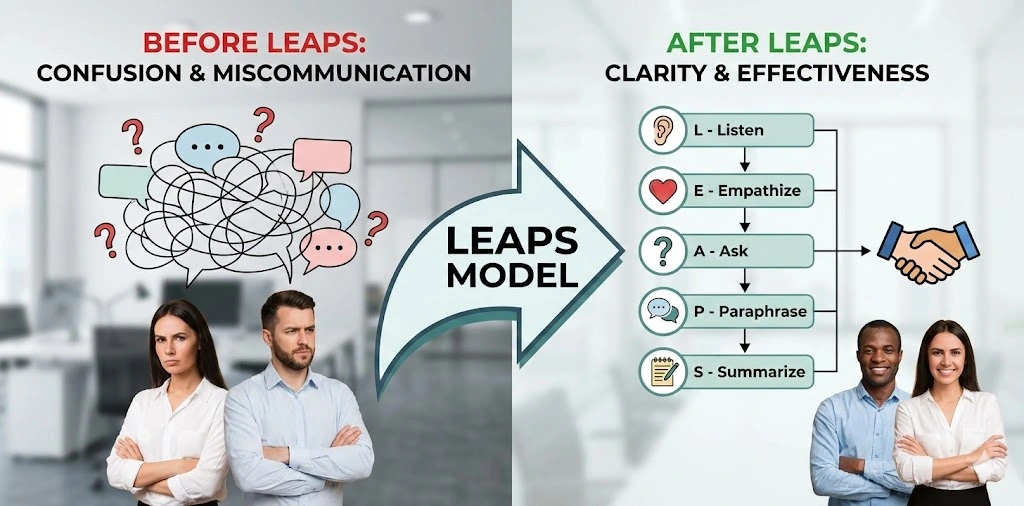
The LEAPS model secures message clarity through a five-step sequential framework.
This model transforms conversations from reactive exchanges into intentional, empathetic dialogues. Academic professionals and students utilise LEAPS to navigate 3 complex scenarios: discussions, conflicts, and trust-building.
What Is the LEAPS Model of Communication?
The LEAPS model is a five-stage communication framework developed by Dr James E. Lukaszewski to eliminate misinterpretation, ensuring both parties understand messages without misinterpretation.
LEAPS stands for 5 core communication actions, which are Listen, Empathise, Ask, Paraphrase, Summarise.
This structured approach prevents common communication failures, such as assumptions, emotional reactions, unclear expectations, and unresolved misunderstandings. The model applies to academic discussions, professional negotiations, conflict resolution, and personal relationships requiring clarity.
Step 1: Listen Actively to Build Understanding
Focus complete attention on the speaker to achieve active listening, if you want to avoid formulating premature responses.
Most communication failures occur because people listen to respond rather than understand. Active listening requires maintaining eye contact, avoiding interruptions, and concentrating on message content rather than preparing counterarguments.
How to listen with the LEAPS model:
Apply active listening through 5 deliberate practices that optimise your listening environment by eliminating digital distractions and eliminate distractions and demonstrate genuine attention to the speaker’s message.
- Eliminate distractions (phones, notifications, competing tasks)
- Maintain appropriate eye contact, showing engagement
- Avoid interrupting or finishing sentences
- Note key points without immediate judgement
- Wait for complete message delivery before processing responses
Example:
A student explains assignment confusion to a tutor. The tutor listens without interrupting, allowing the student to articulate all concerns before offering guidance.
Step 2: Empathise to Validate Emotions
Empathy elevates communication quality by acknowledging the speaker’s perspective without requiring agreement.
Academic pressure creates stress, affecting communication tone and clarity. Empathy reduces tension by validating feelings, creating psychological safety, and enabling honest dialogue.
Empathetic responses in LEAPS:
Use 3 empathy phrases that validate emotions whilst maintaining objectivity in academic discussions.
- “I recognise this deadline creates pressure”
- “I recognise this feedback might feel disappointing”
- “I see how this confusion has created frustration”
Empathy doesn’t mean agreement. It means acknowledging emotions whilst maintaining objective discussion about solutions.
Example:
A student receives critical feedback. The tutor says, “I understand receiving this feedback feels discouraging, especially after the effort you invested”, before explaining improvement strategies.
Step 3: Ask Clarifying Questions
Clarifying questions eliminate assumptions by revealing unstated expectations and hidden concerns.
Open-ended questions encourage detailed responses, revealing information that closed questions miss. Clarifying questions ensure both parties understand the topic scope, expectations, and constraints before proceeding.
Effective LEAPS questions:
Ask 4 types of open-ended questions, such as ‘What specific aspects need clarification?’ or ‘Which requirements are unclear?’
- “What specific aspects need clarification?”
- “Can you describe what you expected versus what occurred?”
- “Which requirements feel unclear?”
- “What outcome would address your concern?”
Questions demonstrate genuine interest in understanding rather than defending positions.
Example:
A tutor receives a complaint about marking. Instead of defending the grade, they ask, “Which feedback points feel unclear?” and “What would help you understand the assessment criteria?”
Step 4: Paraphrase to Confirm Accuracy
Restate the speaker’s message in original words to verify understanding, if you want to catch misinterpretations.
This step catches misinterpretations before they cause problems. Paraphrasing shows the speaker you’ve processed their message and creates an opportunity for correction if understanding is inaccurate.
Paraphrasing structure:
Begin paraphrasing statements with 4 standard phrases that signal your intention to verify understanding before responding.
- “So what you’re saying is…”
- “Let me confirm I understand correctly…”
- “To summarise your main concern…”
- “If I’ve understood, you need…”
Wait for confirmation before proceeding. Speakers correct misunderstandings at this stage.
Example:
Student: “I don’t understand why my essay received this mark.”
Tutor paraphrases: “You’re confused about the specific criteria that affected your grade, particularly the analysis section?”
Step 5: Summarise to Close with Clarity
The summarisation process identifies key points to prevent future confusion regarding discussion outcomes.
Summaries create a shared understanding of conversation conclusions, next steps, and responsibilities. This step eliminates “I thought you meant” conflicts arising from different interpretations.
Effective LEAPS summaries include:
Structure summaries using 5 essential elements that create a shared understanding of conversation outcomes and prevent future confusion.
- Identify main discussion points covered
- Confirm agreed solutions or next steps
- Assigned specific responsibilities
- Establish deadlines or timeframes
- Follow-up arrangements if needed
Both parties should confirm the summary’s accuracy.
Example:
Tutor concludes: “To summarise our discussion: You’ll revise the introduction and methodology sections by Friday, then we’ll review them together before final submission next Wednesday.”
Review the guide on How to Do Assignments in the UK to master academic communication standards.
Application of LEAPS in Academic Settings
Use of LEAPS in Student-Tutor Discussions
LEAPS prevents common misunderstandings in assignment requirements, feedback interpretation, and deadline negotiations. Students articulate concerns clearly. Tutors respond with a structured understanding.
Use of LEAPS in Group Project Communication
LEAPS ensures all group members understand tasks, deadlines, and quality expectations. Paraphrasing prevents assumptions. Summarising confirms shared understanding.
Use of LEAPS in Feedback Conversations
Receiving criticism triggers defensiveness. LEAPS reduces emotional reactivity through empathy, enabling students to process feedback constructively rather than personally.
Benefits of Using the LEAPS Model
Reduced misunderstandings: Five-step verification catches interpretation errors before they cause problems.
Stronger relationships: Empathy and active listening build trust between students, tutors, and peers.
Efficient conflict resolution: Structured approach prevents emotional escalation, focusing conversations on solutions.
Improved retention: Paraphrasing and summarising reinforce information, aiding memory and comprehension.
Disadvantages of the LEAPS Model
Time investment: Following all five steps extends conversation duration, challenging in fast-paced environments.
Requires practice: Natural-sounding LEAPS communication needs repetition. Initial attempts feel mechanical.
Potential over-empathy: Excessive empathising can reduce objectivity in situations requiring firm boundaries or decisions.
Resistance from others: People unfamiliar with structured communication may find LEAPS formal or unnecessary.
Despite limitations, LEAPS benefits outweigh drawbacks in situations where clarity and understanding are essential.
When & When Not to Use the LEAPS Model
The LEAPS model (Listen, Empathise, Ask, Paraphrase, Summarise) is a powerful communication tool designed to de-escalate tension and ensure clarity. Below is a guide on when to apply or use this framework and when not to use this framework.
| Apply LEAPS When… | Apply LEAPS For… |
| Discussing complex requirements: Ensuring all technical nuances of an assignment are understood. | Simple informational exchanges: Such as sharing a file link or confirming a meeting room number. |
| Addressing conflicts: Defusing misunderstandings between peers or instructors. | Time-critical emergencies: Such as a technical outage or an immediate deadline failure where direct action is required. |
| Providing critical feedback: Delivering sensitive evaluations while maintaining professional rapport. | Casual conversations: Everyday social interactions (e.g., “How was your weekend?”) that do not require verification. |
| Negotiating deadlines: Approaching extensions with empathy and a clear summarisation of new terms. | Routine status updates: Brief “yes/no” confirmations or standard progress reports. |
| Clarifying group expectations: Aligning diverse perspectives in collaborative projects. | Automated communications: Responding to system-generated notifications or alerts. |
Conclusion
The LEAPS model transforms reactive exchanges into structured dialogues, ensuring mutual understanding through systematic listening, empathy, questioning, paraphrasing, and summarising.
Academic success depends on clear communication between students, tutors, and peers. LEAPS prevents misunderstandings that waste time, create frustration, and damage relationships. The model requires practice but produces substantial improvements in interaction quality.
When academic communication becomes overwhelming, assignment requirements feel unclear, or feedback discussions create confusion, FQ Assignment Help connects students with qualified Senior Writers who understand UK university requirements.
We provide essay writing support, dissertation guidance, coursework assistance, and research paper writing with clear communication throughout every stage.
Your academic success requires effective communication and quality support. We provide both.