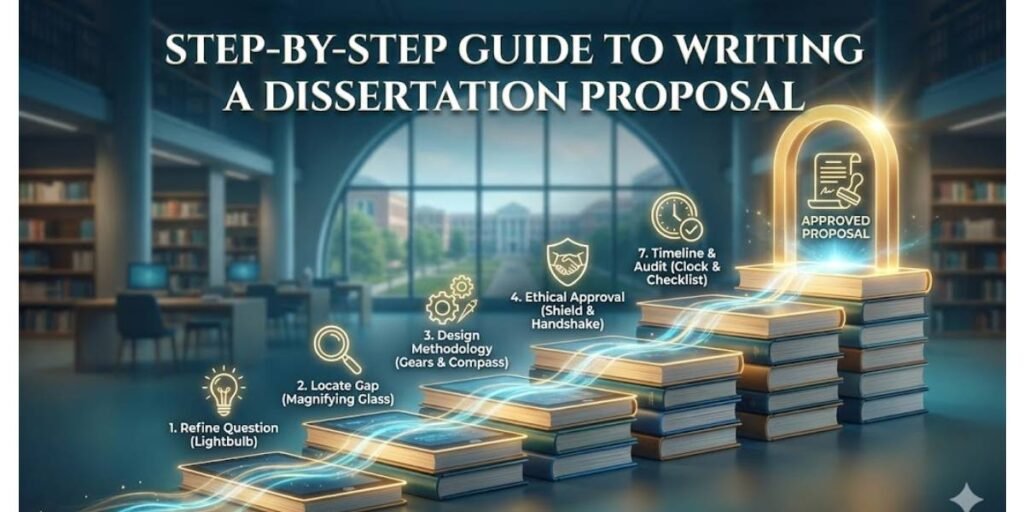
Most of the students think that a dissertation proposal is a “summary” of their future research paper or dissertation. But it is a legalistic contract between you and your university. If the contract is weak, your research will be rejected before it even begins.
A successful proposal must prove three things: that your research is worth doing, that it is feasible, and that you have the methodological rigor to execute it. This guide provides the scientific blueprint to move your proposal from a “draft” to an “approved” status.
What is a Dissertation Proposal?
A dissertation proposal is a formal document that outlines the “What,” “Why,” and “How” of your research, serving as a roadmap for the full-scale investigation.
The bridge between a student and a researcher is the ability to move from a broad interest to a narrow inquiry. If you haven’t yet settled on your area of focus, it is vital to learn how to choose a dissertation topic that ensures high research impact before drafting this proposal.
The Proposal Formula
Identified Research Gap + Methodological Alignment + Ethical Feasibility = Approved Proposal
- The “Methodological Drift” proposes a question that your chosen data collection method cannot actually answer.
- Being too descriptive. If your proposal doesn’t argue for a change or new understanding, it lacks academic value.
- Supervisors approve proposals that solve a problem, not ones that just discuss a topic.
Step 1: Refining the Research Question
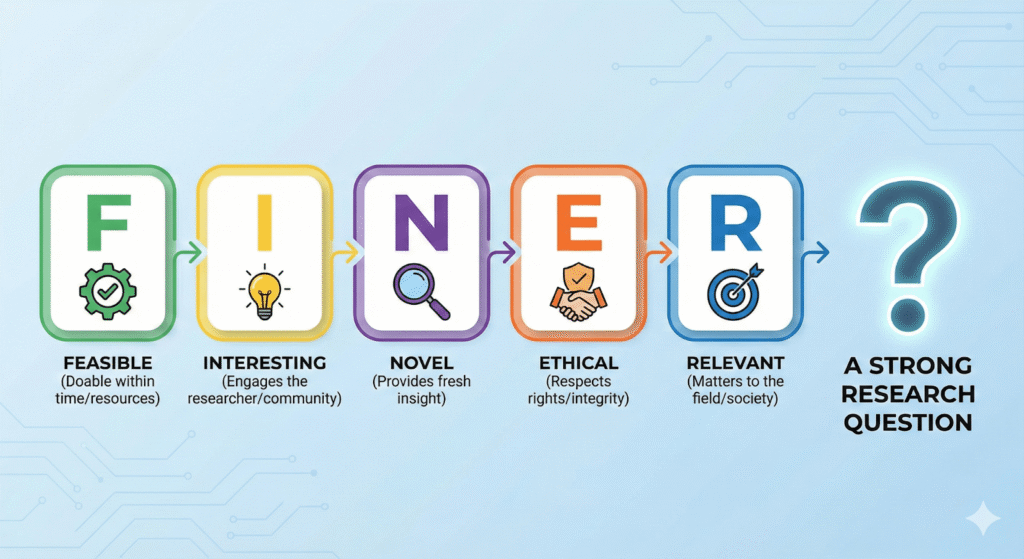
Your Research Question (RQ) is the primary attribute of your proposal. It must be FINER:
- Feasible
- Interesting
- Novel
- Ethical
- Relevant
Avoid: “How does social media affect mental health?” (Too broad, descriptive).
Adopt: “The impact of Instagram’s algorithmic changes on the self-esteem of female UK undergraduates (2023–2025).” (Specific, measurable, time-bound).
Once the question is set, you must justify its existence by showing exactly where the current academic conversation has stopped.
Step 2: The Literature Review (Locating the Gap)
A literature review is a critical map of existing research on your topic. Instead of just listing books, you are evaluating what other experts have discovered. This process proves you understand the current academic conversation and identifies the exact “gap” that your own research will finally fill.
In a proposal, the literature review is not a book report. It is a Gap Analysis. You are looking for the “Uninvited Guest.” The contradiction or silence in previous studies that your work will address.
To move from a 2:2 to a First-Class mark, you must transition from describing what authors said to evaluating how their work relates to your specific inquiry.
To demonstrate Topical Authority, your review must follow this flow:
- Themes over Authors: Group your research by concepts (e.g., “The Economic Impact”) rather than just listing names.
- Critical Appraisal: Use CASP (Critical Appraisal Skills Programme) or other appraisal tools to show the weaknesses in existing research.
- The “Gap” Statement: Explicitly state: “While studies X and Y focus on the USA context, there is a total lack of data regarding the UAE market.”
If you find yourself struggling with the critical tone required here, you need to learn how to do assignments in the UK first.
Step 3: Designing the Research Methodology
This is the most scrutinized section of any proposal. Your methodology is the Value you bring to the research. You must decide on your Research Paradigm.
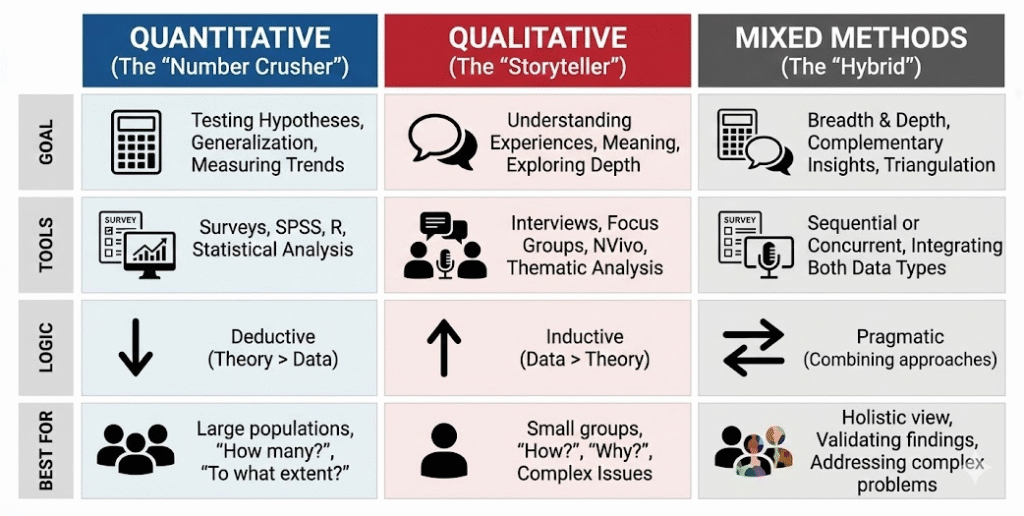
If you are a first-year researcher, these terms can feel like “Academic Noise.” But we have sorted it for you with an easy explanation of each methodology:
1. Quantitative Research (The “Number Crusher”)
This method focuses on objective measurements and mathematical analysis. You are looking for patterns that apply to a large group of people.
- The Logic: If I test 500 people, can I prove a trend?
- Example: Sending a survey to 300 UK students to find out exactly what percentage of them use AI tools for daily study.
2. Qualitative Research (The “Storyteller”)
This method focuses on subjective experiences, meanings, and “the human element.” You aren’t counting responses; you are trying to understand the depth of a response.
- The Logic: Why do people feel this way, and what are the hidden details?
- Example: Conducting one-on-one, deep-dive interviews with 10 nurses to understand the emotional stress of working 12-hour shifts.
3. Mixed Methods (The “Hybrid”)
This is the most rigorous approach. You use both numbers and stories to get a complete picture. It is highly favored for First-Class dissertations because it provides “Triangulation” (checking your facts from two different angles).
- The Logic: Use the survey to see what is happening, then use interviews to find out why.
- Example: Surveying 200 employees about job satisfaction (Quantitative), then holding a focus group with 5 of them to explain the low scores (Qualitative).
Comparison of Methodological Approaches
| Attribute | Quantitative | Qualitative | Mixed Methods |
| Goal | Testing hypotheses / Generalization | Understanding experiences / Meaning | Both breadth and depth |
| Tools | Surveys, SPSS, R, Regression | Interviews, Focus Groups, NVivo | Sequential or Concurrent |
| Logic | Deductive (Theory > Data) | Inductive (Data > Theory) | Pragmatic |
| Best For | “How many?” or “To what extent?” | “How?” and “Why?” | Complex social issues |
But Remember:
You must explain your Sampling Strategy.
Will you use “Purposive Sampling” (choosing specific experts) or “Random Sampling”? In a top-tier proposal, the “Why” is more important than the “What.”
You don’t just use interviews because they are “easier”; you use them because your research requires phenomenological depth.
Even the most brilliant methodology will be rejected if it does not account for the “Safe Research” protocols required by your university’s ethics board.
Step 4: Ethical Considerations and Feasibility
A proposal that ignores ethics is an automatic fail. Universities in the UK have strict Institutional Review Board (IRB) standards.
You must address:
- Informed Consent: How will you protect participants?
- Data Security: Where will the data be stored (GDPR compliance)?
- The Risk/Benefit Ratio: Does the academic value outweigh any potential stress to participants?
Even the most ethical study will fail if you cannot prove you can finish it within the semester.
Step 5: Constructing the Theoretical or Conceptual Framework
The framework is the Architectural Attribute of your research. Without it, your dissertation is just a collection of random observations.
Theoretical Framework:
- The existing theories (e.g., Maslow’s Hierarchy, Efficient Market Hypothesis) provide the lens through which you analyze your data.
Conceptual Framework:
- A visual or written map showing how the specific variables in your study relate to one another.
In a First-Class proposal, you must justify your framework. Do not just pick a theory because it is famous; pick it because it has Predictive Validity for your specific Research Question.
A solid framework provides the logic, but your proposal still needs a verifiable trail of evidence to be taken seriously by the ethics board.
Step 6: The Preliminary Bibliography (Building Evidence)
Your bibliography is a Trust Signal. Supervisors look at your reference list to see if you have been reading the “Heavyweights” in your field or just relying on blog posts and Wikipedia.
Precision Referencing Protocols:
- UK/Australia: Usually requires strict Harvard or OSCOLA (for Law).
- USA/UAE: Frequently utilizes APA 7th or Chicago.
Accuracy in citation is not a “bonus”; it is a baseline requirement. A single formatting error in your bibliography can signal a lack of attention to detail, which leads to closer scrutiny of your methodology.
If you are unsure about your citation accuracy, our team of UK-qualified researchers can perform a full Reference Material Audit to ensure your bibliography is bulletproof.
You can also read more about our tested techniques that will help you reference properly and avoid plagiarism.
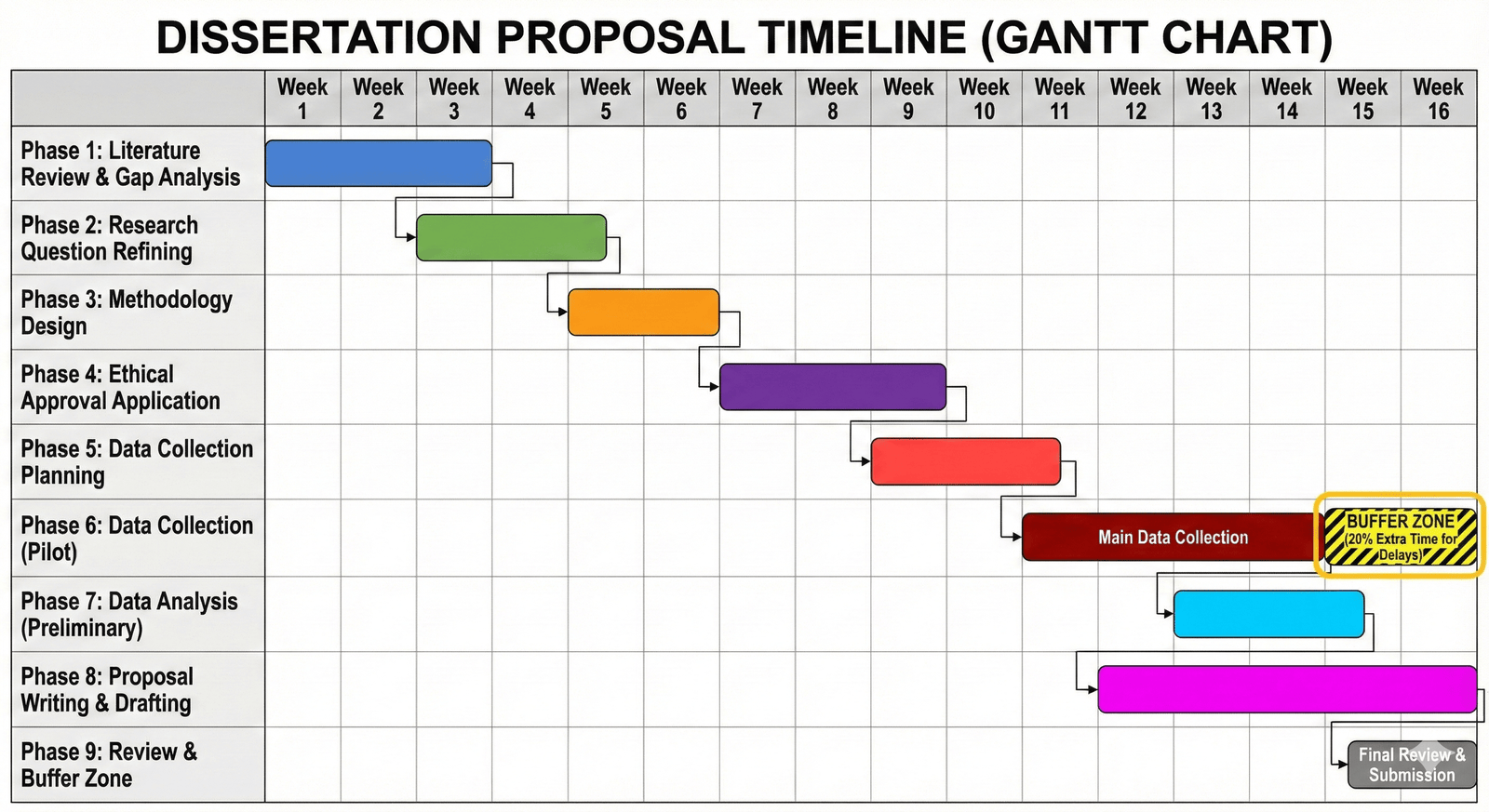
Step 7: The Research Timeline (The Gantt Chart)
A proposal is a promise to finish. You must prove Feasibility through a structured timeline. Most successful proposals include a Gantt Chart.
A Gantt Chart is a visual timeline that breaks your research down into phases (Literature Review, Data Collection, Analysis, Writing) and assigns a deadline to each.
Here’s a Tip For You:
The “Buffer” Method. After auditing 10,000+ student timelines, we recommend adding a 20% “Buffer Zone” to your data collection phase. Participants will be late, and the software will crash. If your timeline is too tight, your supervisor will reject the proposal as “Unrealistic.”
Step 8: The Final Audit (Submission Readiness)
Before you hit “Submit,” you must perform a Final Quality Audit. This is the stage where most students fail due to simple, avoidable errors.
The Submission Audit
Rubric Alignment + Turnitin Check + Proofreading = Approval
- The Bottleneck: Ignoring the “Word Count” constraints for specific sections.
- The Risk: Submitting without a 0% AI-generated content check.
- The Reality: The first page determines the supervisor’s mood; the last page determines their decision.
Final Checklist for an Approval-Ready Proposal:
- Alignment Check: Does the Title match the Research Question, and does the Question match the Methodology?
- The “So What?” Test: Does the introduction clearly state why this research matters to the field?
- Visual Structure: Is the document easy to scan with clear headings and no “walls of text”?
Once these technical boxes are checked, you are no longer just a student with an idea; you are a researcher with a plan.
Avoiding Common Mistakes in the Proposal
After auditing hundreds of students’ failed proposals, our consultants have identified three recurring “GPA-Killers.”
- Vague Methodology: Saying “I will use a questionnaire” without explaining the Likert scale or validation process.
- Lack of Alignment: The research question asks “Why,” but the methodology only collects “What.”
- Underestimating the Timeline: Forgetting that ethical approval can take 4–6 weeks.
To ensure your work remains on the “Critical Path” to success, read our deep dive into common mistakes in university assignments.
The Academic Truth:
How long should my dissertation proposal be?
It Depends. Usually, a proposal is 10% to 15% of the total dissertation word count (e.g., 1,000–2,000 words). However, check your specific module handbook, as UAE and Australian standards vary.
What is the most important section of the proposal?
The Methodology. It is the only section that proves you can actually do the work. A great idea with a bad methodology is just a dream; a simple idea with a perfect methodology is a dissertation.
My proposal was rejected because it was “too descriptive.” What does that mean?
It depends, but usually, it means you spent too much time saying what is happening and not enough time explaining how you will analyze it. You need to increase the “Evaluative Density” of your literature review.
Do I need to have my results ready for the proposal?
No. You are proposing a plan. You shouldn’t have results yet. If you do, it implies you have already conducted the research without ethical approval. A serious academic offense.
What if I realize my methodology is wrong after the proposal is approved?
Act Fast. You must submit a “Change of Scope” or “Amendment Form” to your supervisor. This is why getting a high-quality reference material from the best dissertation writing services in the UK is vital. It helps you see the “Methodological Dead-Ends” before you commit.
Can I use AI tools to write my proposal?
No. While AI can help with brainstorming, most universities in the UK and Australia now use advanced AI-detection software. A “Flagged” proposal can lead to an immediate academic integrity hearing. It is much safer to use a custom academic writing support that provides human-researched, original model papers.
Conclusion
Your dissertation proposal is the most intellectually demanding part of your final year. It requires a balance of Academic Precision and Strategic Vision. By following this step-by-step framework, refining your RQ, identifying the gap, and justifying your methodology, you secure the approval needed to proceed with confidence.
If you need a PhD consultant to audit your methodology or refine your research gap for a first-class result, FQ Assignment Help is available for you 24/7.