
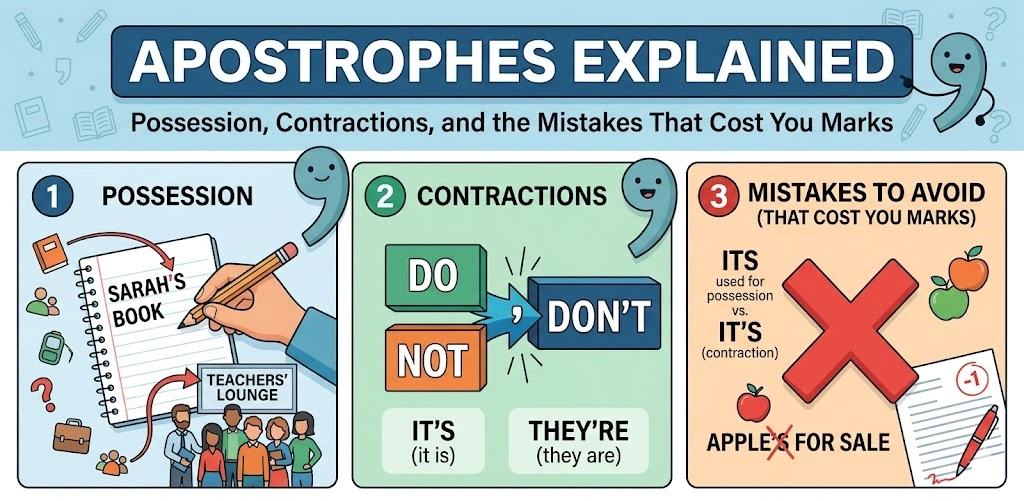
Apostrophes cause more written English errors than almost any other punctuation mark. The rules governing them are actually straightforward, 2 functions, a handful of exceptions, and several specific mistakes to avoid. Master these, and apostrophe errors disappear from your writing permanently.
What Does an Apostrophe Actually Do?
An apostrophe serves exactly 2 purposes in English:
1. It shows possession, indicating that one noun owns or relates to another. 2. It marks omitted letters, replacing missing letters in contractions.
That is the complete list. Apostrophes never make a word plural. Understanding this single principle eliminates the most common apostrophe error in written English immediately.
Using Apostrophes for Possession
Singular Nouns
Add ‘s to any singular noun to show possession, regardless of what letter the word ends in.
- the student’s essay: The essay belonging to one student
- the company’s policy: The policy of one company
- Charles’s book: The book belonging to Charles
- the boss’s decision: The decision of one boss
Note: for names ending in s, both Charles’ and Charles’s are acceptable in British English. Choose one form and apply it consistently throughout your document.
Plural Nouns Ending in S
Add an apostrophe after the existing s. No additional s required.
- the students’ essays: essays belonging to multiple students
- the companies’ policies: policies of multiple companies
- the parents’ evening: the evening for parents
Plural Nouns Not Ending in S
These irregular plurals follow the same rule as singular nouns, add ‘s.
- the children’s books
- the women’s team
- the people’s choice
Compound Possession
Shared ownership: Apostrophe on the last name only: Sarah and James’s house (one house, jointly owned)
Separate ownership: Apostrophe on each name: Sarah’s and James’s houses (two houses, individually owned)
Possessive Pronouns: No Apostrophe Needed
Possessive pronouns already indicate ownership. They never take an apostrophe.
| Pronoun | Correct | Incorrect |
| his | his car | his’ car |
| hers | the decision is hers | the decision is her’s |
| its | the cat licked its paw | the cat licked it’s paw |
| ours | the victory was ours | the victory was our’s |
| theirs | the responsibility is theirs | the responsibility is their’s |
Using Apostrophes in Contractions
Contractions combine two words into one, with the apostrophe replacing the omitted letters.
| Full form | Contraction |
| do not | don’t |
| cannot | can’t |
| will not | won’t |
| should not | shouldn’t |
| they are | they’re |
| you are | you’re |
| it is / it has | it’s |
| we are | we’re |
Important note for UK university students: contractions are generally considered too informal for academic writing. Essays, dissertations, reports, and coursework should use full word forms, do not rather than don’t, it is rather than it’s. Reserve contractions for informal communication.
The It’s/Its Problem: Solved Permanently
This is the single most common apostrophe error in written English. The confusion arises because it’s looks possessive. But it is not.
It’s = contraction of it is or it has Its = possessive pronoun (no apostrophe, follows the same rule as his, hers, ours)
The test: replace the word in question with it is. If the sentence still makes sense, use it’s. If it does not, use its.
- It’s raining outside > It is raining outside > correct: it’s
- The company changed its policy > The company changed it is policy > correct: its
Apply this test every time uncertainty arises, and the error becomes impossible to make.
The Greengrocer’s Apostrophe: The Most Visible Mistake
The term greengrocer’s apostrophe refers to the widespread error of using an apostrophe to form a plural, named after market stall signs advertising apple’s and banana’s.
Apostrophes never make a word plural. Adding s or es forms plurals. The apostrophe has no role in this process whatsoever.
- Three reports were submitted. Not three report’s.
- The 1990s produced significant economic change. Not the 1990’s.
- She received straight As. Not straight A’s.
Before and After: Apostrophe Errors Corrected
Original (with errors):
The student’s were confused about it’s rules, but the teacher’s clarified each ones purpose clearly.
Corrected:
The students were confused about its rules, but the teachers clarified each one’s purpose clearly.
Errors corrected: unnecessary apostrophe in student’s (plural, not possessive), wrong it’s (possessive, not contraction), unnecessary apostrophe in teacher’s (plural, not possessive), and correct possessive one’s retained.
Apostrophe Decision Guide
| Situation | Rule | Example |
| One owner | Add ‘s | the teacher’s desk |
| Multiple owners (plural ending in s) | Add ‘ after s | the teachers’ desks |
| Multiple owners (irregular plural) | Add ‘s | the children’s books |
| Possessive pronoun | No apostrophe | the decision is hers |
| Contraction | Replace omitted letters | don’t, it’s, they’re |
| Simple plural | No apostrophe | three reports, the 1990s |
| It is/it has | it’s | it’s raining |
| Belonging to it | its | its colour |
Conclusion
Apostrophe rules reduce to 2 functions, possession and contraction, with a clear set of specific exceptions. Apply ‘s for singular possession, apostrophe-only for plural nouns ending in s, and no apostrophe for possessive pronouns. Test it’s against it is before using it. Never use an apostrophe to form a plural. These rules, applied consistently, eliminate apostrophe errors from academic writing entirely.
Students strengthening their broader punctuation and grammar accuracy before submitting assignments can build strong foundational skills by learning how to write an assignment for university and how to edit & proofread it.
FQ Assignment Help connects UK students with qualified English language and academic writing specialists who produce distinction-grade submissions with accurate punctuation, grammar, and referencing throughout. Explore our English assignment help service for expert support tailored to your exact module requirements.