
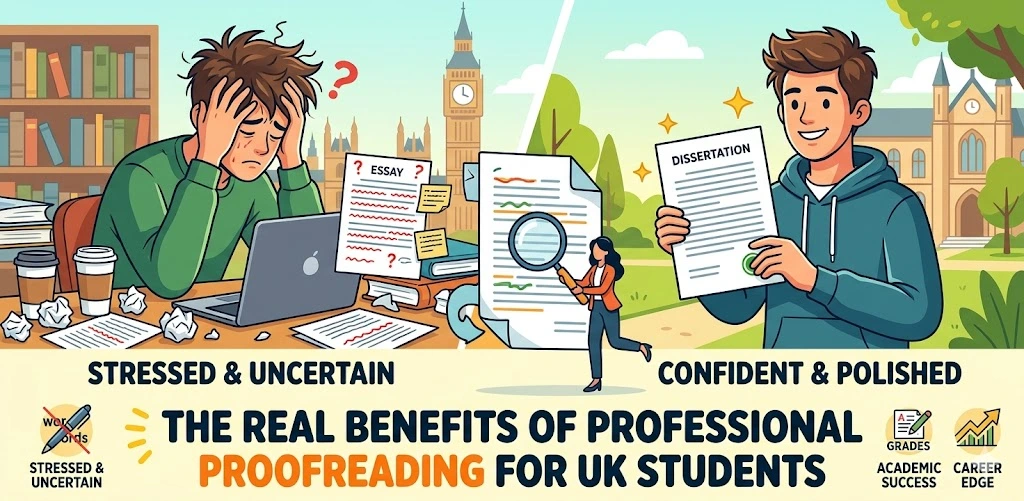
Submitting written work with avoidable errors costs UK university students marks every single academic year. Not because their ideas lack quality, but because spelling inconsistencies, grammatical slips, punctuation errors, and formatting problems sit undetected in final drafts that never received proper proofreading attention.
Professional proofreading addresses this directly. The following covers what proofreading actually involves, why spell check alone fails, and the 7 concrete benefits professional proofreading delivers for students and writers.
What Proofreading Actually Is and What It Isn’t
Proofreading is the final stage of the writing process. The pass that happens after drafting and editing is complete. Where editing addresses content, argument structure, and paragraph organisation, proofreading focuses on surface accuracy: spelling, grammar, punctuation, capitalisation, formatting consistency, and word repetition.
The distinction matters. Submitting a well-argued essay full of grammatical errors loses marks on presentation criteria; most UK university marking rubrics assess separately from content quality.
Why Spell Check Is Not Enough
Automated spell check catches obvious misspellings. It does not catch:
- Words used in the wrong context (their instead of there)
- Missing commas that change sentence meaning entirely
- Inconsistent capitalisation of proper nouns throughout a document
- Repeated phrases appear three sentences apart
- Sentences that are grammatically correct but too convoluted to read clearly
Spell check identifies what looks wrong. A professional proofreader identifies what reads wrong. That distinction determines whether a 2,000-word essay earns a 2:1 or drops to a 2:2 on presentation grounds.
7 Benefits of Professional Proofreading
1. Grade protection through error elimination
Every grammar error, spelling inconsistency, and formatting problem in a submitted assignment represents a potential mark deduction. Professional proofreading eliminates these before the marker ever sees them, protecting grades that months of research and drafting have earned.
2. Clarity that makes arguments land harder
Unclear sentences bury strong ideas. A professional proofreader identifies sentences that confuse rather than communicate, suggesting precise restructuring that makes every argument read with the clarity it deserves. Strong ideas deserve clear expression.
3. Time efficiency for students under deadline pressure
Thoroughly proofreading a 3,000-word dissertation chapter takes 2–4 hours of focused attention. Students managing multiple simultaneous deadlines rarely have that time available. Professional proofreading returns those hours, allowing focus on research, revision, and exam preparation instead.
4. Objective eyes that writers cannot replicate themselves
Writers read what they intended to write, not what the page actually says. This cognitive bias, sometimes called writer’s blindness, means self-proofreading consistently misses errors that a fresh, objective reader catches within minutes. Professional proofreaders provide that objectivity structurally.
5. Support for non-native English speakers
International students writing in English as a second language face specific challenges around article usage (a versus the), tense consistency, and idiomatic expression. Professional proofreading corrects these patterns whilst preserving the writer’s original voice, producing submissions that read as native-level academic English without replacing the student’s authentic argument.
6. Consistent quality across every submission
A proofreading service applies the same standard to every document, like essays, reports, dissertations, and personal statements. Academic performance should not fluctuate based on how much revision time remains before a deadline. Professional proofreading ensures it does not.
7. Credibility in academic and professional contexts
Written work creates first impressions. A cleanly presented, error-free submission communicates attention to detail, subject seriousness, and professional capability, qualities every university marker and future employer notices. Polished writing builds credibility that careless errors permanently undermine.
What Professional Proofreading Catches
Consider this sentence from a student essay:
“The research suggest that participents who recieved the intervension showed significant improvment in there outcomes compared too the control group.”
A spell check flags recieved and improvment. A professional proofreader corrects all 7 errors:
Subject-verb agreement (suggest > suggests)
Spelling (participents, recieved, improvment)
Word confusion (there > their, too > to), returning a sentence that actually reflects the quality of the research it describes.
Conclusion
Professional proofreading delivers measurable academic benefit, protecting grades, strengthening clarity, saving time, and ensuring submissions reflect the genuine quality of the work behind them. Spell check handles surface spelling. Professional proofreading handles everything else.
Students who invest time in research and argument construction deserve submissions that present that work without preventable errors, reducing its academic impact. Understanding common mistakes in university assignments helps students identify the error patterns professional proofreading consistently catches and corrects before submission.
FQ Assignment Help provides professional proofreading and editing services for UK university students across every subject, academic level, and submission deadline. Explore our academic writing service for distinction-grade support that covers every stage of your written submission, from first draft through to final polished submission.