
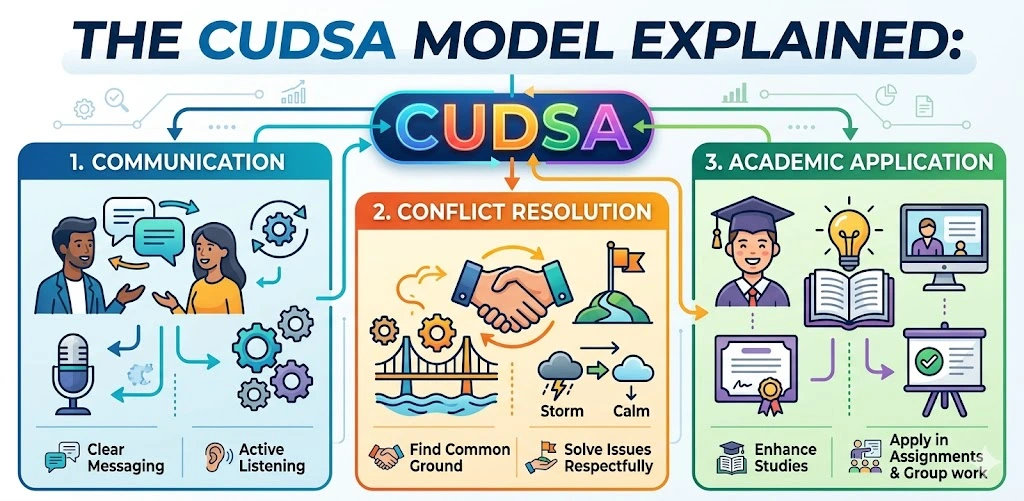
Effective communication rarely fails because of what gets said. It fails because of how the message moves, or does not move, from one person to another. The CUDSA model provides a structured framework for making that movement deliberate, whether the context is resolving a workplace conflict, designing a persuasive marketing campaign, or structuring an academic assignment argument.
This guide explains what the CUDSA model is, covers both of its primary interpretations, walks through a real conflict resolution example, and demonstrates how UK university students apply the model across management, marketing, and organisational behaviour assessments.
What Does CUDSA Stand For?
CUDSA appears in academic literature across 2 distinct frameworks, and the distinction matters.
CUDSA as a communication model:
- C: Confront (or Clarify)
- U: Understand
- D: Develop (or Discuss)
- S: Share (or Select)
- A: Agree (or Act)
CUDSA as a goal-setting and productivity framework:
- C: Clarify
- U: Understand
- D: Decide
- S: Strategise
- A: Act
Both versions follow the same underlying logic, move from ambiguity through understanding toward deliberate, measurable action. The communication model focuses on interpersonal and organisational messaging. The productivity framework focuses on personal goal achievement. UK management and marketing assignments most commonly reference the communication model, though the goal-setting interpretation appears in leadership and personal development modules.
The 5 Stages of the CUDSA Communication Model
Stage 1: Confront (Clarify)
The opening stage establishes the purpose of the communication. Confront does not carry an aggressive meaning here. It means facing the issue directly rather than allowing ambiguity to persist.
Clarifying the objective before a conversation begins removes assumptions, focuses the dialogue, and ensures all parties understand what the exchange is actually about. In assignment writing, this maps directly to the function of a strong introduction, stating what the essay argues before any evidence or analysis appears.
Key question at this stage: What is the specific issue, goal, or message this communication needs to address?
Stage 2: Understand
Understanding requires genuine active listening, suspending judgment and creating space for the other perspective to emerge fully before any response gets formulated. This stage recognises that effective communication is bidirectional, not a series of alternating monologues.
In conflict resolution, the Understand stage is where root causes surface. In marketing communication, it represents audience research, understanding what the target consumer actually needs rather than what the brand assumes they need. In academic writing, it parallels the literature review function, engaging with existing perspectives before positioning an argument.
Key question at this stage: What does the other party actually need, believe, or experience, and how does that differ from my initial assumptions?
Stage 3: Develop (Decide/Discuss)
Development organises the information gathered in the previous stage into a structured, logical response. Raw understanding does not produce resolution or communication. The Develop stage transforms insight into a workable plan, argument, or message.
This stage involves evaluating options, ranking approaches by effectiveness, and constructing the logical sequence through which the final message will travel. In workplace communication, this means building a proposal. In academic writing, this corresponds to the analytical body paragraph, taking evidence and developing its significance into a reasoned argument.
Key question at this stage: Given what I now understand, what is the most effective structure for my response, message, or plan?
Stage 4: Share (Select/Strategise)
Sharing delivers the developed message through the most appropriate channel, tone, and language for the specific audience and context. The same content communicated poorly, wrong register, wrong timing, wrong medium, fails regardless of how well the previous stages performed.
Share covers the practical execution of communication: word choice, body language, presentation format, and pacing. In marketing, this represents the creative execution of a campaign. In academic writing, it maps to the actual drafting stage, translating structured thinking into a clear, precise written argument.
Key question at this stage: How should this message be delivered to reach this specific audience most effectively?
Stage 5: Agree (Act)
The “Agreement” confirms that the communication has achieved mutual understanding and alignment. This stage closes the loop, both parties confirm shared expectations, next steps get defined, and the communication moves from dialogue into action.
Without this stage, even well-structured communication produces ambiguity about what happens next. In conflict resolution, Agree produces a documented action plan. In marketing, it produces a conversion. In academic writing, it corresponds to the conclusion, confirming the argument’s central claim and signalling what the analysis has established.
Key question at this stage: Do all parties share the same understanding of what has been decided and what happens next?
CUDSA in Action: Workplace Conflict Resolution Example
Two colleagues in a project team experience ongoing tension. One believes the other consistently misses agreed deadlines. The second believes task requirements shift without notice, making original deadlines impossible to meet.
Confront: The team manager identifies the core issue, not personal incompetence or bad faith, but miscommunication around scope and timeline expectations. The conversation focuses on process, not blame.
Understand: Both colleagues explain their experience. One describes the impact of delayed deliverables on downstream tasks. The other details how last-minute scope changes invalidate original time estimates. Active listening reveals that neither party recognised how their actions affected the other.
Develop: Together, the team identifies 3 practical solutions, written confirmation of scope at project initiation, a 24-hour notice protocol for any scope change, and a weekly 15-minute alignment meeting.
Share: The manager presents the agreed protocol clearly in written form, distributed to all team members, with explicit owner responsibilities and review dates assigned.
Agree: Both colleagues confirm the new process meets their concerns. A 4-week review date is set to assess whether the protocol has reduced conflict effectively.
The conflict resolved not because anyone capitulated, but because the CUDSA framework moved both parties from competing narratives toward shared understanding and a jointly owned solution.
How CUDSA Applies to UK University Assignments
Marketing Assignments
Marketing module assignments frequently ask students to analyse how communication campaigns move audiences from awareness through to purchase behaviour. CUDSA maps directly onto this journey:
- “Confront” generates attention
- “Understand” builds empathy and relevance
- “Develop” is the structure of the message
- “Share” executes it across chosen channels
- “Agree” produces conversion or brand commitment
Applying CUDSA to campaign analysis demonstrates the theoretical framework application. A marking rubric criterion across most UK marketing programmes at undergraduate and postgraduate levels.
Students applying CUDSA alongside other marketing communication frameworks can strengthen their analytical approach through our guide to applying marketing frameworks in assignments, which covers framework selection, application, and critical evaluation across UK marketing programme assessments.
Management and Organisational Behaviour Assignments
Conflict resolution case studies represent a standard assessment format across UK business school modules. Applying the CUDSA model to a workplace scenario demonstrates understanding of structured communication methodology, interpersonal dynamics, and organisational process design.
Strong management assignments do not simply describe the CUDSA stages. They apply each stage to the specific case scenario, evaluate where the model succeeds, and critically assess its limitations in that context.
Leadership Assignments
Leadership modules assess students’ ability to analyse how effective leaders align teams, manage resistance, and build consensus around shared objectives. CUDSA’s progression from clarification through understanding to agreed action maps precisely onto transformational and situational leadership theory frameworks.
Students exploring leadership communication models benefit from understanding the full range of key management theories that contextualise CUDSA within broader organisational leadership frameworks.
Strengths and Limitations of the CUDSA Model
Strengths:
Sequential clarity: The model provides a clear stage-by-stage structure that reduces the ambiguity most communication failures produce.
Versatility: CUDSA applies across marketing, conflict resolution, leadership, education, and personal goal-setting without requiring significant adaptation.
Action orientation: Unlike purely descriptive communication models, CUDSA produces measurable outcomes at the Agree/Act stage rather than simply explaining how communication works.
Accessibility: The framework’s simplicity makes it applicable to practitioners without specialist communication training.
Limitations:
Linear assumption: Real communication rarely follows a clean sequential path. Parties revisit earlier stages, skip stages under pressure, or cycle back when new information emerges. CUDSA does not account for this natural non-linearity.
Emotional complexity underestimated: The model assumes rational progression through stages. In high-emotion conflicts or power-imbalanced relationships, individuals may resist the Understand or Agree stages regardless of structural clarity.
Context dependency: The appropriate application of each stage varies significantly across cultures, organisational hierarchies, and communication channels in ways the model does not specify.
Conclusion
The CUDSA model provides a structured, practical framework for moving communication from ambiguity through understanding toward deliberate, measurable agreement and action. Across conflict resolution, marketing, leadership, and academic analysis, its 5-stage progression, including Confront, Understand, Develop, Share, & Agree, gives both practitioners and students a reliable methodology for designing communication that actually achieves its intended outcome.
For UK university students, CUDSA represents a high-value theoretical framework for management, marketing, and organisational behaviour assignments, particularly in case study and conflict resolution assessment formats where applied theoretical knowledge determines distinction-grade outcomes.
Students applying communication models within management assignments benefit from exploring our guide to writing MBA case study assignments, which covers theoretical framework application within the structured case analysis format that most UK business schools assess.
5 Frequently Asked Questions
Q1: What does CUDSA stand for in communication?
In communication and conflict resolution contexts, CUDSA stands for Confront, Understand, Develop, Share, and Agree, representing the 5 sequential stages through which effective communication moves from ambiguity toward mutual understanding and agreed action.
Q2: Is CUDSA the same as a goal-setting framework?
CUDSA appears in both communication theory and goal-setting literature. The communication version uses Confront, Understand, Develop, Share, and Agree. The productivity version substitutes Clarify, Understand, Decide, Strategise, and Act. Both follow the same underlying logic of moving deliberately from ambiguity toward action.
Q3: Where is the CUDSA model most commonly used in academic assignments?
CUDSA appears most frequently in UK university marketing, management, and organisational behaviour assignments, particularly in conflict resolution case studies, communication campaign analyses, and leadership theory applications, where a structured communication framework application demonstrates theoretical depth.
Q4: What are the main limitations of the CUDSA model?
CUDSA assumes linear progression through its stages, which real communication rarely follows. It also underestimates emotional complexity, power dynamics, and cultural variation, factors that frequently disrupt the model’s structured sequential flow in practical application.
Q5: How does the CUDSA model differ from other communication models?
Unlike descriptive models such as Shannon-Weaver or Berlo’s SMCR model, which explain how messages are transmitted, CUDSA is prescriptive and action-oriented. It tells practitioners what to do at each stage to produce a specific communicative outcome rather than simply describing the communication process.
FQ Assignment Help connects UK students with qualified management, marketing, and organisational behaviour specialists who apply theoretical frameworks, including CUDSA, with distinction-grade analytical precision across every assignment format. Explore our business management assignment help service for expert academic support tailored to your exact module requirements.