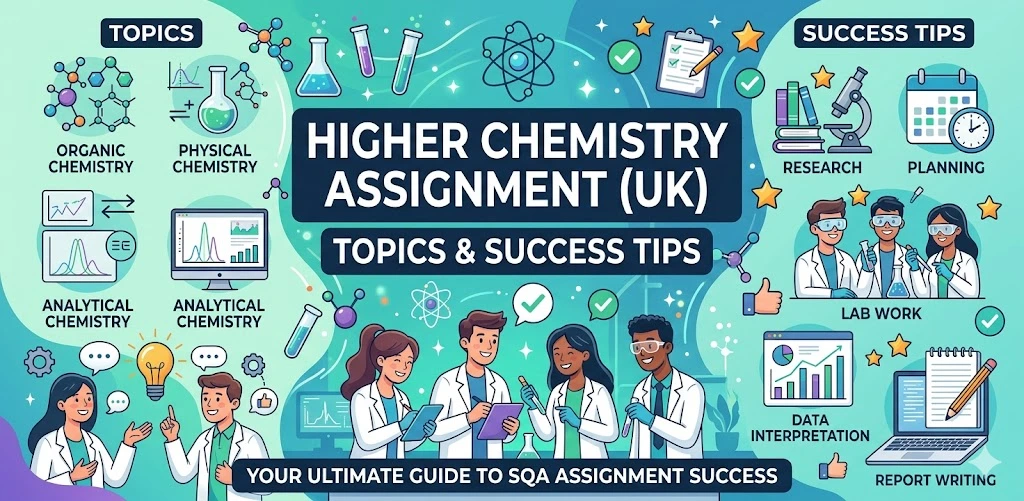
The Higher Chemistry assignment sits at the centre of your course assessment. It carries 20 marks, scaled to 30, representing 20% of your total course grade. That is a significant chunk of your final result. One that rewards students who plan carefully, understand exactly what markers look for, and choose their topic with genuine strategic thought.
This guide covers everything. What the assignment actually involves. How the marks break down. Which topics give you the strongest competitive advantage? How to structure each section. And the mistakes that quietly cost students marks every year.
What is a Higher Chemistry Assignment & What Does It Involve?
The assignment is an independent research project. Not an exam. Not a test. You select a chemistry topic, conduct a laboratory experiment, gather comparative data from the internet or literature sources, and write a report submitted directly to the Scottish Qualifications Authority (SQA) for external marking.
Your teacher does not mark it. An external examiner who has never met you judges it in two stages purely on what appears on the page.
Stage 1: Research.
Select your topic, agree on your aim with your teacher, conduct your experiment, and gather literature data. Reasonable independent freedom applies here.
Stage 2: Report.
Write your findings under tightly controlled conditions. Maximum 2 hours. Direct supervision throughout. No internet. No draft reports. Just your raw data, your literature findings, and your ability to communicate what you discovered.
Total recommended time across both stages: no more than 8 hours.
Choosing Your Higher Chemistry Assignment Topic
Topic selection for a higher chemistry assignment is where many students stumble. Not because they choose boring topics, but because they choose topics that cannot satisfy the assignment’s technical requirements.
Your topic must satisfy 3 non-negotiable Scottish Qualifications Authority (SQA) requirements. It must be appropriate for Higher Chemistry level. It must involve an experiment generating numerical data. Measurements you can record, tabulate, calculate from, and graph. And comparative literature data must exist somewhere you can find and properly cite.
Beyond those requirements, the strongest topics share 3 additional qualities:
1. Researchability: Peer-reviewed papers, government databases, and reliable scientific sources carry comparative data you can cite with full references.
2. Experimentability. The procedure generates at least 3 data points across a meaningful variable range, producing a graph with a visible trend.
3. Contemporary relevance: The chemistry connects to active real-world problems. Topics touching on sustainability, clean energy, medicine, or environmental protection demonstrate research awareness that markers respond to positively.
Higher Chemistry Assignment Topics by Category
Here are the 4 major chemistry research categories, including environmental and sustainable chemistry, advanced energy and electrochemical studies, organic and industrial applications, and inorganic and physical chemistry, with specific topic options and experimental angles across all 16 topic areas.
1. Environmental and Sustainable Chemistry
This category produces some of the most competitive Higher Chemistry assignments currently submitted to SQA. Environmental relevance, rich literature, and clean experimental data combine to make these topics highly accessible and high-scoring.
Biodegradable Plastics and Biopolymers
Specific topic options:
- Effect of temperature on the hydrolysis rate of polylactic acid (PLA)
- Comparison of degradation rates between starch-based bioplastics and petroleum-based plastics under controlled conditions
- Synthesis of a biopolymer from natural starch and analysis of its mechanical properties
- Effect of pH on the degradation rate of a biodegradable polymer film
Biodegradable plastics investigations examine sustainable polymer alternatives, measuring mass loss, tensile strength change, or degradation rate across controlled experimental variables. Experimental work can involve measuring mass loss over time under different hydrolysis conditions, producing clean numerical data across multiple time points or temperature variables.
The literature base is extensive, including materials science journals, government environmental databases, and sustainability research publications, all of which carry comparative degradation data. Underlying chemistry covers polymer structure, ester bond hydrolysis, and condensation polymerisation. All firmly within Higher Chemistry content.
Water Purification Technologies
Specific topic options:
- Effect of pH on the removal efficiency of heavy metal ions using precipitation reactions
- Comparison of the adsorption rates of different activated carbon materials for removing organic contaminants
- Effect of coagulant concentration on turbidity reduction in water treatment
- Effectiveness of different chemical disinfection methods against organic pollutants
Water purification investigations generate excellent numerical datasets through titration analysis, colourimetric measurement, or conductivity testing across multiple sample conditions. Government water quality databases, environmental chemistry journals, and WHO water safety publications provide readily citable comparative data. Underlying chemistry covers ion exchange, precipitation reactions, adsorption mechanisms, and oxidation-reduction chemistry. All well-supported by the Higher Chemistry course content.
Green Chemistry in Synthesis
Specific topic options:
- Comparison of reaction yield using conventional versus green solvent systems in an organic synthesis
- Effect of catalyst type on the efficiency of an oxidation reaction
- Measuring atom economy across different synthesis routes for the same product
- Effect of reaction temperature on yield when using an enzyme-based green catalyst
Green chemistry investigations examining solvent substitution, catalytic efficiency, or atom economy produce yield percentage data across multiple experimental conditions, including clean, calculable, and graphable. The atom economy calculation itself satisfies the chemical calculation requirement directly. Literature on green chemistry reaction efficiency is available through the Royal Society of Chemistry publications and open-access sustainability chemistry journals.
Carbon Capture Materials
Specific topic options:
- Effect of sodium hydroxide concentration on the rate of carbon dioxide absorption
- Comparison of carbon dioxide absorption capacity across different alkaline solutions
- Effect of temperature on the efficiency of carbon dioxide capture by amine-based solutions
- Rate of carbon dioxide uptake in different solid adsorbent materials
Carbon capture investigations measuring absorption rates across different alkaline concentrations or temperatures produce titration-based numerical data with clear trends. Government climate science databases and energy chemistry journals carry comparative carbon capture efficiency data from multiple citable sources. Underlying chemistry covers acid-base reactions, gas solubility, equilibrium, and enthalpy; a strong combination for the underlying chemistry section.
2. Advanced Energy and Electrochemical Studies
Energy chemistry topics carry exceptional literature support in 2025–26, with active global research generating recent publications across every sub-area.
Advanced Battery Technologies
Specific topic options:
- Effect of electrolyte concentration on the voltage output of an electrochemical cell
- Comparison of voltage and current output across different electrode material combinations
- Effect of temperature on the internal resistance of a galvanic cell
- Investigating the relationship between electrode surface area and current output
Electrochemical cell investigations examining voltage output, internal resistance, or energy density across different electrode materials or electrolyte concentrations produce strong, measurable numerical datasets. The shift toward solid-state and sodium-ion battery research as alternatives to lithium-ion systems generates substantial recent literature (2024–2026) that provides rich comparative data and demonstrates awareness of contemporary research directions.
Underlying chemistry covers standard electrode potentials, oxidation and reduction half-equations, and electrochemical cell theory, core Higher Chemistry content that markers reward when explained with genuine understanding.
Hydrogen Production and Storage
Specific topic options:
- Effect of catalyst material on the rate of hydrogen evolution during electrolysis
- Effect of electrolyte concentration on hydrogen production rate in water splitting
- Comparison of hydrogen evolution rates at different electrode materials
- Effect of temperature on the efficiency of catalytic water splitting
Catalytic water splitting experiments measuring hydrogen evolution rates across different catalyst materials or electrolyte concentrations produce clean, measurable data with visible trends. Fuel cell technology literature and hydrogen energy research publications provide excellent comparative efficiency data from multiple peer-reviewed sources. Underlying chemistry, including electrolysis, catalysis, bond enthalpy, and activation energy, maps precisely onto Higher Chemistry content areas.
Photocatalysis and Solar Energy
Specific topic options:
- Effect of titanium dioxide concentration on the photocatalytic degradation rate of a dye solution
- Comparison of degradation rates of organic pollutants under UV light versus visible light conditions
- Effect of pH on the photocatalytic efficiency of a semiconductor material
- Investigating the relationship between light intensity and photocatalytic degradation rate
Photocatalytic degradation investigations measuring concentration changes in organic dye solutions over time produce clean absorbance data from UV-visible spectrophotometry across multiple time intervals. Materials science databases and photochemistry journals provide comparative photocatalytic efficiency data that satisfies the literature comparison requirement. The underlying chemistry of light absorption, electron excitation, reactive oxygen species, and oxidation mechanisms demonstrates sophisticated chemical understanding that markers reward in the underlying chemistry section.
3. Organic and Industrial Applications
The following 3 organic and industrial chemistry topic areas cover pharmaceutical synthesis, chiral chemistry, and stimuli-responsive materials, each offering distinct experimental angles, strong literature support, and underlying chemistry that maps directly onto the Higher Chemistry course content.
Click Chemistry in Drug Development
Specific topic options:
- Comparison of reaction yield across different click chemistry reaction conditions
- Effect of temperature on the efficiency of a copper-catalysed azide-alkyne cycloaddition
- Comparison of reaction time and yield between click chemistry and conventional synthesis routes
- Effect of catalyst concentration on the yield of a click chemistry reaction
Click chemistry investigations can focus on specific reaction yield measurements, comparative efficiency analyses across different conditions, or catalyst optimisation experiments that produce percentage yield data across multiple trials. The Nobel Prize awarded to click chemistry research in 2022 means literature coverage is exceptional.
Recent journal publications, Royal Society of Chemistry articles, and pharmaceutical research papers all carry highly citable comparative data. Underlying chemistry of carbon-carbon bond formation, reaction mechanisms, and catalysis demonstrates strong Higher Chemistry and beyond content knowledge.
Students exploring organic chemistry topics in greater depth for their Higher Chemistry assignment benefit from specialist guidance available through our organic chemistry assignment help service, covering reaction mechanisms, synthesis routes, and pharmaceutical chemistry applications.
Stereoselective Synthesis and Chiral Catalysts
Specific topic options:
- Comparison of optical rotation values between chiral and racemic synthesis products
- Effect of chiral catalyst concentration on the enantiomeric excess of a synthesis product
- Measurement of optical purity across different stereoselective synthesis conditions
- Comparison of reaction yield between chiral and achiral catalyst systems
Chirality investigations examining optical rotation, yield comparison between chiral and racemic synthesis routes, or enantiomeric excess measurements produce measurable numerical data across multiple experimental conditions.
Pharmaceutical chemistry journals and organic synthesis publications provide excellent comparative data on chiral catalyst efficiency. Underlying chemistry of stereoisomerism, optical activity, enantiomers, and reaction mechanisms maps directly onto Higher Chemistry organic content.
Chemistry of Smart Materials
Specific topic options:
- Effect of temperature on the swelling ratio of a thermoresponsive hydrogel
- Comparison of phase transition temperatures across different smart polymer compositions
- Effect of pH on the volume change of a pH-responsive hydrogel
- Measuring the shape recovery rate of a shape-memory polymer across different temperature conditions
Smart material investigations measuring phase transition temperatures, hydrogel swelling ratios, or resistance changes in conducting polymers across temperature or pH ranges generate clean, graphable numerical datasets. Literature on stimuli-responsive polymers and hydrogel chemistry is well-developed across materials science journals and biomaterials research publications. The underlying chemistry of polymer cross-linking, intermolecular forces, and thermal properties sits within accessible Higher Chemistry content.
4. Inorganic and Physical Chemistry
The following 3 inorganic and physical chemistry topic areas span metal-organic frameworks (MOFs), nanoscale drug delivery systems, and advanced spectroscopic analysis, each producing measurable experimental datasets with rich comparative literature available across inorganic and physical chemistry research publications.
Metal-Organic Frameworks (MOFs)
Specific topic options:
- Effect of synthesis temperature on the surface area of a MOF material
- Comparison of gas adsorption capacity across different MOF structures
- Effect of activation conditions on the porous properties of a synthesised MOF
- Investigating the relationship between linker length and pore size in MOF synthesis
MOF investigations examining gas adsorption capacity, surface area estimation, or comparative stability across different synthesis conditions produce measurable data suitable for tabulation and graphing. Open-access chemistry databases and inorganic chemistry journals, particularly those covering hydrogen and carbon dioxide storage applications, provide rich comparative data from well-established citable sources. Underlying chemistry covers coordination bonding, porous structure, surface chemistry, and gas adsorption mechanisms.
Nanotechnology in Targeted Drug Delivery
Specific topic options:
- Effect of synthesis conditions on the particle size of silver or gold nanoparticles
- Comparison of drug loading efficiency across different nanoparticle surface treatments
- Effect of pH on the drug release rate from a nanoparticle delivery system
- Measuring the stability of nanoparticle dispersions under different ionic strength conditions
Nanoparticle investigations examining particle size, surface charge, or drug loading efficiency across different preparation conditions produce measurable UV-visible spectrophotometry or dynamic light scattering data. Clinical research papers and materials science journals carry extensive comparative nanoparticle characterisation data. Underlying chemistry covers colloid science, surface area to volume ratio, intermolecular forces, and nanoparticle synthesis mechanisms.
Raman Spectroscopy in Molecular Analysis
Specific topic options:
- Identification and comparison of molecular structures in unknown compound mixtures using Raman spectroscopy
- Effect of concentration on Raman spectral intensity in solution analysis
- Comparison of structural analysis accuracy between Raman spectroscopy and infrared spectroscopy
- Detecting adulteration in food samples using Raman spectral analysis
Raman spectroscopy investigations produce peak intensity data across multiple samples or concentrations that can be quantified and compared against literature spectral databases. Analytical chemistry journals and spectroscopy reference databases provide directly comparable spectral data for citation. This topic demonstrates analytical chemistry sophistication that distinguishes a submission within a typical Higher Chemistry cohort.
The 20-Mark Breakdown: Where Points Come From
Understanding the marking scheme transforms how you approach every section. Here is where the 20 marks are distributed across the assignment:
| Section | Marks |
| Aim | 1 |
| Underlying Chemistry | 3 |
| Data Collection and Handling | 6 |
| Graphical Presentation | 4 |
| Analysis | 1 |
| Conclusion | 1 |
| Evaluation | 3 |
| Structure | 1 |
| Total | 20 |
Aim: 1 mark. One sentence. Clear statement of what your investigation sets out to determine. “To investigate the effect of temperature on the rate of the reaction between hydrochloric acid and sodium thiosulfate” is acceptable. “To investigate chemistry” is not.
Underlying Chemistry: 3 marks. This is your demonstration of genuine chemical understanding relevant to your aim. Markers award holistically. 3 marks for good understanding, 2 marks for reasonable, 1 mark for limited, 0 for none. Writing in your own words matters here. Copying directly from your extracted sources earns nothing.
Data Collection and Handling: 6 marks. The heaviest weighted single section. Six separate marks covering:
- A summary of your experimental method (1)
- Sufficient raw experimental data (1)
- Data presented in a correctly structured table with headings and units (1)
- Values correctly calculated using a chemical relationship (1)
- Comparative data from an internet or literature source (1)
- A proper citation and reference for that source (1)
Graphical Presentation: 4 marks. Your graph of experimental results, assessed across an appropriate graph type, suitable scales, correct axis labels and units, and accurate data plotting with a line or curve of best fit where relevant.
Analysis: 1 mark. A valid comparison between your experimental data and your literature source data. Not just a description. A genuine stated relationship between the two datasets.
Conclusion: 1 mark. One clear statement connecting directly back to your aim, supported by all the data in your report. Not a restatement of results.
Evaluation: 3 marks. Three evaluative statements, each supported by justification. At most, one can evaluate your internet or literature source. The other two must address your experimental procedure with direct reference to your actual data.
Structure: 1 mark. A clear, concise report with an informative title. “Higher Chemistry Assignment” alone does not qualify.
Data collection and handling carry the most weight at 6 marks. Graphical presentation follows at 4 marks. Underlying chemistry and evaluation together account for 6 marks. Every section matters, but these four determine most of your score.
How to Structure Your Higher Chemistry Assignment Section-by-Section
Aim
One sentence. State your independent variable and dependent variable directly. “To investigate the effect of [variable] on [measurement]” works consistently. “To investigate chemistry” does not earn the mark.
Your title must tell an external reader, someone who has never seen your experiment, exactly what your report is about.
For example:
- “The Effect of Temperature on the Rate of Reaction Between Sodium Thiosulfate and Hydrochloric Acid” works.
- “Chemistry Experiment Report” does not work.
Underlying Chemistry: 3 Marks
Write entirely in your own words. You can quote briefly from extracted sources, but every quote needs your own explanation immediately following it. Copying passages from literature earns zero marks here. Not 1. Not 2. Zero!
Strong underlying chemistry sections include balanced equations for key reactions, explanations of relevant chemical properties, definitions of chemical terms a non-specialist reader would not immediately understand, and discussion of trends or relationships the theory predicts before experimental data is introduced.
If your investigation involves reaction rates, explain collision theory and activation energy. If it involves enthalpy, explain bond breaking and bond forming. Connect the theoretical chemistry directly to what your experiment measures.
Data Collection and Handling: 6 Marks
Six marks across six specific requirements. Approach each one as a separate checklist item. Treat each of the 6 marks as a separate checklist item:
1. Method summary: 3 to 5 sentences maximum. What you did, what you measured, and any specific safety measures your particular experiment required.
2. Raw data table: Every recorded measurement, including all individual repeat trial values. No processed values here.
3. Table with headings and units: Every column must have a clear heading. Units must appear in every column heading or after every value in that column.
4. Chemical calculation: Apply a relevant chemical relationship to your data. Show at least one sample calculation in full, with units throughout every step.
5. Comparative literature data: Find data from a citable source that you can compare to your experimental results. It does not need to match your conditions exactly.
6. Citation and full reference: Cite within the body using a number in brackets. Provide the full reference at the report’s end. Website references require the full URL and date accessed. Journal references require title, author, journal name, volume, and page number. Students unfamiliar with academic citation conventions across different source types benefit from our complete guide on how to reference and avoid plagiarism, which covers website, journal, and book referencing formats in detail.
Graphical Presentation: 4 Marks
Four marks. All four are achievable with basic care.
Choose your graph type based on your data. Scatter graphs suit continuous numerical variables. Bar graphs suit discrete categorical comparisons. Both axes must be labelled with units. Scales must use the available graph area efficiently. Draw a line or curve of best fit on scatter graphs where a clear trend exists. Do not force one through scattered points that show no pattern.
Analysis: 1 Mark
Compare your experimental data with your literature data. Identify the relationship between the two datasets. State whether your values are consistent, higher, or lower than literature values, and offer a chemical reason for any significant difference. Description alone earns nothing here.
Remember that: That is analysis. It compares. It quantifies. It explains.
Conclusion: 1 Mark
One mark. One sentence. Connect directly back to your aim.
One sentence connecting directly back to your aim, supported by the complete dataset. Do not restate individual results. Do not introduce new information.
Do not restate individual results. Do not introduce new information. State what the complete dataset tells you in relation to the question your aim asked.
Evaluation: 3 Marks
Three separate evaluative statements, each following this structure:
- First, identify a factor.
- Next, explain its effect on your data.
- Then, state what you did or would do to minimise it.
At most one statement can evaluate your internet or literature source. The remaining two must address your experimental procedure with direct reference to your actual data values.
For example: “Repeating each trial 3 times and calculating average values reduced the impact of random measurement errors on the accuracy of my calculated rate values.” That is one complete evaluative statement with identification, effect, and action.
A second example: “Heat loss to the surroundings during the combustion experiments meant that my enthalpy values were consistently lower than the literature values. Surrounding the calorimeter with insulation in future would reduce this systematic error and produce results closer to theoretical predictions.”
Students who want to strengthen their scientific report writing foundations before beginning their assignment benefit from our guide to structuring scientific assignments, which covers the logical flow, section hierarchy, and presentation principles that external markers reward.
Common Higher Chemistry Assignment Mistakes That Students Should Avoid
Copying from literature sources in the underlying chemistry section. Every copied passage earns nothing. Every word you write in your own voice, demonstrating genuine understanding, earns marks.
Missing units from table column headings. One missing unit heading costs the data presentation mark. Check every column before submitting.
Describing results rather than analysing them. The analysis section requires comparison with literature data and an identified relationship. Description without comparison earns nothing.
Weak evaluation statements without justification. “My results could be improved by being more careful” is not an evaluative statement. It identifies nothing, explains nothing, and justifies nothing.
Informative title omitted or too vague. “Higher Chemistry Assignment” earns no structure mark. Include your independent variable, dependent variable, and the chemical system you investigated.
Forgetting to include the literature source citation within the report body. The reference at the end earns nothing if no citation number appears in the body near the relevant data.
Concluding the Guide
The Higher Chemistry assignment rewards preparation. Not talent alone. Students who understand the marking scheme, choose a researchable topic with experimental depth, and address every section deliberately and specifically consistently outperform students who rely on general chemistry ability without strategic preparation.
Students building strong scientific research and report-writing foundations can benefit from our guide on how to apply critical thinking in research and writing, which covers the analytical reasoning skills that strengthen every section of a research-based assessment.
FQ Assignment Help connects UK students with qualified chemistry specialists who understand SQA marking requirements, Higher Chemistry content, and the research and report writing skills that produce distinction-grade submissions. Explore our chemistry assignment help service for expert academic support built around your exact assignment requirements.