
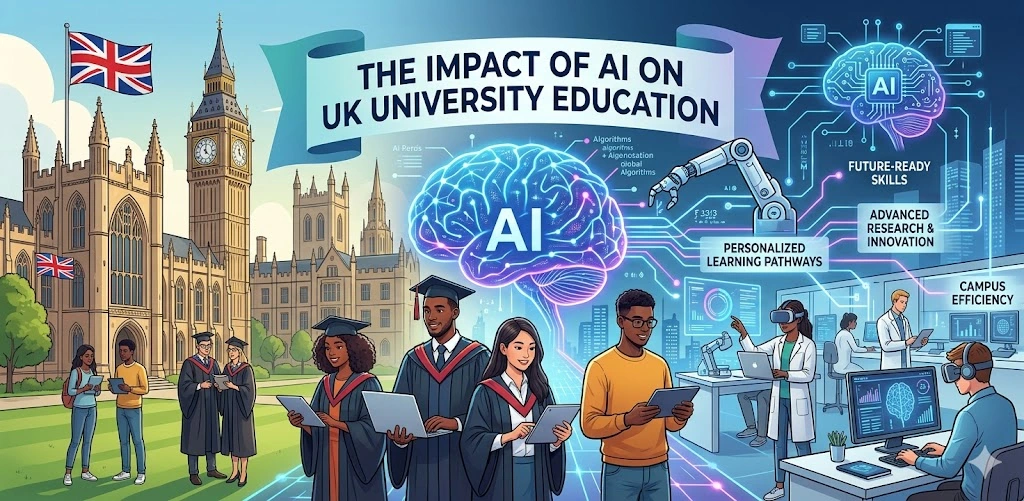
Artificial intelligence has moved from a theoretical discussion point into the operational reality of UK higher education. Lecture halls, assessment systems, research libraries, and student support services across English universities now incorporate AI tools at a scale that would have seemed ambitious just five years ago.
Understanding what AI actually does in this environment, its genuine benefits, its real limitations, and the serious questions it raises around academic integrity, gives every UK student a more informed perspective on the educational landscape they navigate daily.
How AI Is Changing the Way UK Universities Teach
Personalised Learning at Scale
The most significant educational application of AI in UK universities involves adaptive learning platforms, systems that analyse individual student performance data and adjust content delivery accordingly. Rather than every student receiving identical lecture materials at an identical pace, adaptive platforms identify where each student struggles, where they excel, and what additional resources would most benefit their specific learning trajectory.
For a first-year undergraduate managing 5 modules simultaneously, this means support arrives precisely where it is needed rather than uniformly across material the student already understands.
Research published in Creative Education (Karimi & Khawaja, 2023) found that adaptive learning technologies improve student motivation and engagement by enabling progress at each individual’s own pace, a measurable shift from the passive reception model that dominated university teaching for generations.
Intelligent Tutoring Systems
AI-powered tutoring programmes provide students with immediate feedback on submitted work, identifying common misconceptions, suggesting targeted explanations, and recommending additional learning resources without requiring a scheduled tutorial appointment. For students at institutions where staff-to-student ratios make one-to-one academic support scarce, these systems provide accessible guidance that previously required waiting days for a response.
Virtual tutors can analyse student responses in real time, spot patterns of misunderstanding across an entire cohort, and alert teaching staff to recurring comprehension gaps before examination periods arrive, giving academic departments data-driven early warning systems for student support intervention.
Transformed Assessment and Feedback
Machine learning systems now grade short-form assessments, quizzes, and structured written responses across UK university programmes with documented accuracy. These tools provide instant, detailed feedback, identifying specific areas for improvement rather than returning a grade alone. For students managing tight submission schedules, immediate automated feedback creates revision opportunities that traditional marking timescales cannot provide.
Beyond individual feedback, AI assessment analytics give universities programme-level insight, identifying which module components consistently produce weak student performance, enabling curriculum adjustments based on evidence rather than assumption.
Administrative and Institutional Benefits
AI’s impact on UK universities extends beyond the classroom into the operational infrastructure that shapes student experience.
Automated administrative processes, enrolment management, timetabling, library resource allocation, and admissions processing reduce the administrative burden on university staff, redirecting human expertise toward student-facing support roles that AI cannot replicate. Institutions implementing AI-driven administrative systems report measurable efficiency gains in processing times, resource allocation accuracy, and student query response rates.
Predictive analytics identify at-risk students earlier than traditional academic monitoring allows, analysing attendance patterns, assignment submission behaviour, and assessment performance trajectories to flag students who benefit from proactive academic or well-being support before crisis points develop.
Accessibility improvements represent one of AI’s most equitable contributions to UK higher education. Speech recognition tools, text-to-speech systems, and real-time language translation make academic content accessible to students with disabilities and international students navigating language barriers, expanding genuine participation in higher education across previously underserved populations.
The Challenges Universities Cannot Ignore
Algorithmic Bias and Fairness
AI systems learn from existing data, and existing data frequently contains historical inequalities. When AI algorithms trained on biased datasets make decisions about student support allocation, assessment grading, or academic pathway recommendations, those biases replicate and potentially amplify at scale. Karimi and Khawaja (2023) note that institutions must conduct regular algorithmic audits to identify and address bias before it affects student outcomes.
The Office for Students (OfS) and the Quality Assurance Agency (QAA) have both signalled that AI governance in higher education requires institutional transparency, universities must be able to explain how algorithmic decisions affecting students are made, and demonstrate that those decisions are free from discriminatory outcomes.
Data Privacy and Security
Every personalised learning interaction, every adaptive assessment response, and every predictive analytics calculation generates student data. UK universities operate under GDPR obligations that require explicit consent mechanisms, transparent data usage policies, and robust cybersecurity infrastructure to protect sensitive personal information from breach or misuse.
The volume of student data that AI systems require creates a governance challenge that grows as AI adoption expands. Institutions that fail to establish clear data governance frameworks risk not only regulatory penalties but fundamental erosion of student trust in digital learning environments.
The Critical Thinking Question
The most significant pedagogical concern surrounding AI in UK education is not whether machines will replace professors. They will not. The concern is subtler: whether students who use AI tools to retrieve information, generate essay outlines, or check argument logic gradually develop weaker independent analytical capabilities than students who practise those skills through friction and effort.
Research cited by Karimi and Khawaja (2023) suggests that automating information retrieval and analysis processes reduces student motivation to conduct their own investigation and evaluation, producing a more passive learning environment than the critical, inquiry-driven model that UK universities aim to foster.
The answer is not abandoning AI tools but designing their use deliberately, ensuring students engage with AI as a thinking aid rather than a thinking replacement.
Academic Integrity: The Issue UK Students Cannot Afford to Ignore
The most immediately consequential AI development for UK university students is the rapid proliferation of AI writing tools, and the equally rapid development of institutional AI detection systems designed to identify their use in academic submissions.
Universities across the UK now deploy AI detection software alongside traditional plagiarism checkers as standard components of their academic integrity frameworks. The QAA’s guidance on AI-generated content in academic submissions makes clear that presenting AI-generated work as one’s own constitutes academic misconduct, carrying consequences that range from mark reduction through to programme exclusion, depending on institutional policy and the severity of the breach.
Detection systems have become increasingly accurate. Tools, including Turnitin’s AI detection functionality, GPTZero, and institutional proprietary systems, identify AI-generated writing patterns with growing reliability, analysing sentence structure variation, stylistic consistency, and linguistic naturalness markers that AI writing characteristically produces and human writing characteristically does not.
For students navigating heavy workloads, complex assignments, and tight deadlines, the temptation to use AI generation tools is understandable. The academic and professional consequences of detection, however, are serious and lasting, appearing on academic transcripts in ways that affect postgraduate applications and graduate employment prospects.
This is precisely where human-written academic support serves a fundamentally different function. FQ Assignment Help produces every assignment, essay, dissertation, and coursework piece from scratch by qualified human specialists, with zero AI generation involved at any stage. Every solution we provide passes full Turnitin verification and produces a clean originality report.
Students receive genuine human expertise, authentic analytical reasoning, and work that demonstrates the critical thinking their marking rubric assesses, without the academic integrity risk that AI-generated content carries.
Students concerned about how AI detection affects academic submissions can build a deeper understanding through our guide on the AI impact on academic integrity, which covers how detection systems work, what institutions look for, and how students can protect their academic standing.
What the Future of AI in UK Higher Education Looks Like
AI integration in UK higher education will continue expanding, not as a replacement for human-led education but as an increasingly sophisticated layer of support, analysis, and personalisation sitting alongside it. The institutions that navigate this transition most successfully will be those that establish clear ethical frameworks, invest in staff AI literacy, maintain robust data governance, and preserve human mentorship, critical dialogue, and original thinking at the centre of the educational experience.
For students, the practical implication is digital literacy, understanding what AI tools can and cannot do, where using them enhances learning and where over-reliance undermines it, and how institutional policies govern their acceptable use within assessed work.
The balance between embracing AI’s genuine educational benefits and protecting the critical thinking, original analysis, and academic integrity that UK degrees represent remains the defining challenge for British universities across the next decade.
Conclusion
Artificial intelligence is reshaping UK higher education across teaching, assessment, administration, and student support in ways that carry measurable benefits and serious responsibilities simultaneously. Personalised learning, intelligent tutoring, automated feedback, and predictive analytics expand educational access and improve student outcomes when implemented with genuine care for equity, transparency, and data governance. The academic integrity challenge AI writing tools create, however, demands that students understand precisely what their institutions detect, how detection works, and what consequences submission of AI-generated work carries.
Students building stronger academic writing skills, the kind of genuine analytical capability that no AI tool can replicate, find strong foundational guidance in our guide to apply critical thinking in research and writing, which covers the independent reasoning skills UK university assessors specifically reward at distinction level.
Frequently Asked Questions
Q1: Is AI replacing university lecturers in the UK?
AI handles repetitive tasks like short-form grading and scheduling, but does not replace human teaching. Mentoring, critical dialogue, and complex subject expertise remain entirely human-led functions across UK universities.
Q2: Can UK universities detect AI-generated assignments?
Yes. Most UK universities now use AI detection tools, including Turnitin’s AI detection alongside traditional plagiarism checkers. Submitting AI-generated work as your own constitutes academic misconduct under QAA guidelines.
Q3: Does AI improve learning outcomes for UK students?
Adaptive learning platforms and intelligent tutoring systems show measurable improvements in student engagement and performance when implemented with proper support. However, over-reliance on AI tools risks reducing independent critical thinking development.
Q4: What are the main risks of AI in UK higher education?
The 4 primary risks are algorithmic bias producing unfair outcomes, data privacy breaches, erosion of student critical thinking, and academic integrity violations from AI-generated assignment submissions.
Q5: How should UK students use AI tools responsibly in their studies?
Students should use AI tools for research exploration, idea organisation, and feedback review. Not for generating submitted work. Every UK university’s academic integrity policy specifies what constitutes acceptable AI use within assessed coursework.
FQ Assignment Help produces every assignment, essay, dissertation, and coursework piece from scratch by UK-qualified human specialists, zero AI generation, full Turnitin verification, and complete academic integrity compliance guaranteed. Explore our academic writing services for distinction-grade support that protects your academic standing throughout your entire programme.