Reflective essays confuse students. They think reflection means describing what happened, adding “I felt…” statements, and calling it critical thinking.
Wrong.
Reflection isn’t storytelling. It’s structured analysis using proven frameworks, examining experiences systematically, identifying learning, and planning future improvement.
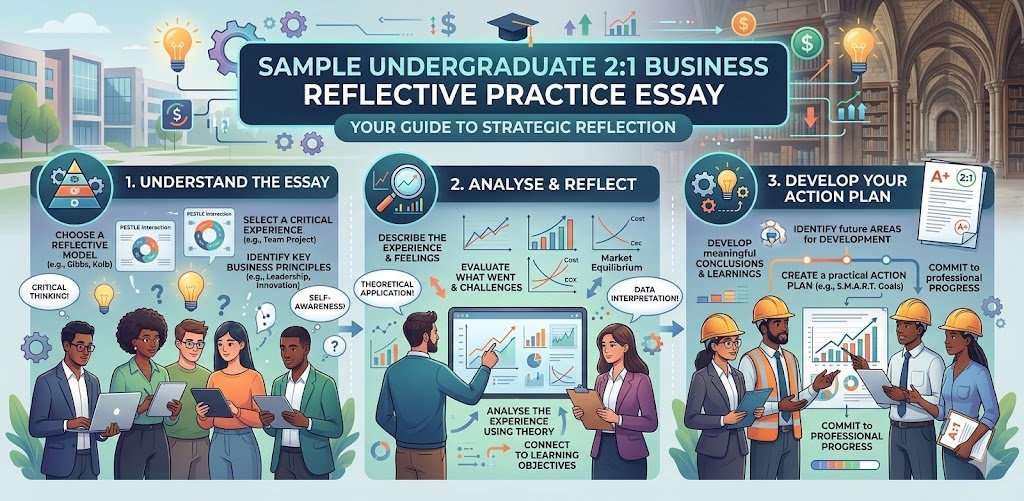
This guide shows you exactly how reflective essays work. We’ll demonstrate five different reflective models applied to the same business experience, enabling direct comparison of each framework’s approach and application.
What is a Reflective Essay?
A reflective essay is a structured piece of writing. It analyses personal experiences using established frameworks, examining what happened, why it happened, what you learned, and how you’ll improve, demonstrating critical thinking beyond simple description or storytelling.
What Students Get Wrong About Reflective Essays
Here, we have enlisted the common mistakes that destroy your reflective essay grades:
Mistake 1: Pure description without analysis
Students narrate events chronologically: “First this happened, then that happened, finally this occurred.” No critical thinking. No learning identified. Just storytelling.
Reflective essays demand analysis: Why did events unfold this way? What influenced outcomes? What could have been different? What did you learn?
Mistake 2: Vague, unsupported feelings
“I felt stressed.” “It was challenging.” “I learned a lot.”
These statements mean nothing without explanation. Why were you stressed? What specifically challenged you? What exactly did you learn? How will it change future practice?
Mistake 3: Ignoring theoretical frameworks
Reflection without structure produces rambling, unfocused writing. Reflective models provide systematic frameworks ensuring comprehensive analysis covering all essential elements.
Mistake 4: Missing the “so what?” factor
Good reflection answers: “So what did I learn? So what will I do differently? So what are the implications for my professional practice?”
Without demonstrating growth and future application, reflection lacks purpose.
Master essay organisation fundamentals with our comprehensive guide on how to structure and plan your essay effectively.
Understanding the 2:1 Classification
A 2:1 (pronounced “two-one”) represents Upper Second Class Honours in the UK university grading system, typically 60-69% marks.
This classification demonstrates:
- Strong understanding of subject material
- Good analytical and critical thinking skills
- Effective application of theory to practice
- Well-structured, coherent arguments
- Appropriate use of academic sources
- Clear evidence of independent learning
2:1 essays aren’t perfect (that’s First Class, 70%+), but they’re consistently strong, showing depth beyond basic comprehension.
For reflective essays, the 2:1 standard requires:
- Systematic application of reflective frameworks
- Critical analysis, not just description
- Clear identification of learning outcomes
- Evidence-based reasoning connecting theory and practice
- Honest self-evaluation with specific examples
- Concrete action plans for future improvement
Explore different assignment formats in our guide covering 8 academic essay types for UK university students.
Sample Reflective Essay Scenario
Before examining different reflective models, here’s the business experience we’ll reflect upon using each framework:
Context: During a group marketing project for a fictional product launch, I was appointed team leader responsible for coordinating five team members, managing timelines, and delivering a final presentation worth 40% of the module grade.
What happened: Initial meetings went well with enthusiastic participation. However, midway through the project, two team members stopped attending meetings and missed deadlines without communication. I attempted contacting them via email and messaging apps, with limited response. Facing deadline pressure, I redistributed their tasks among the remaining members, causing workload stress and resentment. The presentation was delivered successfully, achieving 65% (2:1 grade), but team relationships were strained, and I felt I had failed as a leader despite the acceptable academic outcome.
This scenario will be analysed using 5 different reflective models below, demonstrating how each framework structures reflection differently.
One Essay, Five Different Models
The following sections present the same reflective experience analysed through 5 different reflective frameworks:
- Gibbs’ Reflective Cycle (1988)
- Kolb’s Experiential Learning Cycle (1984)
- Schön’s Reflective Practice (1983/1987)
- Driscoll’s What? Model (1994/2007)
- Atkins and Murphy (1993)
Why show multiple models?
This enables direct comparison of how different frameworks approach reflection. Some are more structured, others are more flexible. Some emphasise feelings, others prioritise action. Understanding these differences helps you choose the most appropriate model for specific reflective tasks.
Each model below is a complete reflective essay demonstrating a 2:1 standard analysis using that particular framework.
Model 1: Gibbs’ Reflective Cycle (1988)
Gibbs’ six-stage cycle moves systematically through Description, Feelings, Evaluation, Analysis, Conclusion, and Action Plan.
Description (What happened?)
As team leader for a marketing project, I coordinated five group members developing a product launch campaign. Initial progress was positive with clear role allocation and timeline agreement. However, two members disengaged midway, missing meetings and deadlines without explanation. I attempted contact through multiple channels, receiving minimal responses. Facing the approaching deadline, I redistributed uncompleted tasks among the remaining members, creating workload pressure. We delivered the presentation, achieving 65%, but team morale was damaged, and I questioned my leadership effectiveness.
Feelings (What were you thinking and feeling?)
Initially, I felt confident and enthusiastic about the leadership opportunity, viewing it as a chance to demonstrate organisational skills. When members disengaged, I experienced frustration mixed with self-doubt, questioning whether I had failed to create an inclusive team environment.
Positive Feeling: Initial confidence and enthusiasm
Negative Feeling: Frustration and self-doubt when problems emerged
Redistributing work felt unfair to committed members, causing guilt about overburdening them, whilst resenting absent members who faced no consequences. The presentation’s success brought relief but also disappointment that interpersonal challenges overshadowed academic achievement. I felt I had succeeded academically but failed personally in maintaining team cohesion.
Negative Feelings: Guilt, resentment, and disappointment despite academic success
Evaluation (What was good and bad about the experience?)
Positive aspects included successful task completion despite setbacks, demonstrating resilience and adaptability. Committed team members showed exceptional dedication, strengthening our working relationships. The 2:1 grade validated our collective effort despite reduced team size.
Negative aspects dominated the experience. Communication breakdown with disengaged members suggested leadership failures in establishing accountability mechanisms and maintaining engagement. Redistributing work without consultation created resentment, indicating poor conflict resolution skills. The focus on task completion rather than team well-being reflected an inadequate understanding of leadership’s relational dimensions.
Analysis (What sense can you make of the situation?)
Tuckman’s (1965) team development model suggests groups progress through forming, storming, norming, and performing stages. We never successfully navigated the ‘storming’ stage where conflict emerges. Rather than addressing emerging tensions through open dialogue, I avoided confrontation, hoping problems would resolve independently.
Belbin’s (2010) team roles theory highlights that effective teams require diverse roles, including coordinators, implementers, and complete-finishers. I focused exclusively on task coordination, neglecting team maintenance roles essential for cohesion. Leadership literature distinguishes task-oriented versus relationship-oriented styles (Hersey and Blanchard, 1969). I exhibited extreme task orientation, prioritising deadline achievement over interpersonal relationships. A strategic error, given that sustained team performance requires both dimensions.
Conclusion (What else could you have done?)
Early intervention when members first missed meetings was critical. Establishing clear accountability mechanisms, including regular check-ins, milestone tracking, and agreed consequences for non-participation, would have prevented problems escalating. Balancing task completion with team well-being required distributing workload changes through consultation rather than unilateral decision-making.
Developing emotional intelligence (Goleman, 1995), including empathy and social awareness, would have enabled understanding why members disengaged, potentially addressing underlying issues rather than symptoms.
Action Plan (If it arose again, what would you do?)
Specific future actions include:
- Establish accountability frameworks early: Create team contracts specifying roles, responsibilities, deadlines, and escalation procedures for non-compliance
- Implement regular check-ins: Schedule brief individual meetings, identifying challenges before they escalate
- Balance task and relationship focus: Allocate equal attention to both achieving objectives and maintaining positive team dynamics.
- Develop conflict resolution skills: Undertake training in difficult conversations and mediation techniques.
- Practice consultative decision-making: Involve team members in problem-solving rather than imposing solutions.
An action plan demonstrates specific, measurable changes translating learning into improved future practice. It is essential for 2:1 reflective writing.
Model 2: Kolb’s Experiential Learning Cycle (1984)
Kolb’s 4-stage cycle emphasises learning through experience: Concrete Experience, Reflective Observation, Abstract Conceptualisation, and Active Experimentation.
Concrete Experience (What happened?)
The marketing project leadership experience involved coordinating a five-person team developing a product launch campaign. Two members disengaged during the project, missing deadlines and meetings. I redistributed their work among the remaining members without consultation, creating stress but enabling successful presentation delivery, achieving 65%. Team relationships deteriorated despite academic success.
Reflective Observation (What did I notice?)
Several observations emerged from analysing this experience systematically.
About myself: I demonstrated strong task-orientation, prioritising deadline achievement over team cohesion. When conflict emerged, I avoided confrontation, hoping problems would resolve independently rather than addressing them directly. My decision-making was unilateral rather than consultative, potentially alienating committed members.
Observation: Task-focused, conflict-avoidant, unilateral decision-maker
About others: Committed team members showed resilience and dedication, compensating for absent members without complaint initially. However, stress manifested later through reduced communication and visible frustration. Disengaged members provided minimal explanation for their absence, suggesting either personal issues I failed to identify or a lack of commitment to group work.
Observation: Committed members are resilient but increasingly frustrated; disengaged members are uncommunicative.
About the situation: Group work success depends on both task completion and relationship maintenance. Academic achievement alone doesn’t constitute successful teamwork if interpersonal dynamics suffer. Early intervention prevents problems escalating beyond resolution.
Observation: Task success ≠ team success; early intervention critical
Abstract Conceptualisation (What does it mean?)
This experience illustrates several theoretical concepts from organisational behaviour and leadership literature.
Leadership styles: Hersey and Blanchard’s (1969) Situational Leadership Theory suggests that effective leaders adapt styles to situations. I employed solely directive, task-oriented leadership despite the situation requiring supportive, relationship-oriented approaches addressing team dysfunction.
Team dynamics: Tuckman’s (1965) stages demonstrate that teams must successfully navigate conflict (storming stage) to achieve high performance. We stalled at storming because I avoided rather than managed conflict, preventing progression to norming and performing stages.
Emotional intelligence: Goleman’s (1995) framework identifies self-awareness, self-regulation, motivation, empathy, and social skills as leadership competencies. My low empathy and social skills prevented understanding why members disengaged and addressing root causes rather than symptoms.
These concepts reveal that effective leadership requires balancing task achievement with people management, adapting styles situationally, and developing emotional intelligence, enabling relationship navigation.
Active Experimentation (How will I apply this learning?)
Future applications of this learning include:
Experiment 1: Implementing team contracts. In the next group project, I will co-create team contracts specifying roles, expectations, communication protocols, and accountability mechanisms. This establishes shared understanding and agreed consequences for non-participation.
Experiment 2: Regular individual check-ins. I will schedule brief weekly individual meetings with each team member, providing space for raising concerns before they escalate. This demonstrates care for individual well-being beyond task completion.
Experiment 3: Consultative problem-solving. When challenges emerge, I will convene team discussions exploring solutions collaboratively rather than imposing decisions unilaterally. This respects team members’ autonomy and expertise.
Experiment 4: Emotional intelligence development. I will undertake emotional intelligence training focusing specifically on empathy and conflict resolution, improving my ability to understand others’ perspectives and navigate difficult conversations effectively.
Active experimentation transforms learning into concrete behavioural changes, demonstrating the practical value of reflection essential for 2:1 work.
Model 3: Schön’s Reflective Practice (1983/1987)
Schön distinguishes reflection-in-action (thinking while doing) and reflection-on-action (thinking after doing), emphasising professional judgment in complex situations.
Reflection-on-Action (Looking back at the experience)
Analysing the marketing project leadership retrospectively reveals significant gaps between my intended approach and actual practice.
Intended approach: I aimed to be an inclusive, supportive leader fostering collaborative environments where all members felt valued and motivated. I envisioned facilitating open communication, distributing tasks fairly, and celebrating collective achievements.
Actual practice: When members disengaged, I reverted to authoritarian, task-focused leadership. Rather than investigating why disengagement occurred, I simply redistributed work,k prioritising deadline achievement over understanding team dynamics. My communication became directive rather than facilitative, and I made unilateral decisions, excluding team input.
The gap between intention and practice: This discrepancy arose from inadequate preparation for conflict scenarios. I had leadership theories informing my intended approach, but lacked practical skills in executing those theories under pressure. When the idealised collaborative environment broke down, I defaulted to familiar authoritarian patterns rather than adapting thoughtfully.
Reflection-in-Action (Thinking during the experience)
Schön emphasises that professionals must think on their feet, adapting approaches as situations unfold. Examining my in-the-moment thinking reveals limited adaptive capacity.
When members first missed meetings: My immediate thought was “they’re probably busy; it will be fine.” This reflected wishful thinking rather than critical assessment. A reflective practitioner would have immediately investigated, understanding that early intervention prevents escalation.
When redistributing work, I thought, “We need to get this done; I’ll just assign their tasks to others.” This instrumental thinking prioritised outputs over processes and relationships. Reflective practice would have paused, considering implications for team morale and exploring alternative solutions collaboratively.
When tensions rose, I noticed stress among committed members, but thought, “We just need to finish, then it will be over.” This avoidance strategy ignored relational damage extending beyond project completion. Reflective practitioners address tensions immediately rather than deferring to hypothetical future resolution.
My reflection-in-action was minimal. I operated reactively rather than reflectively, missing opportunities for adaptive intervention.
Professional Artistry and Tacit Knowledge
Schön argues that professionals develop ‘artistry,’ intuitive expertise navigating complex, unique situations beyond formulaic rule-following. My leadership lacked this artistry because I relied on rigid task-completion frameworks rather than developing situational sensitivity.
Tacit knowledge, the “knowing-how” developed through experience, was insufficient. I possessed theoretical knowledge about leadership (knowing-that) but lacked practical wisdom (knowing-how), applying theories flexibly in messy, ambiguous contexts.
Developing professional artistry requires:
- Increased situational awareness: Paying attention to subtle cues indicating emerging problems
- Reflective conversations: Engaging team members in dialogue, exploring issues rather than imposing solutions
- Tolerance for uncertainty: Accepting that leadership involves navigating ambiguity without clear right answers
- Integration of theory and practice: Moving beyond seeing theory as separate from practice toward seeing them as mutually informing
Schön’s framework reveals that effective practice requires continuous reflection both during and after action, developing intuitive expertise through iterative learning cycles.
Model 4: Driscoll’s What? Model (1994/2007)
Driscoll’s framework uses 3 simple trigger questions: What? So What? Now What?. It provides an accessible structure for systematic reflection.
What? (Description of the event)
I led a five-member marketing team developing a product launch presentation. Midway through, two members disengaged, missing meetings and deadlines. I redistributed their uncompleted tasks among the remaining members without consultation. We successfully presented, achieving 65%, but team relationships were strained. I felt academically successful but interpersonally inadequate as a leader.
So What? (Analysis and significance)
So what does this experience reveal about my leadership capabilities?
It exposes significant weaknesses in conflict management, emotional intelligence, and adaptive leadership. When idealised collaborative environments broke down, I lacked the skills to navigate dysfunction constructively. My task-orientation overshadowed people-management, reflecting an incomplete understanding of leadership’s multidimensional nature.
So what does this mean for my professional development?
It indicates an urgent need for developing soft skills, including empathy, difficult conversation navigation, and consultative decision-making. Technical competence in project management (timelines, task allocation) is insufficient without interpersonal competence (relationship building, conflict resolution, emotional awareness).
So what theoretical insights does this experience validate?
Hersey and Blanchard’s (1969) Situational Leadership: Leaders must adapt styles to contexts. My rigid task-orientation, despite requiring relationship-orientation, validates the need for situational flexibility.
Confirms the importance of adaptive leadership styles.
Tuckman’s (1965) team development stages: Groups must navigate conflict successfully to perform effectively. Our failure to progress beyond storming demonstrates that avoiding conflict doesn’t resolve it. Active management is essential.
Confirms that teams need active conflict navigation.
Goleman’s (1995) emotional intelligence: Leadership effectiveness depends significantly on understanding and managing emotions, both one’s own and others’. My limited emotional intelligence directly caused a relationship breakdown.
Confirms a critical leadership competency.
So what were the consequences of my actions?
Immediate consequences: Successfully met academic deadlines, maintaining grade standards, but damaged team relationships and created unnecessary stress for committed members.
Consequence: Task success, relationship failure.
Longer-term consequences: Committed members are reluctant to collaborate with me again, potentially affecting future group work opportunities. I missed valuable learning about conflict resolution that would have developed crucial professional skills.
Consequence: Damaged reputation, missed learning opportunity
Personal consequences: I experienced guilt, frustration, and disappointment, questioning my leadership capabilities and potentially avoiding future leadership roles despite them being essential for professional development.
Consequence: Reduced confidence, potential leadership avoidance
Now What? (Action plan and future practice)
Now, what specific actions will I take to develop leadership capabilities?
Action 1: Formal conflict resolution training. Enrol in university-offered conflict management workshops, developing skills for difficult conversations, mediation, and constructive confrontation. Target completion: Next semester.
Action 2: Emotional intelligence development. Read Goleman’s (1995) Emotional Intelligence and complete online assessments identifying specific competency gaps. Implement targeted development strategies addressing weaknesses. Ongoing development activity.
Action 3: Seek leadership mentoring. Identify an experienced leader (academic supervisor, workplace manager, or career services mentor) willing to guide in navigating complex team situations. Schedule monthly mentoring sessions discussing leadership challenges and alternative approaches.
Action 4: Implement team contracts proactively. In all future group work, initiate team contract creation during the first meetings, establishing clear expectations, communication protocols, and accountability mechanisms before problems emerge.
Action 5: Practice consultative decision-making. Consciously involve team members in problem-solving and decision-making processes, even when unilateral decisions seem faster. Build habits of consultation rather than imposition.
Now, what will I do differently if similar situations arise?
If members disengage: Immediately schedule individual conversations exploring reasons for absence rather than assuming explanations. Offer support addressing underlying issues (workload, personal problems, unclear expectations) before problems escalate.
If workload redistribution becomes necessary: Convene a team meeting explaining the situation, soliciting volunteers for additional work, negotiating fair compensation (recognition, future reciprocation, adjusted expectations), and ensuring shared decision-making rather than unilateral imposition.
If tensions rise, address openly through facilitated team discussions rather than avoiding conflict, hoping it resolves independently. Create safe spaces for expressing frustrations and collaboratively developing solutions.
Driscoll’s simple structure ensures comprehensive reflection covering description, analysis, and action, demonstrating learning and development essential for 2:1 work.
Model 5: Atkins and Murphy (1993)
Atkins and Murphy’s framework emphasises awareness, critical analysis, and new perspective development through 3 interconnected stages.
Stage 1: Awareness of Uncomfortable Feelings and Thoughts
The marketing project leadership triggered several uncomfortable realisations, prompting reflection.
Awareness of inadequacy: Despite achieving academic success (65% grade), I felt I had failed as a leader. This discomfort arose from recognising that task completion alone doesn’t constitute leadership success; maintaining team cohesion matters equally.
Uncomfortable Feeling: Sense of failure despite academic achievement
Awareness of guilt: Redistributing work without consultation caused guilt about overburdening committed members. I recognised my decision prioritised my convenience and deadline achievement over fairness and team well-being.
Uncomfortable Feeling: Guilt about the unfair treatment of committed members.
Awareness of avoidance patterns: I noticed my tendency to avoid conflict, hoping problems resolve independently rather than confronting issues directly. This pattern extends beyond this specific incident into broader life contexts, suggesting deep-seated conflict-avoidance requiring attention.
Uncomfortable Realisation: Habitual conflict avoidance pattern.
These uncomfortable feelings signal important learning opportunities; discomfort indicates gaps between values and actions requiring examination.
Stage 2: Critical Analysis of the Situation
Analysing personal knowledge informing the situation:
I possessed theoretical knowledge about participative leadership, emotional intelligence, and team dynamics from module readings. However, I lacked practical knowledge in applying theories under pressure. This reveals the theory-practice gap common among novice leaders; understanding concepts intellectually differs from embodying them behaviorally.
Analysing influences on my actions:
Time pressure: Approaching deadlines created urgency, encouraging quick, unilateral decisions rather than slower, consultative processes. This reveals my limited capacity for managing complexity under pressure, requiring the development of stress management and decision-making skills.
Influence: Time pressure > unilateral decisions
Past experiences: Previous group projects where I was a member rather than a leader involved minimal conflict, creating unrealistic expectations that leadership would be straightforward. Lack of prior leadership experience meant I had no behavioural repertoire for dysfunction.
Influence: Limited leadership experience > inadequate response strategies.
Personal values: I value harmony and dislike confrontation, leading me to avoid difficult conversations. While valuing harmony is positive, allowing this value to prevent necessary conflict management becomes problematic.
Influence: Conflict-avoidant values > unaddressed team dysfunction.
Analysing alternative actions:
Alternative 1: Early intervention conversation. Upon the first missed meeting, I could have contacted the absent member, expressing concern and exploring reasons for absence. This demonstrates care whilst establishing accountability.
Better Alternative: Proactive, caring intervention
Alternative 2: Team meeting addressing workload redistribution. Rather than unilaterally redistributing work, I could have convened a team meeting explaining the situation, soliciting input, and collectively determining fair solutions. This respects team autonomy and distributes decision-making responsibility.
Better Alternative: Consultative, democratic approach
Alternative 3: Seeking support from the module tutor, University staff can guide the management of dysfunctional teams and intervene with non-participating members. I could have sought support rather than managing everything independently.
Better Alternative: Utilising available resources and support
Stage 3: Development of a New Perspective
New perspective 1: Leadership is relational, not just transactional
I previously viewed leadership primarily as task coordination—setting timelines, allocating work, and monitoring progress. This experience taught me that leadership fundamentally involves relationship management. Without positive relationships, task coordination becomes significantly more difficult. Effective leadership requires balancing task and relationship dimensions continuously.
New Perspective: Leadership = tasks + relationships
New perspective 2: Conflict is natural and requires active management
I previously believed that good teams don’t experience conflict and that conflict indicates failure. I now understand that conflict is inevitable in group work and that avoiding conflict causes more problems than addressing it constructively. Effective leaders don’t prevent conflict. They navigate it skillfully.
New Perspective: Conflict is normal; avoidance is problematic
New perspective 3: Leadership skills are developed through practice, not innate
I felt inadequate as a leader, questioning whether I possessed leadership capabilities. This experience taught me that leadership involves learnable skills developed through practice, feedback, and reflection. Struggling initially doesn’t indicate incapacity. It indicates normal learning processes requiring patience and deliberate development.
New Perspective: Leadership is learned, not innate
New perspective 4: Professional development requires discomfort
Growth occurs at the edge of competence, where we feel challenged and uncertain. Avoiding situations where I fail as a leader prevents development. Embracing uncomfortable leadership opportunities, reflecting on them systematically, and implementing learning creates expertise over time.
New Perspective: Discomfort signals growth opportunity
These new perspectives transform how I approach future leadership situations, demonstrating the value of structured reflection for professional development. Essential for 2:1 reflective practice.
Comparing the Five Reflective Models
Now that we’ve examined the same experience through five different frameworks, key differences emerge:
Gibbs’ Reflective Cycle provides the most comprehensive structure with six distinct stages, ensuring thorough coverage of description, feelings, evaluation, analysis, conclusion, and action planning. Best for students new to reflection, needing clear step-by-step guidance.
Kolb’s Experiential Learning Cycle emphasises learning as a continuous process, focusing less on feelings and more on observation, conceptualisation, and experimentation. Best for practical, action-oriented learners preferring experimentation over emotional exploration.
Schön’s Reflective Practice distinguishes reflection-in-action from reflection-on-action, highlighting professional judgment development. Best for professional contexts requiring real-time adaptive thinking beyond post-hoc analysis.
Driscoll’s What? The model offers simplicity through three questions, making reflection accessible without sacrificing depth. Best for time-constrained situations or when introducing reflection to reluctant students.
Atkins and Murphy emphasise uncomfortable feelings as learning triggers and perspective transformation. Best for deep personal development, focusing on attitude and belief changes beyond behavioural modifications.
Choose frameworks matching assignment requirements, personal learning preferences, and the specific experience being reflected upon.
Learn cross-disciplinary analysis techniques in our guide: comparative essay writing guide for engineering solutions.
Conclusion
You’ve seen five frameworks. You understand what 2:1 reflection requires. You know the common mistakes to avoid.
Stop reading. Start practising.
Grab your last group project, challenging placement, difficult presentation, anything where things didn’t go perfectly. Apply Gibbs’ cycle step-by-step. Actually write it. Compare your first draft against the examples above.
Reflection isn’t a spectator sport. It’s skills development through doing.
Your reflective writing won’t perfect itself through more reading. It improves through practice, feedback, and revision.
When reflective essays feel complex, or you’re unsure your analysis demonstrates sufficient depth, FQ Assignment Help provides expert guidance from qualified educators showing exactly how to structure frameworks, develop critical insights, and achieve the grades your effort deserves. Avail our essay writing service in the UK today.