
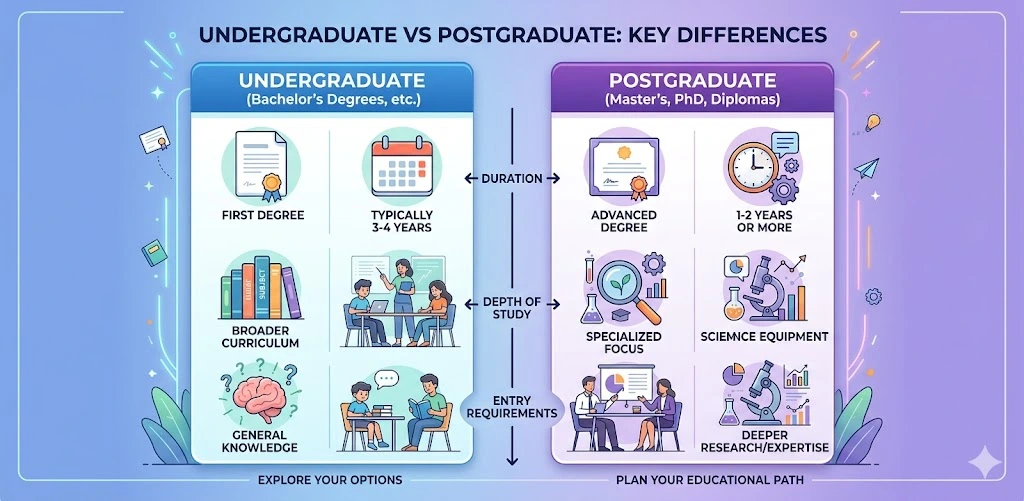
To choose the right academic pathway in UK higher education, understanding the structural, academic, and professional differences between undergraduate and postgraduate degrees provides students with the clarity required for informed decision-making. Both degree levels serve distinct purposes, operate under different entry requirements, and produce measurably different career outcomes.
What Is an Undergraduate Degree?
An undergraduate degree is the first formal qualification students pursue after completing secondary education, A-levels, or equivalent entry qualifications within the UK higher education system.
The Quality Assurance Agency (QAA) for Higher Education classifies undergraduate study across Levels 4, 5, and 6 of the Framework for Higher Education Qualifications (FHEQ). Level 4 corresponds to the first year of a Bachelor’s degree. Level 5 covers the second year. Level 6 represents the final honours year, where students complete dissertations and advanced modules carrying the highest summative assessment weighting.
Undergraduate programmes in the UK produce the following qualification types:
- Bachelor of Arts (BA): Humanities, social sciences, creative subjects
- Bachelor of Science (BSc): Sciences, mathematics, psychology
- Bachelor of Engineering (BEng): Engineering disciplines
- Bachelor of Laws (LLB): Undergraduate law
- Higher National Certificate (HNC): Level 4, 1 year
- Higher National Diploma (HND): Level 5, 2 years
Standard Bachelor’s degree programmes require 3 years to complete in England, Wales, and Northern Ireland. Scottish undergraduate degrees require 4 years. Integrated Master’s programmes, such as MEng or MPhys, extend to 4–5 years, combining undergraduate and postgraduate study within a single qualification.
What Is a Postgraduate Degree?
A postgraduate degree is any qualification pursued after the successful completion of a Bachelor’s degree, operating at Level 7 (taught Master’s) or Level 8 (doctoral research) of the FHEQ.
Postgraduate qualifications narrow academic focus from the broad subject coverage of undergraduate programmes into discipline-specific specialisation, advanced research methodology, and professional expertise development. Students entering postgraduate study require a minimum undergraduate degree classification — most UK universities specify a 2:1 (Upper Second Class Honours) as the standard entry threshold, though some programmes accept a 2:2 alongside relevant professional experience.
UK postgraduate qualifications include:
- Master of Science (MSc): Science, technology, healthcare, data
- Master of Arts (MA): Humanities, education, social sciences
- Master of Business Administration (MBA): Business leadership
- Master of Philosophy (MPhil): Research-based master’s
- Postgraduate Certificate (PGCert): Level 7, 60 credits
- Postgraduate Diploma (PGDip): Level 7, 120 credits
- Doctor of Philosophy (PhD/DPhil): Level 8, 3–6 years
- Doctor of Education (EdD): Professional doctorate
Taught Master’s programmes require 1–2 years to complete. Research doctorates require 3–4 years full-time or 5–6 years part-time.
Key Differences Between Undergraduate and Postgraduate Degrees
The following table presents the principal structural and academic differences between both degree levels across 8 areas:
| QAA FHEQ Level | Levels 4, 5, 6 | Levels 7, 8 |
| Duration | 3–4 years | 1–6 years |
| Entry requirement | A-levels / UCAS points | 2:1 Bachelor’s degree |
| Academic focus | Broad subject foundation | Specialised, research-driven |
| Class size | 100–300 students | 10–30 students |
| Dissertation length | 8,000–12,000 words | 15,000–50,000 words |
| Teaching method | Structured lectures, seminars | Self-directed, research-led |
| UK funding | Student Finance England | Postgraduate Loan (up to £13,347) |
1. Academic Focus and Curriculum Structure
Undergraduate programmes build foundational knowledge across a subject discipline. Students complete core modules, optional elective units, and general skills requirements before specialising in their final year. The curriculum covers a broad subject territory. A BSc Psychology student, for example, studies biological psychology, social psychology, research methods, developmental psychology, and cognitive neuroscience across 3 years.
Postgraduate programmes operate differently. Every module, seminar, and assessed unit connects to the specific specialisation the student enrolled in to pursue. An MSc Health Psychology student studies advanced psychological assessment, chronic illness management, behaviour change theory, and NHS service design. All within a single, tightly defined field.
This distinction in curriculum breadth produces measurably different assessment structures. Undergraduate students face a mix of examinations, coursework, group projects, and presentations across multiple modules. Postgraduate students face fewer but heavier assessments, including:
- Advanced dissertations
- Research proposals
- Systematic literature reviews
- In some programmes: viva voce examinations.
2. Teaching Methods and Student Independence
Undergraduate teaching follows structured contact time. Lectures, seminars, workshops, and tutorials provide regular academic scaffolding throughout each semester. Students receive clear module outlines, weekly reading lists, and formative feedback opportunities that guide progression through assessed content.
Postgraduate teaching reduces structured contact time and increases academic independence. The following 3 shifts define the postgraduate learning experience:
1. Self-directed research replaces structured reading lists. Postgraduate students identify, evaluate, and synthesise peer-reviewed literature independently rather than following prescribed texts.
2. Supervisor relationships replace module tutors. Each postgraduate student works with an assigned academic supervisor who guides research design, methodology, and dissertation development across the programme duration.
3. Original contribution replaces knowledge demonstration. Undergraduate assessment rewards accurate application of existing knowledge. Postgraduate assessment, particularly at the doctoral level, requires students to produce original contributions to their academic field.
3. Class Size and Faculty Interaction
Undergraduate class sizes across UK universities average 100–300 students in lecture settings, with smaller seminar groups of 15–25 students for discussion-based learning. Faculty interaction occurs within timetabled contact hours, with limited opportunity for extended one-to-one academic dialogue outside seminars and scheduled office hours.
Postgraduate programmes enrol significantly fewer students per cohort. Master’s programmes typically run with 10–30 students, creating an environment where faculty interaction extends beyond timetabled sessions into collaborative research discussions, conference participation, and co-authored academic work. Doctoral programmes reduce this further — PhD students often work within research groups of 3–8 colleagues under direct supervisor oversight.
4. Dissertation and Research Requirements
Undergraduate dissertations at UK universities carry a standard length of 8,000–12,000 words at Level 6. Students select a research topic, conduct a literature review, design a methodology, collect or analyse data, and present findings under supervisor guidance. The undergraduate dissertation contributes approximately 30–40 credits toward the final degree classification.
Postgraduate dissertations operate at a different scale entirely. Taught Master’s dissertations range from 15,000 to 20,000 words. Research Master’s dissertations extend to 40,000–50,000 words. Doctoral theses require 80,000–100,000 words and a defence through a viva voce examination before an independent examiner panel.
Students navigating dissertation requirements at any level benefit from understanding how to choose a dissertation topic that ensures high research impact before committing to a research direction. The difference in scope, methodology rigour, and original contribution expectations between undergraduate and postgraduate dissertations demands separate strategic preparation.
Students moving from topic selection into the next stage of their research journey benefit from our guide on writing a dissertation proposal, covering structure, methodology framing, and supervisor expectations at both undergraduate and postgraduate levels.
5. Entry Requirements
Undergraduate entry requirements in the UK centre on UCAS points accumulated through A-levels, BTECs, Access to HE Diplomas, or international equivalent qualifications. Standard university entry requirements range from 96 to 160 UCAS points, depending on course selectivity and institutional ranking.
Postgraduate entry requirements operate on a different basis entirely. The following 4 criteria determine postgraduate programme eligibility across UK universities:
1. Undergraduate degree classification: Minimum 2:1 (Upper Second Class Honours) for most taught Master’s programmes. Students unclear on what a 2:1 classification represents within the broader UK grading framework benefit from understanding how the UK university grading system works before evaluating postgraduate entry eligibility
2. Relevant subject background: Many postgraduate programmes require undergraduate study in a related discipline, though some accept candidates from different fields with demonstrated professional experience.
3. Personal statement and research proposal: Particularly relevant for research-based programmes (MPhil, PhD), where applicants must demonstrate a viable research question and methodological approach.
4. Professional experience: MBA programmes at UK business schools typically require 3–5 years of professional management experience alongside an undergraduate degree.
6. Funding Differences
Undergraduate students in England access Student Finance England tuition fee loans covering up to £9,535 per year (2025/26), alongside maintenance loans based on household income and study location.
Postgraduate students access separate government funding. The UK Postgraduate Master’s Loan provides up to £13,347 for eligible students undertaking a taught or research Master’s programme. Doctoral students access Research Council studentships through bodies including UKRI, ESRC, AHRC, and EPSRC — covering both tuition fees and a maintenance stipend currently set at £19,237 per year (2025/26 UKRI rate).
7. Career Outcomes by Degree Level
Undergraduate degrees provide entry-level professional qualifications across the majority of UK graduate employment sectors. Graduate schemes across finance, engineering, marketing, law, and public sector organisations specify a Bachelor’s degree as the minimum requirement.
Postgraduate degrees produce measurably different professional outcomes across 3 career dimensions:
1. Salary premium: Postgraduate degree holders earn an average of £6,000–£10,000 more per year than undergraduate-only graduates within the same discipline, according to HESA graduate outcomes data.
2. Role seniority: Certain professional pathways require a postgraduate qualification for progression. Clinical psychology, academic research, senior NHS management, chartered accountancy routes, and barrister qualification all specify postgraduate study as a prerequisite.
3. Academic career access: University lecturing, research fellowship, and academic publication all require a doctoral-level qualification as the standard entry point into higher education careers.
8. Duration of Undergraduate and Postgraduate Degrees
Undergraduate Bachelor’s degrees in England, Wales, and Northern Ireland require 3 years of full-time study. Scottish undergraduate degrees require 4 years. Integrated Master’s programmes (MEng, MPhys, MChem) extend to 4–5 years, combining both levels within a single qualification pathway.
Postgraduate duration varies by programme type. Taught Master’s degrees require 1–2 years full-time. Research Master’s degrees (MPhil) require 2 years. Doctoral programmes require 3–4 years full-time or 5–6 years part-time, depending on research complexity and institutional requirements.
A Note on UK vs US Terminology
A common point of confusion arises from the difference between British and American academic terminology. In the United States, “graduate school” refers to any study undertaken after a Bachelor’s degree, encompassing both Master’s and doctoral programmes. In the United Kingdom, the equivalent term is “postgraduate study.”
Graduate, in the UK context, describes a student who has completed their undergraduate degree. This distinction matters when UK students research international programmes or encounter American academic resources, as the terminology refers to the same qualification levels despite the different labelling conventions.
Frequently Asked Questions
Q1: What is the main difference between an undergraduate and a postgraduate degree?
An undergraduate degree builds broad foundational knowledge across a subject and takes 3–4 years to complete. A postgraduate degree deepens specialisation within a specific field, requiring a prior undergraduate qualification for entry.
Q2: Do I need a 2:1 to get into a postgraduate programme in the UK?
Most UK universities require a minimum 2:1 for postgraduate entry. Some programmes accept a 2:2 alongside relevant professional experience, though this varies by institution and subject area.
Q3: How long does a postgraduate degree take in the UK?
Taught Master’s programmes take 1–2 years. Research doctorates take 3–4 years full-time or 5–6 years part-time, depending on the research field and programme structure.
Q4: Can I go straight from undergraduate to postgraduate study?
Yes. Many students progress directly from undergraduate to postgraduate programmes. Others enter postgraduate study after several years of professional work, particularly for MBA and professional doctorate programmes.
Q5: Is a postgraduate degree worth the investment?
Postgraduate degree holders earn £6,000–£10,000 more per year on average than undergraduate-only graduates in equivalent fields. Certain career pathways, including clinical psychology, academic research, and senior NHS management, require a postgraduate qualification for professional entry or progression.
Conclusion
Understanding the difference between undergraduate and postgraduate degrees in the UK determines the academic pathway, funding strategy, and career trajectory available to every higher education student. Undergraduate degrees provide the broad subject foundation and professional entry qualification across the majority of graduate employment sectors. Postgraduate degrees advance that foundation into specialised expertise, research capability, and senior professional positioning, with measurable salary, seniority, and career access benefits.
Students at both levels benefit from building strong academic writing and assessment skills early in their programmes. Understanding how the UK university grading system works establishes the grade classification benchmarks every undergraduate and postgraduate student works toward throughout their academic journey.
Whether you are navigating undergraduate coursework or postgraduate research, FQ Assignment Help connects you with qualified UK academic specialists across every subject and programme level. Explore our academic writing services for distinction-grade support tailored to your exact module requirements.