
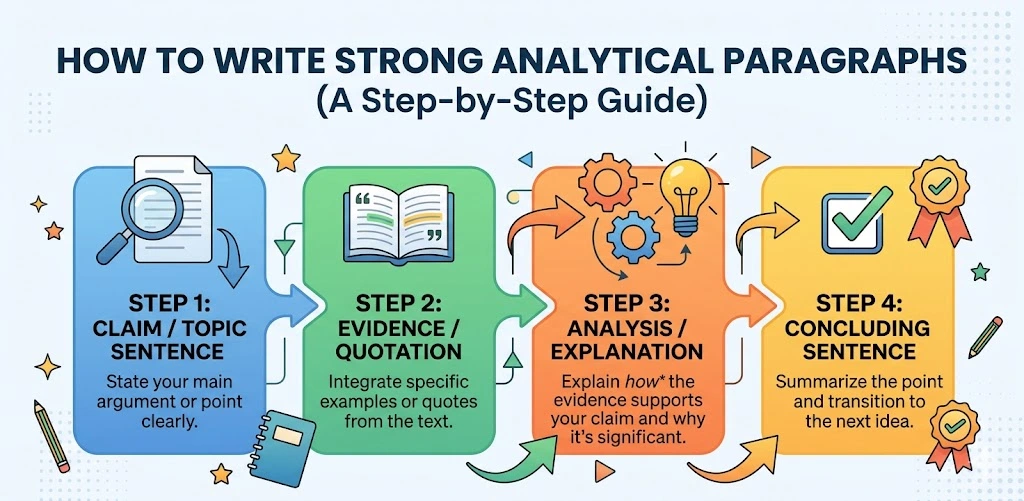
Analytical paragraphs sit at the heart of every strong academic essay. Understanding what they are and how to build them transforms a collection of ideas into a persuasive, well-structured argument that assessors reward with distinction grades.
What Is an Analytical Paragraph?
An analytical paragraph is a focused unit of academic writing that presents one clear idea, explains it, supports it with evidence, and connects it back to the main argument. It does not simply describe or summarise. It proves.
Every analytical paragraph contains 4 components working together:
- Topic sentence: States the main idea of the paragraph
- Explanation: Breaks down what that idea means
- Evidence: Supports the explanation with facts, data, or quotations
- Concluding sentence: Ties everything back to the essay’s central argument
The distinction between a weak and strong analytical paragraph comes down to whether each component does its job and whether they connect in a logical, readable sequence.
Analytical paragraphs appear across multiple academic formats; students building broader writing awareness benefit from understanding the full range of types of academic writing before applying analytical paragraph skills across different assessment contexts.
Building a Strong Analytical Paragraph: Step by Step
The clearest way to understand analytical paragraph construction is to watch one get built from scratch. The following example uses this topic:
Each step below adds one component to the paragraph and shows exactly what it contributes.
Step 1: Write the Topic Sentence
The topic sentence states the single idea this paragraph will prove. One idea only. Clear and direct.
This sentence tells the reader precisely what the paragraph argues. Nothing more. It does not explain yet, nor does it use evidence yet. It declares the argument.
Step 2: Add the Explanation
The explanation unpacks the topic sentence. It answers the question: what does this mean, and why does it happen?
The paragraph now has direction. The explanation tells the reader how the claim works without yet proving it. Notice the sentence structure moves from the broad claim directly into the mechanism behind it.
Step 3: Introduce the Evidence
Evidence proves the explanation. Without it, the paragraph presents opinion rather than argument.
The statistic transforms the claim from an assertion into a supported argument. Evidence must connect directly to the explanation; never introduce data that pulls the reader in a different direction.
Step 4: Analyse the Evidence
Analysis explains why the evidence matters. This is the step most students skip, and the step that separates distinction-grade writing from average work.
The analysis tells the reader what the statistic means in the context of the argument. It does not introduce new evidence. It draws meaning from the evidence already presented.
Step 5: Write the Concluding Sentence
The concluding sentence closes the paragraph by connecting the argument back to the essay’s central thesis. It does not introduce new ideas.
The paragraph is now complete. Every sentence earns its place. Every component connects to the next. The argument moves from claim through explanation through evidence through analysis through conclusion in one clean, logical sequence.
4 Rules to Keep Every Analytical Paragraph Strong
1. One idea per paragraph. The moment a second argument appears, start a new paragraph.
2. Never let evidence speak for itself. Every quotation or statistic needs analysis to explain its significance.
3. Avoid first-person language. “I think” and “in my opinion” weaken analytical writing. Let the evidence and reasoning carry the argument.
4. Read each paragraph aloud. If a sentence sounds disconnected from the one before it, the logical flow needs repair.
Students wanting to take paragraph refinement further after the drafting stage can develop stronger self-editing practice through editing and proofreading techniques. This approach covers the systematic review process that prepares your analytical write-up submission-ready.
Conclusion
Strong analytical paragraphs follow a clear, repeatable structure, including a topic sentence, explanation, evidence, analysis, concluding sentence. The example above demonstrates how each component strengthens the one before it, building a paragraph that does not simply present an idea but proves it. Academic essays, reports, and exam answers all improve when writers treat each paragraph as a self-contained argument with a beginning, middle, and end.
Students developing their essay writing foundations benefit from exploring our guide on structuring and planning your essay, which covers the broader organisational principles that make analytical paragraphs most effective within a complete academic essay.
FQ Assignment Help connects UK students with qualified academic specialists who apply distinction-grade analytical writing across every essay, report, and coursework submission. Explore our essay writing UK service for expert academic support tailored to your exact module requirements.